TL:DR
- Video focus: 60S is yarn information, not a finished-fabric performance result. Request fibre, warp and weft yarn details, weave, density, finished GSM, dyeing and finishing for each candidate. Compare labelled samples under the same agreed conditions and tie the selected construction to a quotation revision.
- Buyer value: Fill a candidate comparison matrix that separates construction changes from finishing changes and identifies the sample to use for quotation.
- Next step: Request fabric specifications.
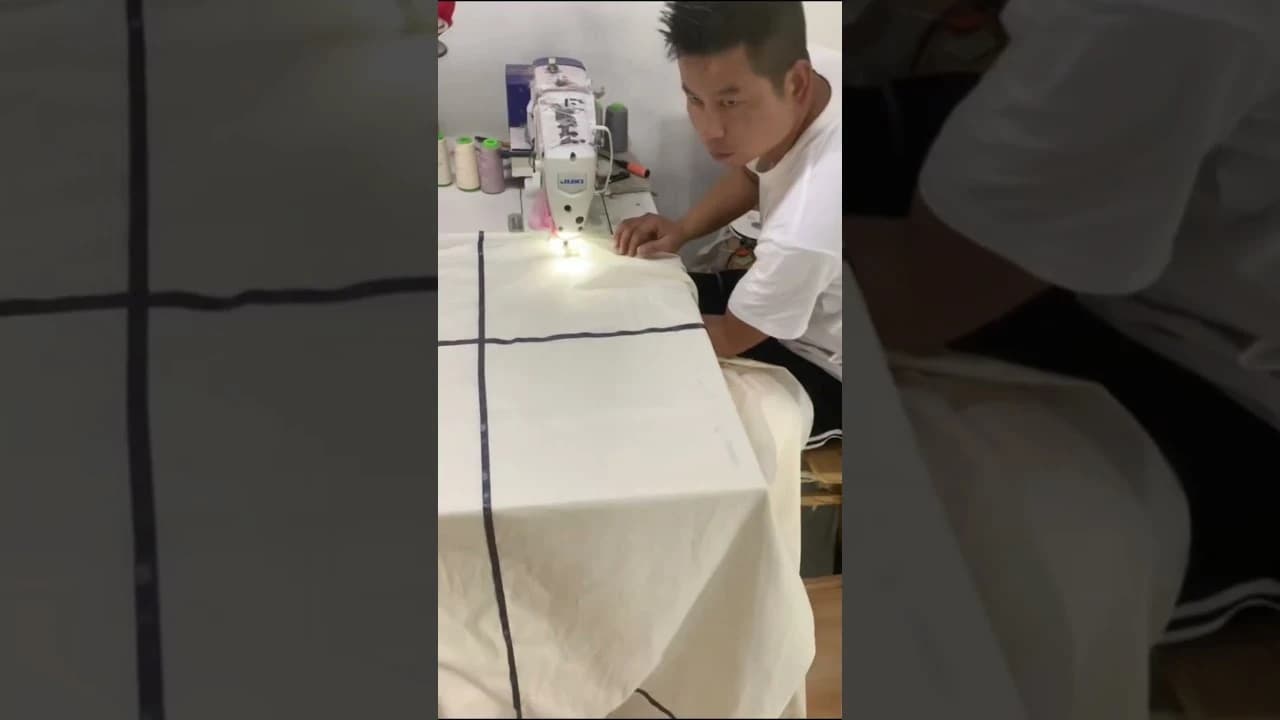
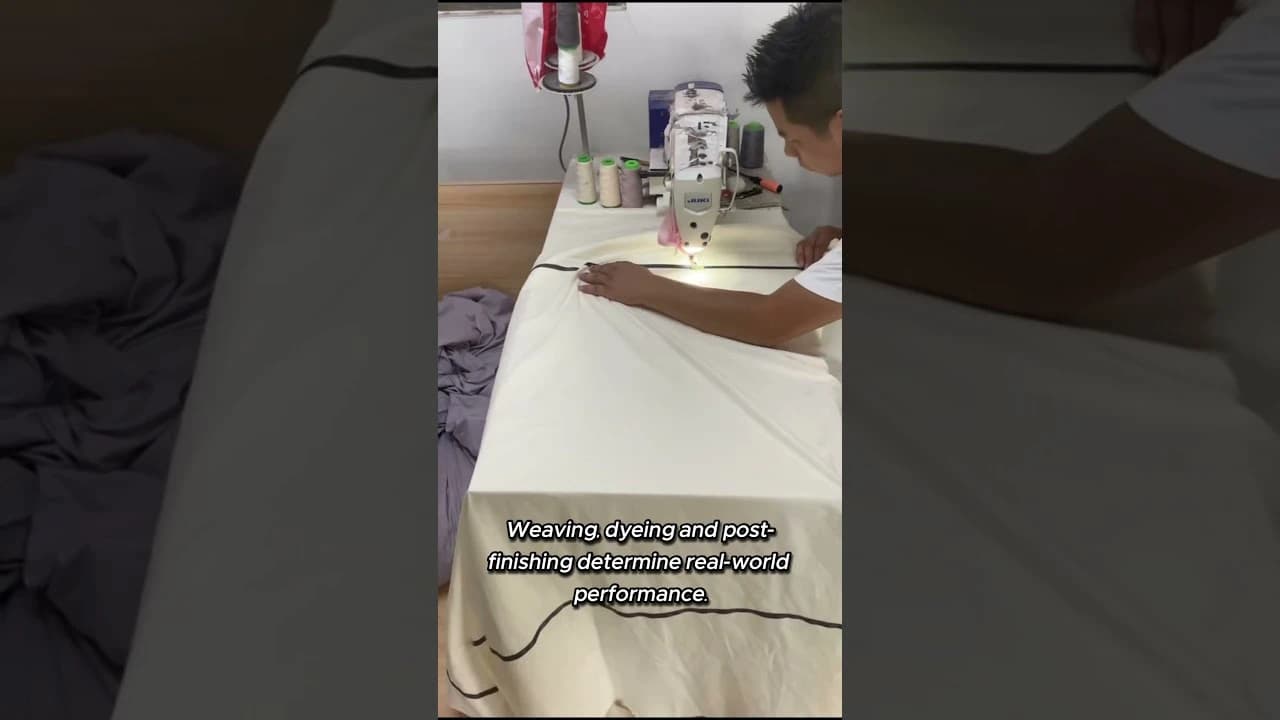
Choose a proposed 60S bedding construction by comparing complete finished samples, not by accepting a luxury label. This Short shows a light panel being handled at a sewing machine; its subtitles discuss 60S and the role of weaving, dyeing and post-finishing. A buyer can use that message to request a construction-and-finish comparison with clearly identified candidates. Fibre, yarn, weave, density, GSM and finish work together, so keep the intended component and care route constant while recording what changes between samples. The clip does not identify the displayed fabric's complete specification or establish comfort, durability or a premium grade.
How to use this fabric guide
Treat the named yarn count or construction as one field in the RFQ. Compare fibre, yarn construction, weave, warp-and-weft density, finished GSM, finish and a physical sample. A finished-fabric claim needs evidence from that finished construction; the yarn number alone is not a performance grade.
Ask what the 60S description includes
Ask the supplier to identify the yarn-count system, warp and weft yarns and whether the description refers to a single or plied yarn. Keep that information separate from thread density and the weight of the finished cloth. The video's entry-level-luxury wording is a positioning statement, not an acceptance criterion. For your purchase, name the component, market, desired appearance and care route before asking which proposed construction fits. Leave an unknown field open for confirmation instead of filling it from the video's appearance.
Use one construction-and-finish matrix
| Specification field | Candidate A | Candidate B | Comparison rule |
|---|---|---|---|
| Sample and revision | Enter ID | Enter ID | Trace every observation to a specimen |
| Fibre and yarn | Supplier-confirmed details | Supplier-confirmed details | State what the 60S term describes |
| Weave and density | Confirmed construction | Confirmed construction | Record warp and weft separately |
| Finished GSM | Value and condition | Value and condition | Use the same agreed basis |
| Dyeing and finish | Route and finish reference | Route and finish reference | Identify intentional differences |
| Care and review | Agreed conditions and notes | Agreed conditions and notes | Keep use and handling consistent |
Separate a controlled trial from an assortment choice
To investigate a finishing difference, ask whether candidates can share the same base construction and differ only in the proposed finish. If weave, density, weight and colour also change, you are comparing whole products rather than isolating one cause. That is still useful for range selection, but record it honestly. Lay the same fabric face in the same light, handle specimens consistently and retain an untouched reference. Describe sheen, drape and surface feel separately rather than reducing them to one unexplained luxury score.
| Buying decision | Useful comparison | Decision record |
|---|---|---|
| Choose a finish | Matched base constructions where available | Finish reference and preferred sample |
| Choose a range item | Complete products for one intended use | All construction differences and buyer preference |
| Review care response | Identified specimens under one agreed route | Before/after observations and open questions |
| Review a performance claim | Relevant documented method and sample scope | Evidence matching the actual claim |
When appearance after care is part of the brief, agree washing, drying, pressing and the condition in which measurements will be taken. Compare the changed specimen with its retained reference and record any concern against its ID. Visual handling cannot establish breathability, pilling, colourfastness or wash life. If one of those is a purchase requirement, specify the required evaluation and review evidence for the proposed finished construction rather than extrapolating from the yarn term.
From a 60S message to a chosen construction
- 01
Define use
Name the component, market, appearance and care route.
- 02
Identify candidates
Request complete constructions, finish references and sample IDs.
- 03
Compare
Record what is controlled, what changes and what remains unverified.
- 04
Quote
Attach the selected sample and specification revision to each variant.
Compare real product records without assuming a video match
The floral and two-tone 60s sateen sets have their own catalogue specifications and are useful related starting points. Their designs differ; they are not a matched experiment or confirmed products from this clip. Ask which proposed options meet your brief before requesting samples. For a decorative programme, the linked border-layout video addresses a separate decision: where the trim should sit on the finished component. Release the fabric reference and layout together, with packaging and separate quantities of at least 100 sets per colour-and-size combination. Quantities cannot be pooled across colours or sizes.
Compare bedding options for your project
| Bedding option | Category | Material / construction | How to use it |
|---|---|---|---|
| 60s Floral Sateen 100% Cotton Four-Piece Bedding Set | Floral Sateen Sets | 100% cotton, 60s sateen jacquard, reactive-printed for high color fastness. | Similar fabric options |
| 60s Sateen Two-Tone & Solid 100% Cotton Bedding Set | Two-Tone Sateen Sets | 100% cotton, 60s sateen, reactive-dyed for high color fastness. | Similar fabric options |
What to include in your enquiry
Fill a candidate comparison matrix that separates construction changes from finishing changes and identifies the sample to use for quotation.
60s Floral Sateen 100% Cotton Four-Piece Bedding Set · Sateen vs. Twill vs. Waffle vs. Brushed: A Cotton Bedding Weave Guide · Request fabric specifications
Technical specifications from related products
These values come from the linked product records. They describe related options and do not claim that the video shows the exact SKU unless it is explicitly marked as an exact product.
60s Floral Sateen 100% Cotton Four-Piece Bedding Set
- Material
- 100% Cotton
- Yarn Count
- 60s / 300TC
- Weaving
- Sateen jacquard
- Dyeing
- Reactive printing
- Fabric Density
- 173 × 113
- Weight
- 120–140 GSM
- Style
- Minimalist floral
- Function
- Soft · warm · skin-friendly · moisture-wicking · breathable
60s Sateen Two-Tone & Solid 100% Cotton Bedding Set
- Material
- 100% Cotton
- Yarn Count
- 60s / 300TC
- Weaving
- Sateen
- Dyeing
- Reactive dyeing
- Fabric Density
- 173 × 113
- Weight
- 120–140 GSM
- Style
- Minimalist two-tone & solid
- Function
- Soft · warm · skin-friendly · moisture-wicking · breathable
Frequently asked questions
- Does 60S prove that bedding is a luxury grade?
- No. A yarn-count description does not establish a premium grade or finished performance. Review fibre, yarn, weave, density, GSM and finish together against your buying brief.
- Which fields should accompany a 60S sample request?
- Ask for fibre, yarn-count system, warp and weft yarns, weave, density, finished GSM, dyeing, finish, sample ID, intended component and agreed care and review conditions.
- How can I compare two finishing options fairly?
- Where possible, use the same base construction and change only the finish. If several fields differ, record a complete-product comparison rather than attributing the outcome to finishing alone.
- Are the floral and two-tone sets the fabric shown?
- They are related 60s catalogue options, not positively matched products. Their own specifications describe those products and must not be assigned to the video fabric.
- How do I turn the selected sample into a quotation?
- Send the selected sample ID, construction and finish revision, components, dimensions, packaging and colour × size quantities. Each combination has a minimum of 100 sets; no pooling across colours or sizes.
Technical references
Similar fabric options
Related guides
Shop by category
Explore our services
Sourcing bedding for your market?
Factory-direct quotes, 100-set minimum per color and size combination, full OEM/ODM customization. We reply within one business day.