
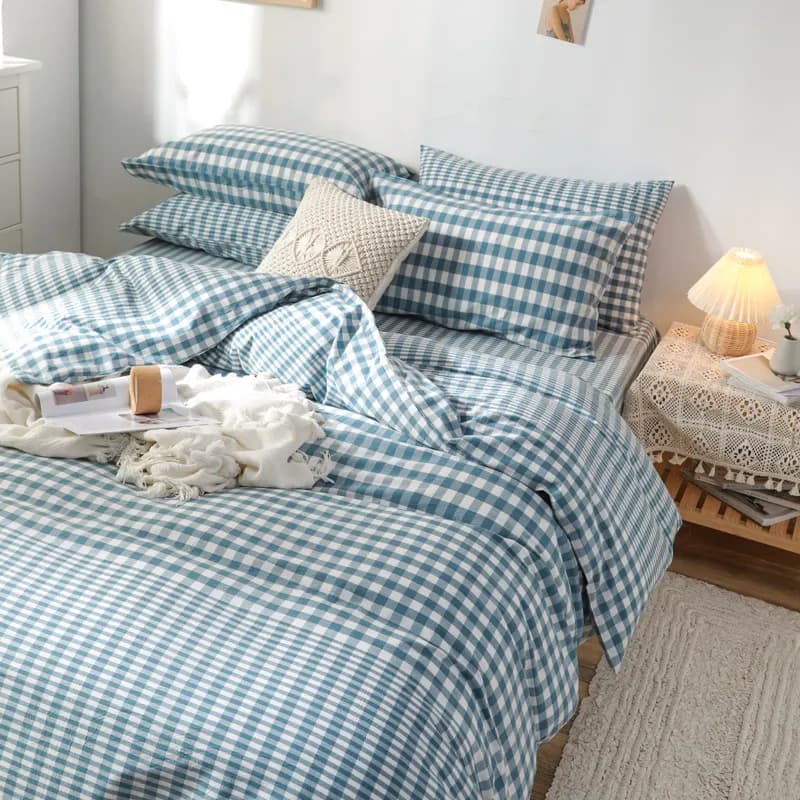
China makes more bedding than anywhere on earth, and the heart of it is Nantong, Jiangsu — widely recognized as China's home-textile capital. If you're an importer, wholesaler, private-label brand, hotel buyer or cross-border seller, sourcing factory-direct from this belt is how you get premium quality at real factory pricing. This guide is the complete roadmap: what to source, how fabrics and quality work, how OEM/ODM and MOQ function, how pricing and logistics are structured, and how to make sure you're dealing with a genuine factory rather than a middleman.
Why source bedding from China — and specifically Nantong
China combines scale, a complete supply chain and mature export infrastructure that's hard to match elsewhere. Within China, Nantong's Dieshiqiao home-textile cluster is one of the world's largest concentrations of bedding and home-textile production, reportedly turning out well over a billion bedding products a year and exporting to more than 130 countries. That density means deep fabric availability, competitive pricing and mills that already understand Western, Middle-Eastern and Australian market requirements.
- Complete supply chain: weaving, dyeing, printing, sewing, filling and packing in one belt.
- Scale and capacity: stable mass production and full-container delivery for reorders.
- Export maturity: mills familiar with OEKO-TEX, certificates of origin and clearance norms.
- Source-factory pricing: buying direct removes the middleman markup baked into marketplace listings.
What you can source: the main bedding categories
A full bedding range from one source factory keeps sizing, branding and quality consistent. The core categories:
- Cotton four-piece sets: the all-season core — high-density cotton (e.g. 40s/13372 twill), sateen, brushed and yarn-dyed jacquard.
- Cooling summer quilts: ice silk, modal and Tencel — light, breathable covers for hot-climate and summer ranges.
- Lyocell / Tencel sets: plant-based, cool and silky — the premium, eco-positioned line.
- Cotton-linen blends: natural, textured, quiet-luxury appeal.
- Down duvets & comforters: warmth-tiered, with high-thread-count down-proof cotton shells.
- Hotel & contract linen: durable cotton sheeting for hospitality programs.
Understanding bedding fabrics & quality
Fabric is where quality is won or lost. The factors that actually matter, in order: fiber quality, fabric density, weave and finishing — not a single marketing number.
- Fiber: long-staple / combed cotton spins finer, stronger, smoother yarn that resists pilling; Lyocell (Tencel) adds cool-touch and an eco story; cotton-linen adds natural texture.
- Density: a high-density construction like 13372 (≈133×72 threads per inch) is tight, opaque and durable.
- Weave: percale (crisp, cool, hard-wearing), sateen (silky, lustrous), twill (durable), waffle (textured), brushed (soft, warm).
- Finishing: reactive dyeing/printing for strong color fastness through repeated laundering.
Thread count vs GSM: what each tells you
Two numbers buyers confuse. Thread count is threads per square inch — a measure of weave density, used for sheets; beyond ~400–600 the numbers are often inflated with multi-ply tricks. GSM (grams per square meter) is fabric weight — the right way to spec quilts and duvets, where lighter (≈120–165 GSM) means summer/cooling and heavier means winter. Spec sheets by thread count and cotton quality; spec quilts by GSM and climate.
OEM vs ODM: customizing your bedding
With OEM you bring your own design and the factory produces it; with ODM you rebrand an existing factory design. OEM gives a unique product with more design work; ODM is faster and lower-risk. Most growing brands launch with ODM and migrate signature SKUs to OEM. Either way, color matching, sizing, logo labels and packaging usually fit within the standard minimum — only heavy bespoke development carries its own minimum.
MOQ and placing your first order
A typical source-factory minimum is 100 sets per style — low enough to test a design without committing to a full container. Make a focused first order: split the 100 across sizes within one style rather than spreading thin across many styles, start with proven colorways, and always confirm a physical sample before bulk. Once a design sells, reorders are simple from locked mill capacity.
Pricing, payment and Incoterms
Bedding is quoted under Incoterms that define who controls each shipping leg: EXW, FOB, CIF and DDP. FOB suits buyers with their own forwarder; CIF lets the supplier handle ocean freight; DDP gives a door-to-door price with duties paid. Payment is typically T/T (deposit plus balance) or L/C for larger or first-time orders. Always confirm exactly what a quote includes so your landed cost is transparent — our International Trade & Logistics guide breaks this down in detail.
Lead times and logistics
Plan in three stages: sampling (about 1–2 weeks), bulk production (roughly 3–6 weeks depending on volume and customization; in-stock programs ship faster), then sea freight, which varies by destination. Order seasonal lines early — summer cooling quilts in late winter/spring, winter weights in summer — so stock lands before demand peaks.
Quality control: avoiding off-spec goods
The cheapest unit price means nothing if the goods are wrong. A stationed three-stage QC catches problems at the source: a fabric spot-check before cutting, an in-line craft patrol during production, and a full finished-goods inspection before container loading — controlling color difference, skipped stitches, stains and damage. Sample sign-off before bulk is the single most important step to prevent off-spec runs. Third-party inspection (e.g. SGS) can be arranged on request.
How to verify a real factory (not a middleman)
- 1.Ask whether they run dedicated lines at the mill — and request workshop production video, not just catalog photos.
- 2.Request the mill's original specs: yarn count, density, weight and composition should be transparent and consistent.
- 3.Confirm in-house QC and ask exactly how color difference and defects are controlled before bulk.
- 4.Check they sample at the mill and only run bulk after you sign off a physical sample.
- 5.Ask for OEKO-TEX compliance, a certificate of origin and an inspection report for clearance.
Markets and compliance
A good source factory tailors product and documentation to each market: cool-toned and cooling SKUs for the Gulf and Southern Europe, OEKO-TEX and origin documentation for European and Australian retail compliance, and flexible Incoterms for the Americas. Confirm the size system early — EU, US/UK and Middle-East dimensions differ — so your range fits its market out of the box.
Source factory vs marketplace vs trading company
Marketplaces are directories that list manufacturers, trading companies and resellers side by side. A trading company buys and re-sells without controlling production. A source factory (or a factory-direct chain on locked mill lines) controls weaving, dyeing, QC and loading itself — so buying direct removes the re-trading markup and keeps quality and customization in your hands. If a supplier can't show you the workshop, the original specs and a real sampling process, you're probably talking to a middleman.
Your sourcing roadmap, step by step
- 1.Define your range: category, target market and price tier.
- 2.Shortlist source-factory suppliers and verify they're genuine manufacturers.
- 3.Request quotes with clear Incoterms and confirm what's included.
- 4.Order physical samples and sign off on hand-feel, color and construction.
- 5.Place a focused first order around a 100-set MOQ.
- 6.Agree QC steps and required documents up front.
- 7.Confirm production schedule, loading plan and shipping.
- 8.Reorder the winners — scale the designs that sell.
Sourcing bedding well isn't about finding the lowest sticker price — it's about reaching the real factory, specifying honestly, and controlling quality and logistics end to end.
Frequently asked questions
- Why source bedding from Nantong, China?
- Nantong (and its Dieshiqiao cluster) is widely recognized as China's home-textile capital — one of the world's largest bedding manufacturing belts, reportedly producing over a billion bedding products a year and exporting to 130+ countries. That means deep fabric availability, competitive factory pricing and mills experienced with export compliance.
- What is the typical MOQ for wholesale bedding?
- A typical source-factory minimum is 100 sets per style — low enough to test a design without a full container. You can usually split that across sizes within one style and request full-size custom.
- Can I private-label (OEM/ODM) my bedding?
- Yes. OEM means the factory produces your design; ODM means you rebrand an existing factory design. Color matching, sizing, logo labels and packaging typically fit within the standard MOQ; heavy bespoke development may carry its own minimum.
- What Incoterms and payment terms are used?
- Bedding is commonly quoted FOB, CIF or DDP (and EXW for buyers with their own forwarder). Payment is usually T/T (deposit plus balance) or L/C for larger or first-time orders. Always confirm what a quote includes for a transparent landed cost.
- How do I verify a supplier is a real factory?
- Ask for workshop production video, the mill's original specs (yarn count, density, weight, composition), in-house QC details, a real mill sampling process, and OEKO-TEX / certificate of origin / inspection documents. A genuine factory can show all of these.
- What are typical lead times?
- Roughly: sampling 1–2 weeks, bulk production 3–6 weeks depending on volume and customization, then sea freight which varies by destination. In-stock programs ship faster than made-to-order. A firm schedule is confirmed per order.
Featured products
Related reading
- Why Source Bedding From Nantong & Dieshiqiao, China's Home-Textile Capital
- Bedding Fabrics & Materials: The Complete B2B Buyer's Guide
- International Trade & Logistics: A Bedding Importer's Guide
- How to Buy Wholesale Bedding Direct From a Factory (Not Alibaba)
- What Is the MOQ for Custom Bedding? A B2B Buyer's Answer
- OEM vs ODM Bedding: Which Should Your Brand Choose?
- How to Choose a Bedding Manufacturer: A B2B Sourcing Checklist
- Tencel vs Cotton Bedding for Wholesale Buyers
Sourcing bedding for your market?
Factory-direct quotes, 100-set MOQ, full OEM/ODM customization. We reply within one business day.