TL:DR
A reversible duvet cover specification identifies panel A and panel B, their fabrics and colour pairing, finished dimensions, closure and intended use in both orientations. Two colours do not necessarily mean two different fabrics, and two fabric faces do not mean a filled quilt. Compare the complete sewn cover before and after the agreed care route, especially when the panels differ.
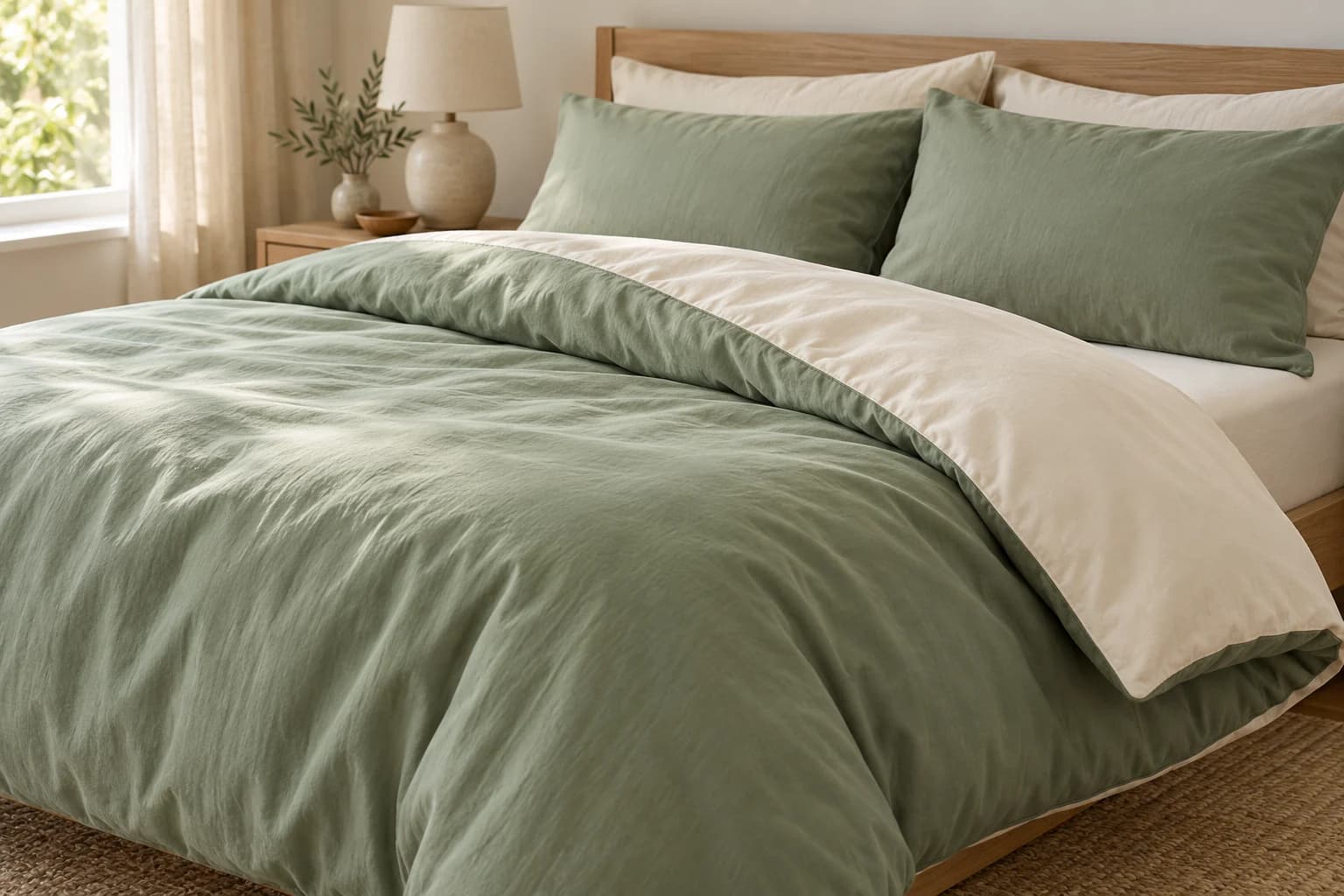
Separate two-tone styling from mixed-fabric construction, then send a controlled face/reverse brief for a complete sewn sample.
Specify a reversible duvet cover by naming panel A and panel B, the material and colour of each, the opening and the finished cover dimensions. State whether both faces are intended for outward display or whether one is a nominated reverse. A two-tone design can use the same construction on both sides; a mixed-fabric cover needs separate records for each panel. For private-label buyers and importers, the purchasing job is to approve that complete pairing, not to assume that a fashionable colour combination proves comfort, durability or a higher selling price.
Separate two-tone, mixed-fabric and filled constructions
A duvet cover is an enclosure for a separate insert. Its two exterior panels are not evidence of an additional insulating filling or a universal two-layer performance benefit. Use two-tone to describe the nominated colour pairing and mixed-fabric to describe different face/reverse materials. If a supplier uses two-layer, ask for a section sketch showing exactly what is joined and where the insert goes. A textured show face and a plain reverse may serve a design brief without being interchangeable in appearance, contact or care; agree the intended orientation rather than assuming reversibility.
| Route | What changes | Control before comparing |
|---|---|---|
| Same construction, two colours | Colour A/B pairing | Both colour references; direction; sample identity |
| Different face and reverse fabrics | Composition, weave, weight or finish | Separate panel cards; assembly and care questions |
| Directional print or jacquard | Motif direction and display face | Artwork orientation; joins; matching pillowcases |
| Filled quilt or comforter | Filling and quilted assembly | Different product brief; do not treat as an empty cover |
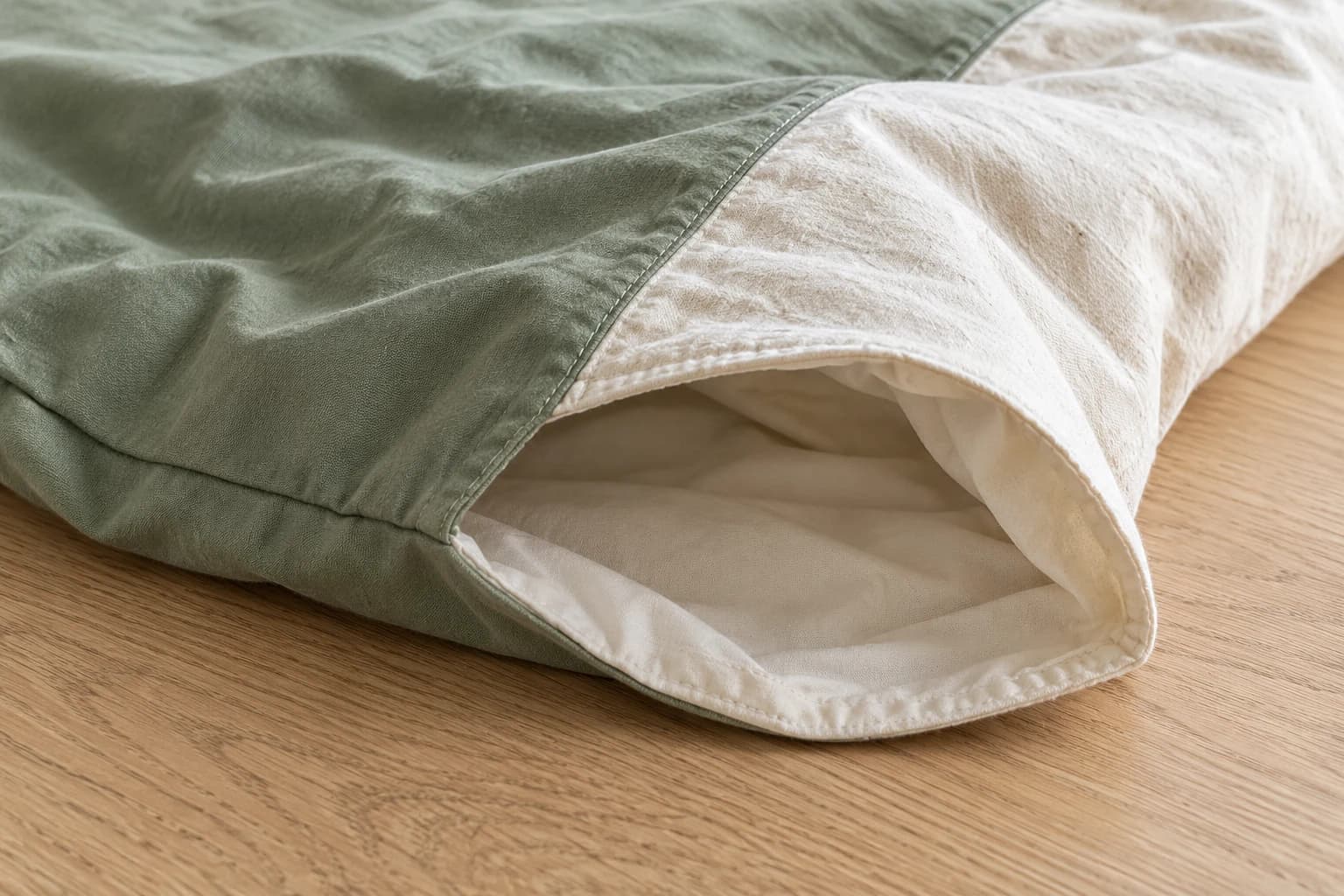
Write a panel A/B specification
Give the pairing a code that travels from swatches to sewn sample, quotation and order. For each panel record fibre composition, fabric construction, yarn or density information when supplied, weight when supplied, finish and colour reference. Do not fill unknown fields from a similar-looking catalogue photo. Record the finished dimensions and measurement points of the cover separately from those of the intended insert. Add opening position, closure, corner attachment requirements and any directional design. Ask the supplier to identify differences rather than silently substituting another reverse fabric to meet the price.
| Pairing brief field | Buyer entry | Supplier response / exception |
|---|---|---|
| Identity | [set/SKU; A/B pairing code; revision; intended display] | [same construction understood] |
| Panel A | [fibre; weave; known yarn/density/weight; finish; colour] | [material/sample ID; missing data] |
| Panel B | [same independent fields for the reverse] | [material/sample ID; differences] |
| Cover and insert | [finished dimensions; unit; measurement points; insert reference] | [proposed fit and tolerances] |
| Assembly | [opening/closure; ties or attachments; seam; motif direction] | [drawing; feasibility; exceptions] |
| Coordinated set | [pillowcase/sheet materials; A/B orientation; quantities] | [component matching; pack contents] |
| Care and commercial basis | [care route; sample review; sets per colour×size; pack] | [assembled sample; itemised quote; unresolved fields] |
Compare the sewn assembly, not only two swatches
Two attractive swatches do not show how their joined edges behave. Review the finished cover laid flat and on the nominated insert; turn it to each intended display side and open and close it normally. Observe whether seams roll towards one face, the edges pull, the opening sits awkwardly or the motif changes orientation. Record pillowcase fronts and backs separately if the set uses the same colour story. A coordinated photograph is useful for design review, but it cannot establish fibre composition, dimensional stability or a production result for an unexamined construction.
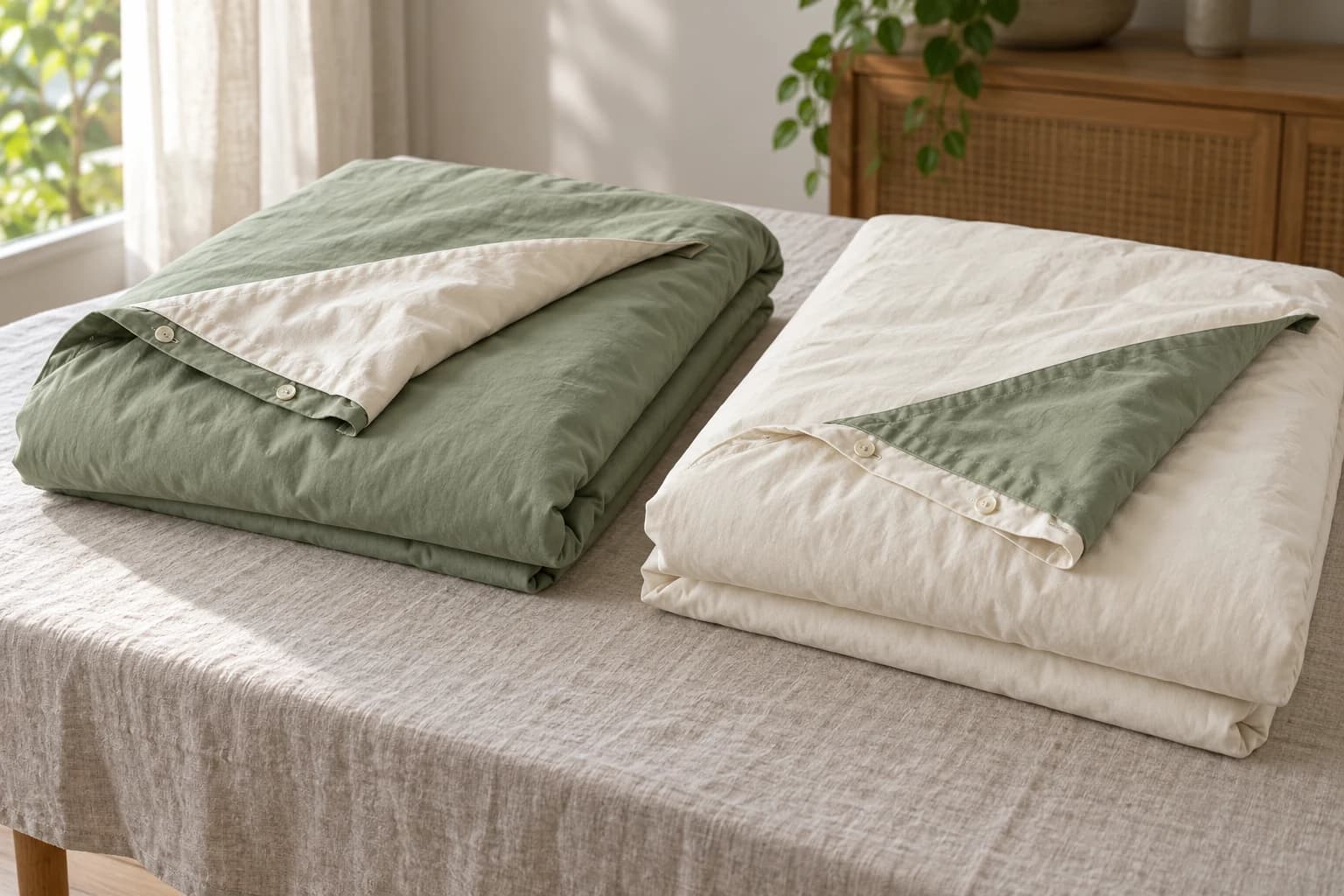
| Assembly observation | Before care | After agreed care / decision |
|---|---|---|
| Dimensions of both faces | [same points; units; sample IDs] | [change; mismatch; decision owner] |
| Joined edges and corners | [rolling; pulling; puckering; alignment] | [repeat observations; unresolved issue] |
| Opening and insert fit | [access; closure; attachment positions] | [usable fit and handling observation] |
| A/B and set presentation | [direction; shade; pillowcase pairing] | [appearance; accepted version / hold] |
Agree a care route that addresses the complete assembly, including trims and closures, and keep the pre-care reference. CottonWorks describes dimensional change as including growth or shrinkage, skew and altered component relationships; this supports checking both materials and their joined form, not predicting a percentage from a fibre name. Where a result is required, define the property, method and buyer criterion through the separate test-request process. For fibre information, retain the panel compositions and ask the destination-responsible reviewer how sectional disclosure and labeling apply. US FTC textile guidance is not a universal rule for every market.
From paired fabrics to a controlled cover sample
- 01
1 · Define A and B
Record material, colour pairing and intended orientation independently.
- 02
2 · Fix assembly details
Add dimensions, opening, closure, attachments and set components.
- 03
3 · Compare the whole cover
Use the nominated insert and agreed care route; record both faces.
- 04
4 · Release one pairing
Attach the chosen sample, drawing, exceptions and quote revision.
Choose a real starting reference and send the pairing
The listed 60s Sateen Two-Tone Cotton Set offers a same-fibre starting reference. The Yarn-Dyed Cotton-Linen Jacquard Set lists an 80% cotton / 20% linen outer face and a 100% cotton inner, illustrating why panel compositions must remain separate. Neither listing supplies every closure or test result required by your project. Send the selected product, A/B brief and sample questions through private-label bedding and contact. The minimum is 100 sets for each colour × size combination, with no pooling across colours or sizes. Define the entire A/B colour pairing on each order line and request confirmation of any development exception.
Frequently asked questions
- Does two-tone mean two different fabrics?
- No. Two-tone describes colour pairing. Record each panel’s fibre, weave and finish independently to establish whether the construction is the same or different.
- Is a two-layer duvet cover a filled quilt?
- Not necessarily. A cover normally encloses a separate insert. Ask for a construction sketch if two-layer is used, and specify any filling as a different product field.
- What should a reversible duvet cover brief include?
- Include A/B material and colour references, intended display orientation, finished cover and insert dimensions, opening/closure, attachments, coordinated components, care route and quantities.
- Why review the complete cover after care?
- Separate swatches do not show the joined assembly. Recheck dimensions, edge rolling, pulling, closure access, insert fit and presentation on the same identified sample after the agreed route.
- Can different colour pairings or sizes share the minimum?
- No. Each colour × size combination requires at least 100 sets without pooling. Identify the complete A/B colour pairing on each line and confirm its specification and quotation basis.
Sources & references
Featured products
Shop by category
Explore our services
Sourcing bedding for your market?
Factory-direct quotes, 100-set minimum per color and size combination, full OEM/ODM customization. We reply within one business day.