In short
Warp is the lengthwise yarn held under tension on the loom; weft is the crosswise yarn inserted across it. Warp carries strength and is usually sized and higher-twist; weft drives softness and smoothness. Bedding density such as 133x72 states warp ends then weft picks per inch.
Warp is the lengthwise yarn held under tension on the loom and weft is the crosswise yarn inserted across it, which is why warp governs strength and weft governs the softness and smoothness you feel. Every bedding density figure, including 133x72, is simply warp ends and weft picks counted per inch.
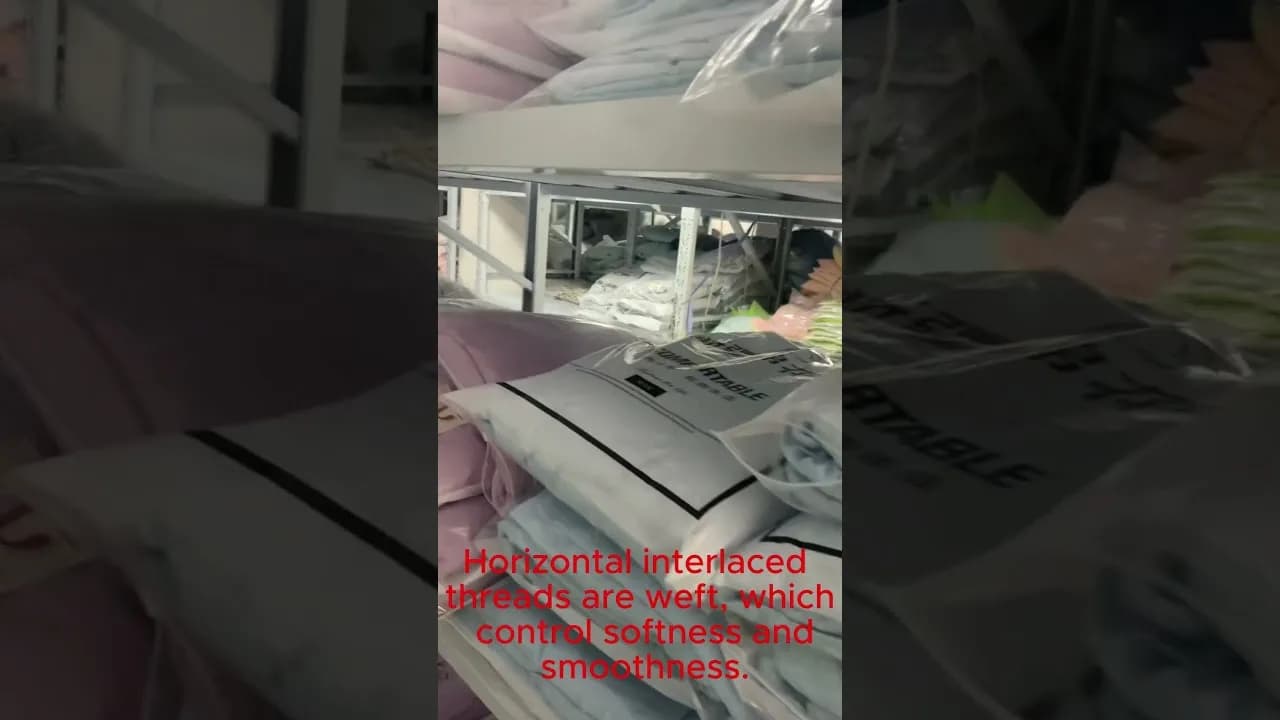
Warp is the set of lengthwise yarns held stationary under tension on the loom; weft is the set of crosswise yarns drawn through them. That single structural fact explains almost everything a bedding buyer needs: because the warp is stretched and abraded throughout weaving it must be the stronger, better-prepared yarn, while the weft, which the video's own caption describes as the horizontal interlaced threads controlling softness and smoothness, is free to be chosen for hand-feel instead of survival.
Warp and Weft: The Two Yarn Systems in Every Woven Sheet
Warp is the longitudinal yarn system, wound onto a warp beam and held in tension across the loom before a single pick is inserted. Weft, also called filling or woof, is the transverse yarn carried across that tensioned sheet by a shuttle, rapier or air jet, interlacing over and under the warp to lock the cloth together. An individual warp thread is called an end; an individual weft insertion is called a pick. Those two words, ends and picks, are the vocabulary the rest of your specification is built from.
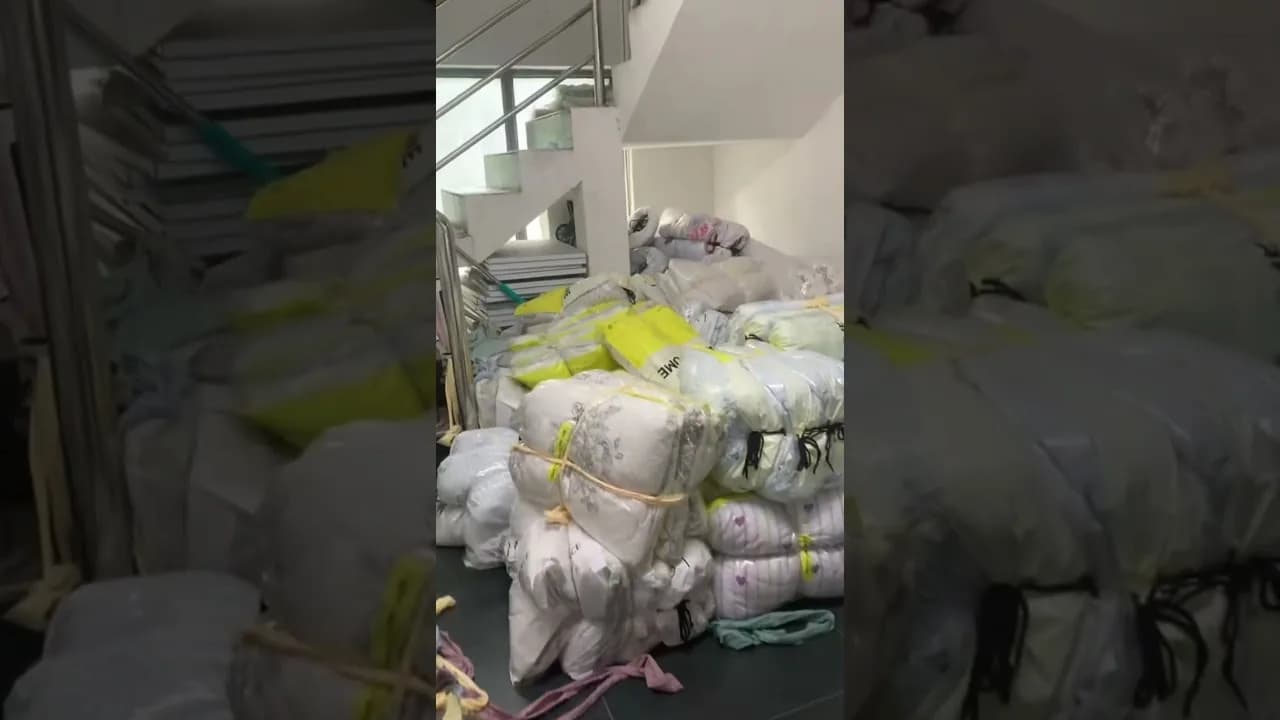
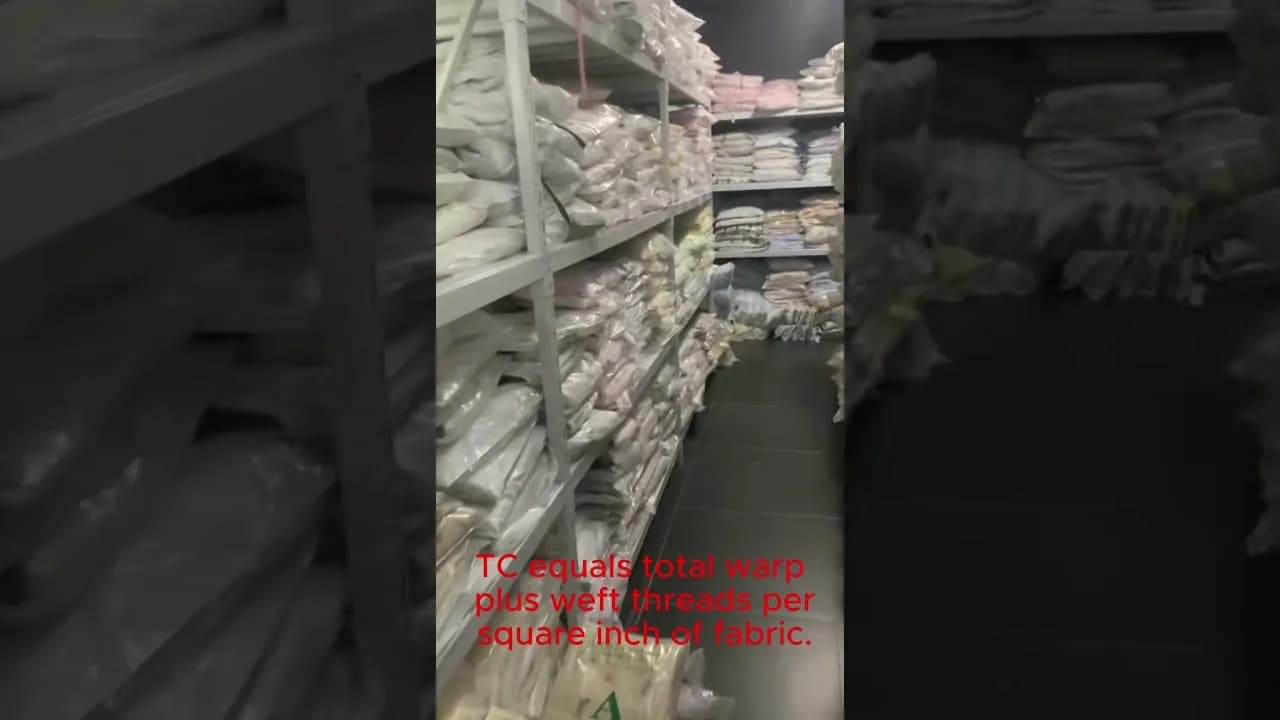
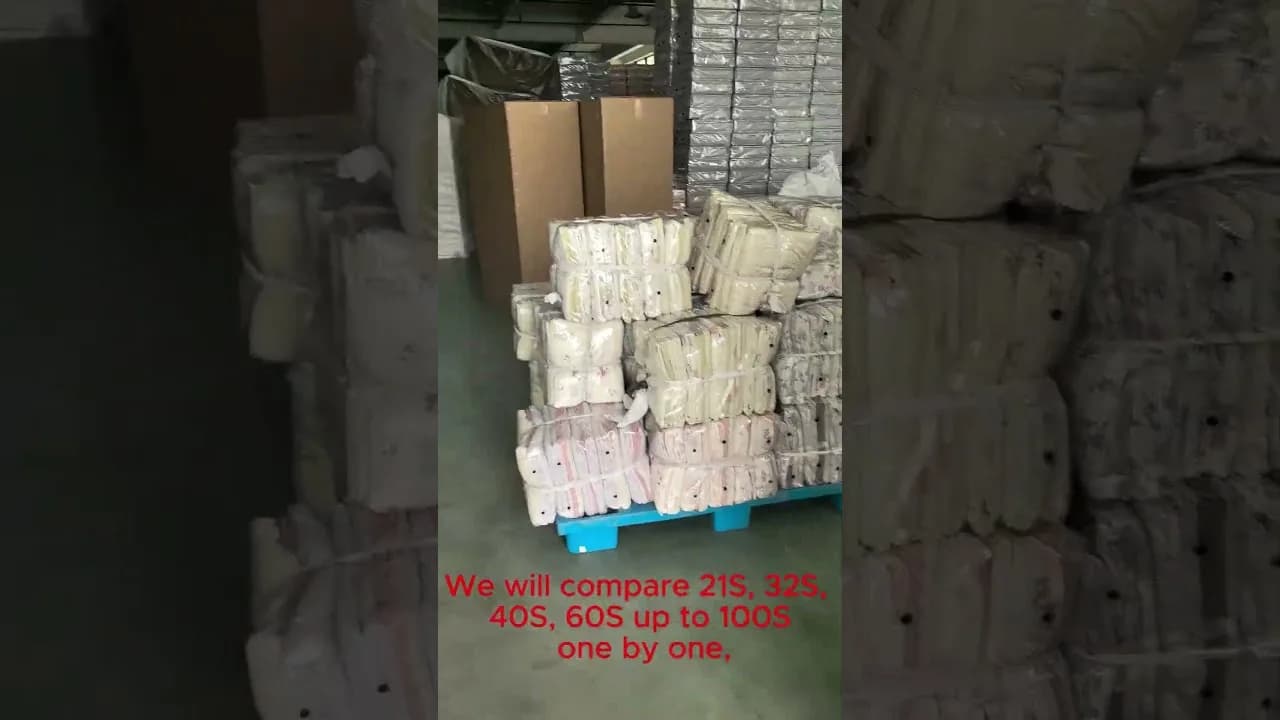
Everything you see in the video footage — bagged, racked, finished sets ready to ship — began as a warp beam and a weft supply. Nothing about a bedding programme's hand-feel, shrinkage behaviour or tear strength is decided after weaving; it is decided when those two yarn systems are chosen and set.
Why Warp Carries Tension and Weft Carries Hand-Feel
The warp must survive the loom. It is held taut, repeatedly lifted and lowered during shedding, and struck by the reed every time the beat-up drives a pick to the fell of the cloth. Because breakage stops the machine, warp yarn is normally sized — coated with a starch or synthetic film that binds surface fibres and reduces breaks — and is often spun with higher twist and better fibre preparation than the weft in the same fabric. Historically the warp was reserved for the strongest available spun and plied fibre for exactly this reason.
The weft has no such burden. It is inserted with minimal tension and never has to hold the fabric on the machine, so a mill can afford to run a softer, lower-twist, sometimes finer yarn in the weft. That is the mechanical basis for the video's claim: the weft is the yarn system a buyer can push toward softness without paying for it in loom efficiency, which is why the crosswise yarn is where a great deal of perceived quality actually lives.
One consequence worth remembering: sizing is a temporary process aid, not a product feature. It is removed in desizing before dyeing or printing, so a greige fabric always feels stiffer and heavier than the finished goods your customer receives. Judging a hand-feel from a greige swatch is one of the most common and most expensive sampling errors in this category.
Warp vs Weft Compared, Line by Line
| Attribute | Warp (ends) | Weft (picks / filling) |
|---|---|---|
| Direction in the finished cloth | Lengthwise, parallel to the selvedge and to the roll | Crosswise, selvedge to selvedge |
| Role on the loom | Held stationary under tension for the whole weaving run | Inserted across the tensioned warp, carries minimal tension |
| Preparation | Usually sized to bind fibres and reduce breakage; desized before dyeing | Normally used as spun, no sizing required |
| What it drives commercially | Tensile and tear strength lengthwise, dimensional stability, shrinkage in length | Softness, smoothness, drape and the surface a sleeper actually touches |
| Typical count and twist | Equal or coarser count, higher twist, stronger and more even yarn | Equal or finer count, lower twist permitted, chosen for hand |
| Where it appears in a density figure | The first number, ends per inch, for example the 133 in 133x72 | The second number, picks per inch, for example the 72 in 133x72 |
| What the buyer should specify | Count, ply, combed or carded, ends per inch | Count, ply, combed or carded, picks per inch |
How Density Is Written: Reading 133x72 and 40x40/133x72
Woven bedding density is written as ends per inch by picks per inch, warp first. A 133x72 construction therefore has 133 warp ends and 72 weft picks in every inch of cloth. The longer four-part notation puts the yarn counts in front of the density: 40x40/133x72 reads as 40S warp yarn, 40S weft yarn, 133 ends per inch, 72 picks per inch. Read left to right it is always warp count, weft count, warp density, weft density.
| Notation on a quotation | How to read it | What is still missing |
|---|---|---|
| 133x72 | 133 warp ends and 72 weft picks per inch; nominal 205 total threads | Yarn counts, ply, combed or carded, finished width and gsm |
| 40x40/133x72 | 40S warp, 40S weft, 133 ends, 72 picks per inch | Ply notation, fibre content, finish and shrinkage control |
| 60x40/173x120 | Finer 60S warp with 40S weft at higher density | Why the counts differ; confirm it is not a substitution |
| 300TC | A summed figure only; the split between warp and weft is hidden | Ends and picks separately, and whether plies were counted |
| 40S/2 | Plied yarn: two 40S singles twisted into one thicker thread | Whether the thread count treats that as one thread or two |
Thread count is simply the sum of ends and picks per inch, which is why 133x72 is often marketed as roughly 200TC. The full arithmetic, including how plied yarns get counted twice to inflate a headline number, is set out in thread-count-truth-bedding-quality-guide, and the specific construction is broken down in 13372-high-density-cotton-explained. If the count side of the equation is new to you, the overview video what-is-yarn-count-s walks the whole 21S to 100S ladder rather than repeating it here.
Why Warp and Weft Can Carry Different Counts
A mill is under no obligation to run the same yarn in both directions, and often should not. Balanced constructions such as 40x40/133x72 use one count throughout and are the easiest to quote, reorder and verify. Unbalanced constructions deliberately split the roles: a stronger or coarser warp for stability with a finer weft for surface feel, or a finer warp to raise ends per inch where a high thread count is the selling point.
- Balanced, same count both ways: simplest to control, easiest to reorder, the default for volume printed cotton.
- Coarser warp, finer weft: buys loom stability and lengthwise strength while keeping the touched surface soft.
- Finer warp, coarser weft: packs more ends per inch to lift thread count, common in sateen where warp floats dominate the face.
- Different twist at the same count: two fabrics can both read 40x40 and still feel materially different in hand.
- Different preparation at the same count: a combed warp with a carded weft is legitimate but must be disclosed, because it changes pilling behaviour.
Weave structure decides which system you actually feel. In sateen the warp floats across several weft picks, so the warp yarn dominates the face and its count and twist drive the sheen; in plain-weave percale the two systems alternate one over one and share the surface. That contrast is worked through properly in percale-vs-sateen-wholesale-weave-guide, and it is the reason a 60S weft is wasted money in a warp-faced sateen.
What Warp and Weft Each Cost You If You Get Them Wrong
Specification errors in the two systems fail in different ways, and recognising the failure mode tells you which yarn to fix. A weak or under-prepared warp shows up as lengthwise tearing, seam slippage and excessive length shrinkage after the first industrial washes — a durability complaint. An under-specified weft shows up as a fabric that measures correctly and still feels papery, coarse or lifeless — a hand-feel complaint that no amount of finishing fully rescues.
Weight is the cross-check that catches both. Grams per square metre is set by the counts and the densities together, so a fabric that meets its density on the pick glass but misses its gsm has had a finer yarn substituted somewhere. what-is-gsm-in-bedding explains why weight is the hardest number in the specification to fake and therefore the one worth testing on arrival, and 40s-mainstream-bedding-yarn covers what the standard volume count delivers across both systems.
Specifying Warp and Weft on a Purchase Order
Writing an enforceable density specification
- 01
1 · Write both counts before the density
State warp count and weft count separately even when they are identical, in the form 40x40/133x72. A PO that says only 133x72 leaves the mill free to choose the yarn, and a PO that says only 40S leaves it free to choose the density.
- 02
2 · Fix ply explicitly in both directions
Write single-ply or plied for warp and for weft, using notation such as 40S single warp, 40S single weft. Ply is the single most common source of a thread count that looks generous for the price, so it must be closed on paper before sampling.
- 03
3 · Add preparation, weave, finish and gsm
Specify combed or carded for each system, the weave, the finishing route including reactive printing or dyeing, and a target finished weight in gsm with a tolerance. Yarn and density alone do not define a finished fabric.
- 04
4 · Ask which system faces the sleeper
For sateen, confirm whether the face is warp-faced and which yarn therefore carries the sheen. For percale, confirm the construction is balanced. This one question prevents paying a fine-yarn premium on the system nobody touches.
- 05
5 · Verify on the swatch, not the sales sheet
Count ends and picks separately under a pick glass on a cut swatch and weigh it for gsm. Two directions counted separately, one weight measured — that is the whole incoming check, and it takes under ten minutes.
- 06
6 · Lock the approved swatch as the bulk reference
Seal and date the approved swatch and reference it by number on the PO. Bulk is then measured against a physical article rather than against a remembered impression of the sample.
If a supplier cannot tell you the warp count and the weft count separately, they are quoting a fabric they have not yet chosen.
How We Source and Control These Constructions
BeddingTextilePro operates a source-factory-direct supply model: we hold locked, dedicated production lines at large-scale Nantong mills, and finished goods ship direct from the mill rather than through a warehouse chain, so buyers get mill pricing without middleman markup. Our own in-line QC teams sit on those lines and check ends and picks, finished width and gsm against the approved swatch before goods are bagged. MOQ is 100 sets, OEM and ODM programmes are standard, OEKO-TEX support is available on request, and quotations are returned within one business day. Private label constructions are handled through /private-label-bedding and contract hospitality specifications through /hotel-linen.
What to Put in Your Next Enquiry
Send the fabric, not the adjective. A workable enquiry names fibre content, warp count and weft count, ply, combed or carded, weave, ends and picks per inch, finished width, target gsm and the finishing route, then adds quantity and the market it is sold into. Every one of those lines exists because warp and weft do different jobs, and a specification that treats them as one yarn has left the most important decision in the fabric to somebody else.
Frequently asked questions
- What is the difference between warp and weft?
- Warp is the lengthwise yarn system, held stationary under tension on the loom for the entire weaving run. Weft, also called filling, is the crosswise yarn drawn through the warp and interlaced over and under it. Because the warp bears constant tension and abrasion it is normally the stronger, sized, higher-twist yarn, while the weft carries little tension and can be chosen for softness and smoothness instead.
- What do the numbers in 133x72 mean?
- 133x72 states weave density as ends per inch by picks per inch, warp first. The fabric has 133 warp ends and 72 weft picks in every inch, giving a nominal thread count of about 205 when the two are summed. The longer form 40x40/133x72 adds the yarn counts in front, meaning 40S warp yarn and 40S weft yarn at that density. Warp always precedes weft in the notation.
- Are ends and picks the same as thread count?
- No. Ends per inch and picks per inch are the two separate density figures for warp and weft; thread count is their sum. A 133x72 construction is roughly 200TC. Stating only the sum hides how the threads are distributed between the two directions, and it also hides whether individual plies in a plied yarn were counted separately, which is the standard way an inflated thread count is produced.
- Why is warp yarn usually stronger than weft yarn?
- The warp is held taut across the loom, lifted and lowered on every shed and struck by the reed at every beat-up, so a weak warp end breaks and stops the machine. Mills therefore size the warp with a starch or synthetic film to bind surface fibres and reduce breakage, and commonly spin it with higher twist and better fibre preparation. The weft is inserted with minimal tension and needs none of this.
- Should warp and weft use the same yarn count?
- Not necessarily. Balanced constructions use one count in both directions and are simplest to reorder and verify, which is why they dominate volume printed cotton. Unbalanced constructions are legitimate and sometimes better: a coarser warp buys stability while a finer weft buys hand-feel, and a finer warp raises ends per inch in warp-faced sateen. The requirement is that both counts are stated on the purchase order, not that they match.
Sources & references
- 1.Warp and weft — definitions, ends and picks, warp tension and strength
- 2.Textile manufacturing — warp beam, sizing, shedding, picking and beating-up
- 3.Units of textile measurement — thread count, ply counting and industry practice
- 4.OEKO-TEX STANDARD 100 — testing for harmful substances, product classes
Shop by category
Sourcing bedding for your market?
Factory-direct quotes, 100-set MOQ, full OEM/ODM customization. We reply within one business day.