TL:DR
Hotel bed linen is specified for industrial laundering and bought on cost per use. Plan around a 3 par stock — one set on the bed, one in the wash, one on the shelf — specify a dense plain weave with generous hems and pocket depth, and hold the supplier to colour fastness, dimensional stability and abrasion results.

Hotel linen is bought on cost per use, not unit price. That means par levels, a construction that survives hundreds of industrial wash cycles, and specifications written tightly enough that a reorder in two years still matches what is on the beds today.
Hotel linen is the clearest example in bedding of a product bought on cost per use rather than unit price. A sheet that costs less and survives eighty industrial washes is dearer per night than one that costs more and survives three hundred. Everything in a hospitality specification — the weave, the hem, the fibre blend, the pocket depth — exists to move that ratio. This guide covers how properties and contract suppliers actually specify and buy: par stock, the constructions that survive commercial laundering, the tests that predict linen life, and the sizing and RFQ detail that decides whether a reorder in two years still matches the beds.
Par stock: how much linen a property actually needs
Par is the hospitality industry's unit of linen inventory: one par is a complete set for every bed in the property. Standard practice is three par — one set on the bed, one in the wash, and one on the shelf — which keeps rooms turning without waiting on a dryer. Properties using an off-site laundry, or running a luxury service level with longer turnaround, commonly go to four or five par so the extra transit days do not strand the housekeeping cart. Getting par wrong is expensive in both directions: too low and rooms wait or linen is over-washed to compensate, shortening its life; too high and capital sits in a cupboard.
| Par level | What it covers | Typical fit |
|---|---|---|
| 2 par | On the bed, in the wash | Too tight — any laundry delay stops a room turn |
| 3 par | On the bed, in the wash, on the shelf | The standard for on-site or fast local laundry |
| 4–5 par | Adds transit and buffer stock | Off-site laundry, luxury service levels, seasonal peaks |
What survives an industrial laundry
Commercial laundering is a far harsher environment than domestic washing: higher temperatures, stronger chemistry, mechanical extraction and high-heat finishing. That reality, not the showroom hand-feel, should drive the construction.
| Dense plain weave (percale-type) | Sateen | Cotton-rich blend | |
|---|---|---|---|
| Wash-cycle durability | Highest | Good, floats abrade sooner | High — blend resists wear |
| Feel | Crisp, cool | Silky, lustrous | Smooth, less breathable |
| Shrinkage risk | Low if pre-shrunk | Low if pre-shrunk | Lowest |
| Press / finish | Presses crisply | Good | Needs least finishing |
| Best for | The core room stock | Suites and premium tiers | High-turnover, cost-led properties |
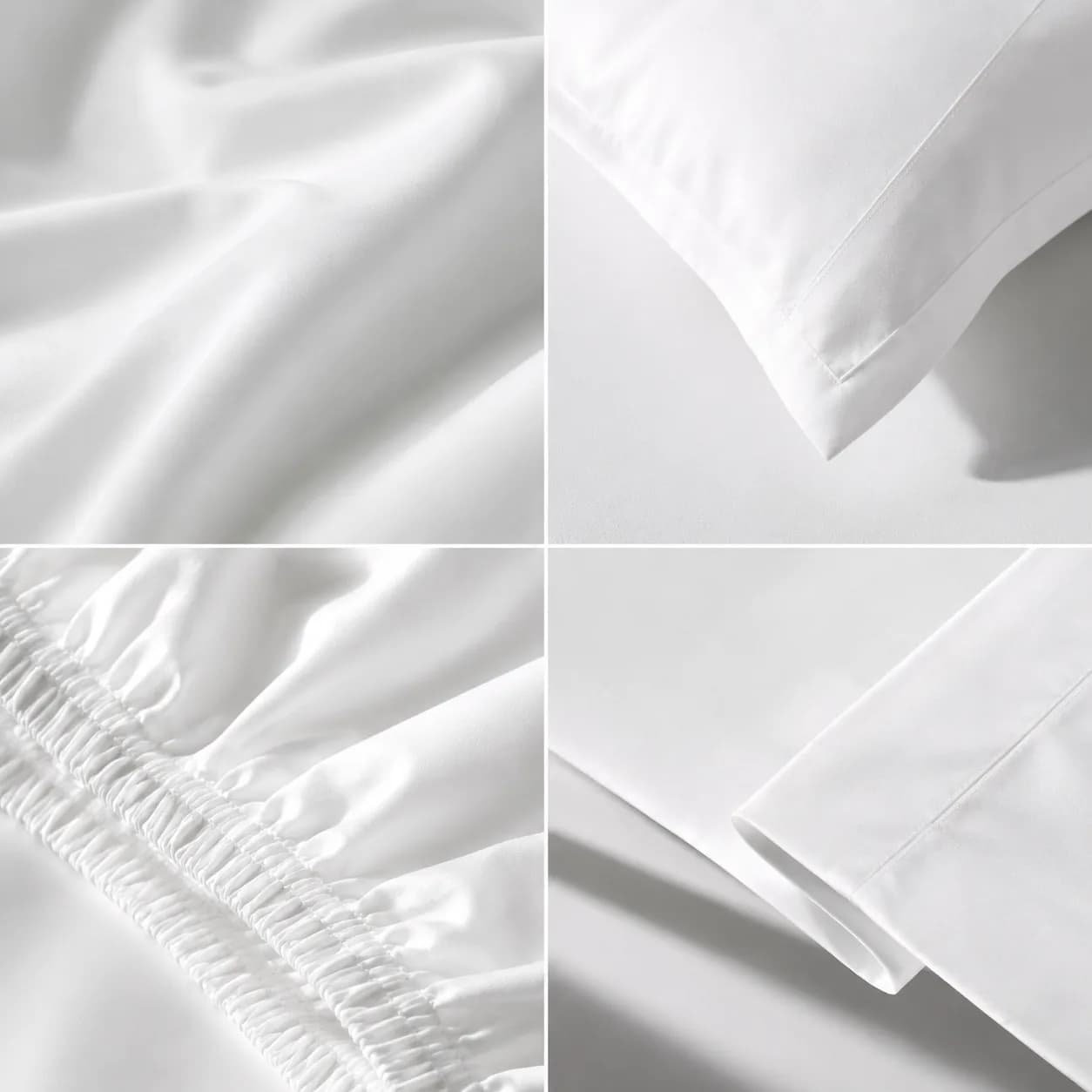
Beyond the weave, three details decide how a sheet ages. Generous hems survive repeated pressing and stop the first fray becoming a rip. Adequate fitted-sheet pocket depth matters more in hotels than anywhere else, because mattresses are deep and protectors add to them — a shallow pocket pops off and gets pulled hard every turn. And pre-shrinking is not optional: dimensional change after the first few industrial cycles is the most common reason a sheet stops fitting the bed it was bought for.
The tests that predict linen life
Where a consumer range is sold on feel, a contract range should be bought on evidence. Three test families do most of the work, and any serious supplier can produce results against them. Colour fastness to laundering — the ISO 105-C06 family, with an ISO 105-C12 variant for industrial laundering conditions — grades how well colour survives washing, typically on a one-to-five grey scale. Abrasion resistance, most commonly by the Martindale method in ISO 12947-2, predicts surface wear and pilling. Dimensional change after washing tells you whether the sheet will still fit after the first month. Fabric weight is stated as grams per square metre; ISO 3801 is the reference method for woven fabric mass.
Ask for the results rather than the reassurance, and specify the grade you require rather than accepting whatever comes back. AATCC publishes the parallel North American test methods, so a supplier quoting to a US property may present AATCC results instead of ISO — that is fine, provided the method and the grade are stated.
Writing the specification and running the RFQ
From requirement to contract
- 01
1. Fix the service level
Core rooms, suites, and any branded-standard requirement. This decides construction and tier before any price is discussed.
- 02
2. Measure the beds properly
Mattress dimensions including depth, plus protectors. Specify finished sizes and pocket depth in centimetres with tolerance, not by bed name.
- 03
3. Set the par and the reorder cycle
Three par as a baseline, more for off-site laundry. Plan replacement as a rolling percentage, not a crisis purchase.
- 04
4. Specify construction and evidence
Weave, yarn count, GSM, hem depth, closure — plus the colour-fastness, abrasion and dimensional-change grades you require.
- 05
5. Sample against the real laundry
Send samples through the property's actual wash process before awarding. A lab grade and your laundry are not the same test.
- 06
6. Lock repeatability
Seal a counter sample and record the exact construction, so a reorder in two years matches the beds rather than approximately matching them.
The rest of the bed runs on a different clock
A procurement plan that only covers sheets and pillowcases will be caught out, because the other components wear and are replaced on completely different cycles. Duvet inners and pillows are laundered far less often but lose loft and support steadily, and they are usually judged on comfort complaints rather than on visible wear. Mattress and pillow protectors are the opposite: they are the hardest-working items in the room, they absorb what would otherwise reach the mattress, and replacing them on schedule is far cheaper than replacing mattresses early. Duvet covers sit between the two, laundered every turn like sheets but replaced less often because they take less direct abrasion.
Specify each of these separately rather than as a single "bedding" line, give each its own replacement cycle, and hold protectors to a stated wash performance too — they go through the same industrial laundry as everything else.
Where hospitality linen budgets leak
- Buying on unit price instead of cost per use, and replacing twice as often.
- Under-par stock, which forces rushed laundering and shortens linen life across the whole inventory.
- Pocket depth specified from the mattress alone, ignoring the protector.
- Accepting "pre-shrunk" without a dimensional-change figure to hold anyone to.
- No sealed counter sample, so the reorder is a slightly different sheet on the same beds.
- Colour or pattern that cannot be laundered with the rest of the stock, creating a separate wash stream.
BeddingTextilePro is a Nantong B2B supplier of bedding sets, summer quilts and hotel linen on source-factory direct supply — locked, dedicated production lines at large-scale Nantong mills, goods shipping direct from the mill — with a 100-set minimum per color and size combination, full OEM/ODM customization and OEKO-TEX support. Request a wholesale quotation and our export team will reply within one business day.
Frequently asked questions
- What is a par level in hotel linen?
- Par is a complete set of linen for every bed in the property. Three par is the standard — one set on the bed, one in the wash, one on the shelf — which keeps rooms turning without waiting on the laundry. Properties using an off-site laundry or running a luxury service level commonly hold four or five par to cover transit time.
- What thread count or construction is best for hotel sheets?
- For core rooms, a dense plain weave in the percale family is usually the best balance: crisp, cool and the most resistant to industrial laundering. Sateen suits suites and premium tiers where feel matters more than maximum wash life. Judge the cloth on yarn count, density, GSM and hem quality rather than on a headline thread-count number.
- How is hotel linen cost actually measured?
- On cost per use — the purchase price divided by the number of wash cycles the linen survives in service. A cheaper sheet with a shorter life is more expensive per night. That is why contract specifications concentrate on construction, hems, pre-shrinking and test evidence rather than on the lowest unit price.
- What tests should a hospitality linen supplier provide?
- Colour fastness to laundering (the ISO 105-C06 family, with ISO 105-C12 covering industrial laundering conditions), abrasion resistance by the Martindale method under ISO 12947-2, dimensional change after washing, and fabric mass per unit area under ISO 3801. AATCC publishes equivalent North American methods; either is acceptable provided the method and grade are stated.
- Can we order hotel linen with our own branding and sizes?
- Yes — woven logos, custom sizes cut to your actual mattress and protector depth, and property-specific packaging are all standard, from a 100-set minimum per color and size combination. Seal a counter sample at approval so reorders in later years match the beds rather than approximately matching them.
Sources & references
- 1.Wikipedia — Colour fastness (wash fastness grading, ISO and AATCC methods)
- 2.AATCC — textile testing standards association
- 3.Wikipedia — Units of textile measurement (GSM, yarn count, thread count)
- 4.Wikipedia — Bed size (country-by-country mattress dimensions)
- 5.OEKO-TEX STANDARD 100 — harmful-substance certification
Featured products
Shop by category
Explore our services
Sourcing bedding for your market?
Factory-direct quotes, 100-set minimum per color and size combination, full OEM/ODM customization. We reply within one business day.