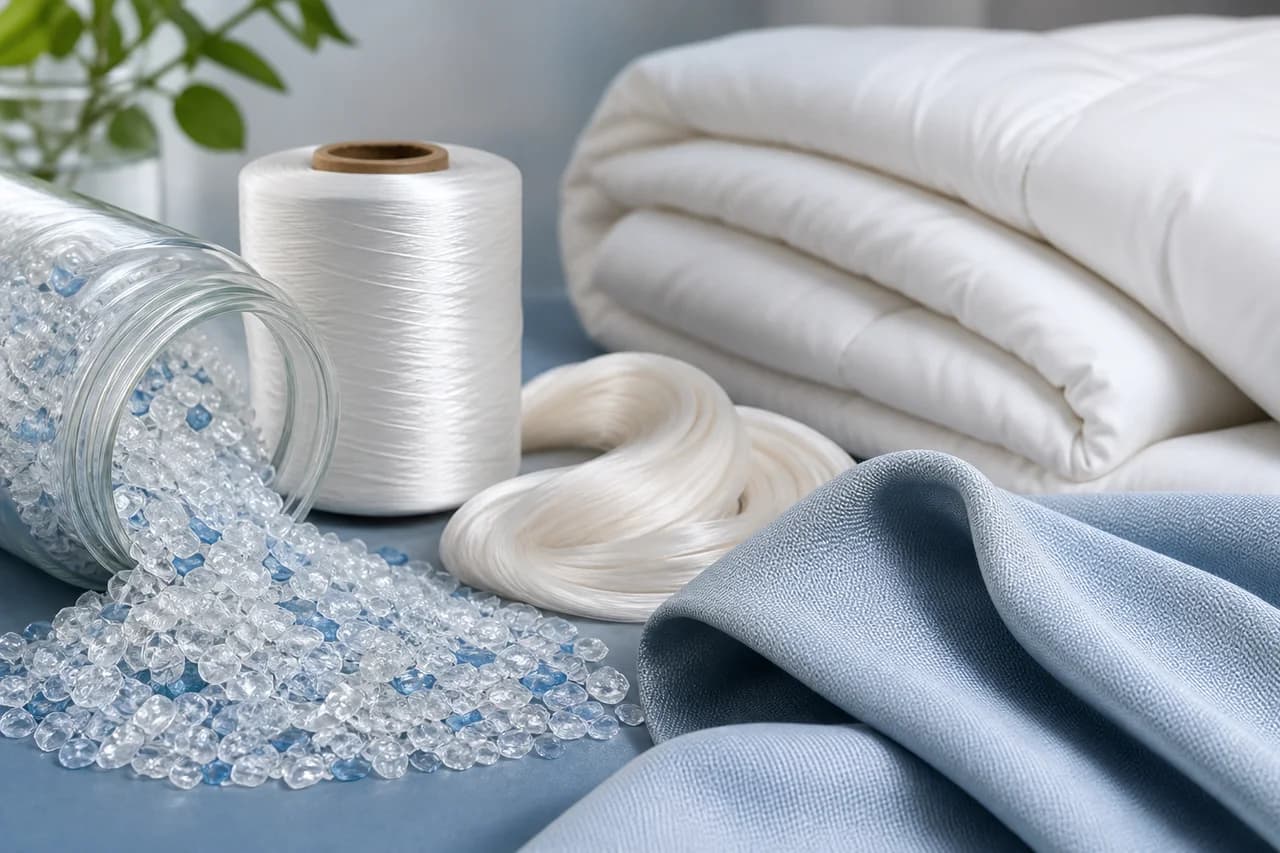
In short
Supercritical CO₂ dyeing uses pressurised carbon dioxide instead of an aqueous dye bath, so the dyeing stage can operate without process water or dye wastewater. It is most mature for polyester and disperse dyes; cotton and Lyocell remain more difficult. Buyers should verify fibre compatibility, industrial-scale capability, colourfastness, CO₂ recovery data and narrowly worded environmental claims.
Supercritical CO₂ dyeing replaces the aqueous dye bath with pressurised carbon dioxide, eliminating process water and dye wastewater at that stage. It is commercially strongest for polyester with disperse dyes—not a universal drop-in process for cotton or Lyocell. Here is how buyers verify fibre fit, colourfastness, facility evidence and environmental claims.
Waterless CO₂ dyeing is a real textile process, but it is not a universal sustainability shortcut. The technology replaces the water bath with carbon dioxide held above its critical point, where it behaves with gas-like diffusion and liquid-like solvent power. Suitable disperse dyes travel through that fluid and diffuse into hydrophobic fibres; depressurisation then separates the CO₂ from residual dye so the fabric leaves the vessel dry. The dyeing stage can therefore use no process water and generate no dye-bath wastewater. For bedding buyers, the decisive limitation is fibre chemistry: industrial use is strongest for polyester, while cotton, Lyocell and other hydrophilic cellulosics require different dyes, fibre modification or co-solvents and are not equivalent drop-in applications.
What is supercritical CO₂ waterless dyeing?
A supercritical fluid exists above its critical temperature and pressure, where there is no separate liquid and gas phase. Carbon dioxide reaches that state at about 31°C and 7.38 MPa, although textile dyeing normally runs at much higher operating temperature and pressure to obtain dye solubility, fibre swelling and level colour. A 2026 technical review describes supercritical CO₂ as a non-polar solvent that naturally favours non-polar disperse dyes and hydrophobic fibres, especially polyester. Unlike conventional aqueous dyeing, the process does not need the large dye bath, dispersing auxiliaries and final drying step in the same form. It does require specialised pressure vessels, pumps, heat control and a closed recovery system, so its economics and available colour library differ from a normal jet-dyeing line.
How does CO₂ dyeing compare with conventional aqueous dyeing?
| Conventional aqueous dyeing | Supercritical CO₂ dyeing | |
|---|---|---|
| Dye carrier | Water plus salts, auxiliaries or dispersants according to fibre | Pressurised supercritical carbon dioxide |
| Best-established bedding fibres | Cotton, Lyocell, polyester and blends with fibre-specific chemistry | Polyester with suitable disperse dyes |
| Dye-bath wastewater | Requires treatment and discharge control | No aqueous dye bath at the dyeing stage |
| Drying after dyeing | Wet fabric must be rinsed and dried | CO₂ leaves as pressure is released, so the fabric exits dry |
| Equipment | Widely available dye-house machinery | Specialised high-pressure vessel and recovery loop |
| Commercial risk | Water, salt, chemical and effluent performance | Capacity access, colour range, pressure-cycle economics and fibre compatibility |
The waterless dyeing cycle, step by step
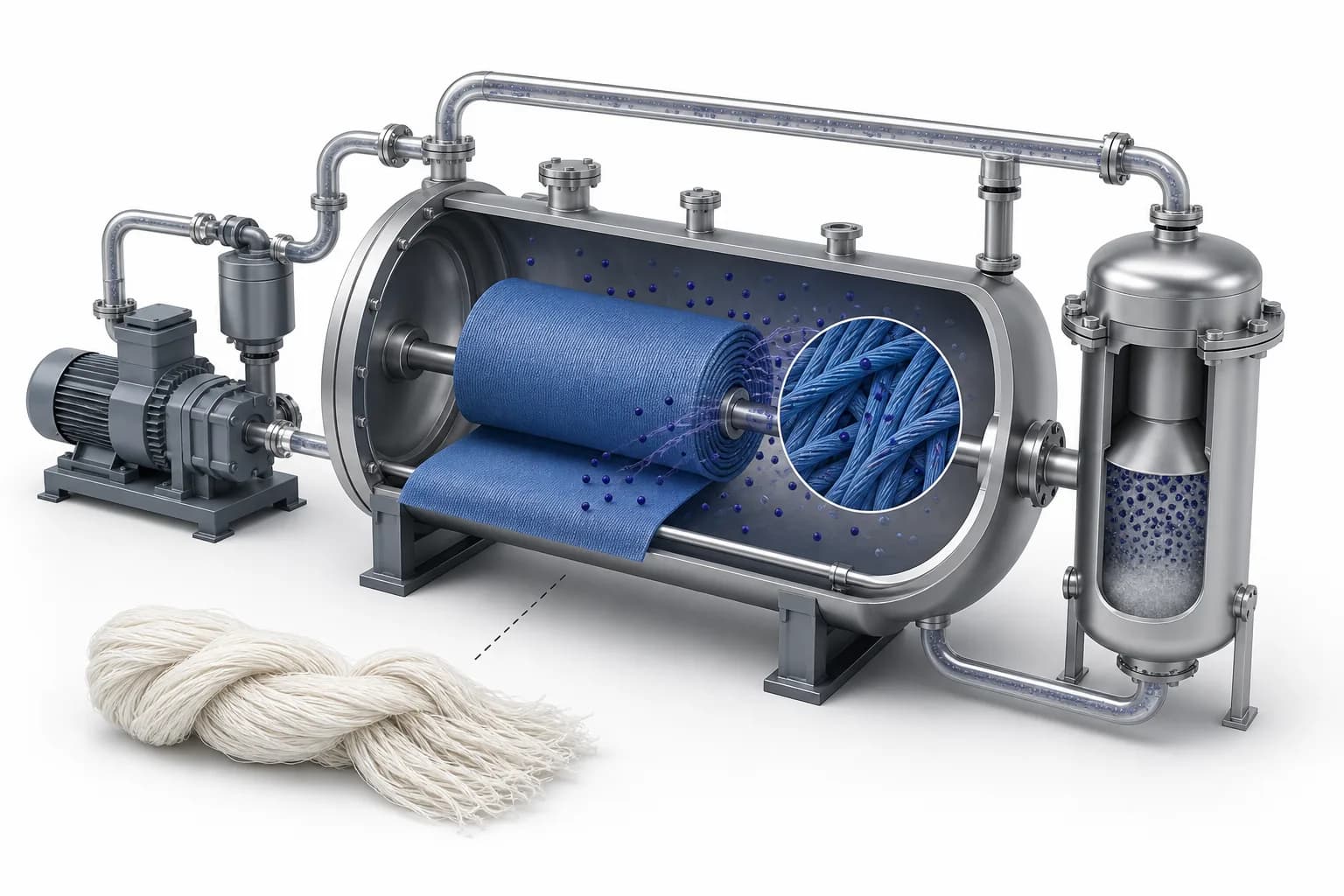
Inside a supercritical CO₂ dyeing vessel
- 01
1 · Load dry fabric and compatible dye
Polyester fabric and a suitable disperse dye enter a sealed high-pressure vessel without an aqueous liquor.
- 02
2 · Raise temperature and pressure
The system moves CO₂ above its critical point and to the operating window needed for dye solubility and fibre diffusion.
- 03
3 · Circulate dissolved dye
Supercritical CO₂ carries dye through the textile while swelling the polymer's amorphous regions so colour can diffuse inward.
- 04
4 · Hold for level colour
Temperature, pressure, flow, time and dye concentration are controlled to achieve shade depth and evenness.
- 05
5 · Depressurise and separate
Lowering pressure removes CO₂ from the fabric and separates residual dye for collection.
- 06
6 · Recover CO₂ and unload dry fabric
The closed system recirculates recovered CO₂; the dyed textile leaves without a conventional rinse-and-dry sequence.
Which bedding fibres are actually suitable?
Polyester is the procurement-ready answer because both the polymer and disperse dyes are hydrophobic. Peer-reviewed studies have achieved deep colour and tested fastness on polyester under supercritical conditions, while recent laboratory work also demonstrates technical feasibility for polyamide 6.6. Cellulosic fibres are harder: cotton and Lyocell normally depend on polar reactive dyes and fibre swelling in water, whereas supercritical CO₂ is non-polar. Research routes include fibre pretreatment, modified reactive-disperse dyes, moisture or co-solvents, but a buyer should not interpret a laboratory paper as proof of repeatable bulk capacity. For a 100% Lyocell bedding range, closed-loop fibre production and well-controlled aqueous reactive dyeing may currently be the more verifiable claim; CO₂ waterless dyeing should be attached only to the exact fabric and facility that actually use it.
| Fibre / product | Current fit for scCO₂ dyeing | Buyer decision |
|---|---|---|
| Virgin or recycled polyester bedding | Strongest commercial fit with disperse dyes | Request industrial run evidence, shade range, fastness and recycled-content traceability |
| Polyamide / nylon cooling textile | Promising; peer-reviewed laboratory evidence exists | Confirm that the named facility has production-scale capability for the exact construction |
| Polyester/cotton blend | Uneven fit because the two fibres need different dye chemistry | Demand component-level colour evidence; avoid assuming both fibres are dyed by one waterless step |
| Cotton bedding | Technically researched but not the mature default | Use verified low-liquor or controlled reactive dyeing unless bulk CO₂ capability is documented |
| Lyocell bedding | Cellulosic and hydrophilic; not the straightforward polyester use case | Keep fibre sustainability and dye-process claims separate and facility-specific |
| GRS recycled polyester | GRS can verify recycled material and chain of custody | Do not present GRS as certification that CO₂ dyeing was used |
What colourfastness and quality evidence should buyers require?
A waterless process still has to deliver a saleable textile. Ask for wash, dry- and wet-rub, perspiration and light fastness appropriate to the destination market, together with shade difference across the roll and between lots. Research on polyester commonly operates around 120°C and high pressure, but those conditions are not a purchase specification by themselves; the pass/fail criteria belong in the PO. For bulk bedding, require a lab dip or approved pilot lot, sealed shade standard, delta-E tolerance, fastness report on the actual fabric, width and GSM after processing, and evidence that decompression has not caused streaks or unevenness. The polyamide 6.6 study itself notes that laboratory samples may not reveal industrial-scale levelness problems—exactly why a commercial reference run matters.
How to verify a supplier's waterless-dyeing claim
- Name the dyeing facility and machine capacity; a fabric trader's brochure is not evidence of an industrial pressure line.
- Match the claim to the exact fibre, dye class, colourway and lot—not to a general sustainability presentation.
- Request the process flow, operating batch size, CO₂ recovery measurement and mass-balance boundary used for any percentage claim.
- Review fastness, shade-levelness and post-process GSM/width results on the actual bedding fabric.
- Separate certifications: GRS verifies recycled content and chain of custody; it does not prove waterless dyeing.
- Word marketing narrowly: 'dyed without an aqueous bath at the dyeing stage' is supportable when documented; 'zero-impact' or blanket 'eco-friendly' claims are not.
Where the technology fits a bedding collection
The strongest near-term bedding application is a recycled-polyester or technical-polyester capsule where the brand can document both the material chain and the dye facility. It can also become relevant to nylon-rich cooling textiles as capacity matures. It is not a reason to relabel an existing cotton or Lyocell program. Buyers building a broader lower-impact range should compare options by fibre and process: GRS-traceable recycled polyester with verified CO₂ dyeing where available; Lyocell for a regenerated-cellulose story with its own production evidence; and durable cotton with controlled reactive dyeing and measured colourfastness. BeddingTextilePro can coordinate these specifications through locked production lines at large-scale Nantong mills, but any waterless claim belongs only on a style for which the named finishing partner and lot evidence have been verified.
The bottom line on waterless CO₂ dyeing
Supercritical CO₂ dyeing can remove process water, dye-bath wastewater and conventional drying from the dyeing stage, making it a meaningful technology rather than a marketing synonym. Its current commercial centre is polyester with disperse dyes, supported by specialised high-pressure equipment; cotton and Lyocell are not equivalent plug-in applications. A sound RFQ therefore starts with fibre compatibility and industrial capacity, then locks shade, fastness, lot evidence, CO₂ recovery and precise claim wording. Buy the documented process on the documented SKU—not a broad green halo around the supplier.
BeddingTextilePro is a Nantong B2B supplier of bedding sets, summer quilts and hotel linen on source-factory direct supply — locked, dedicated production lines at large-scale Nantong mills, goods shipping direct from the mill — with a 100-set MOQ, full OEM/ODM customization and OEKO-TEX support. Request a wholesale quotation and our export team will reply within one business day.
Frequently asked questions
- What is waterless CO₂ textile dyeing?
- It is a dyeing process that uses carbon dioxide above its critical temperature and pressure as the dye carrier instead of an aqueous bath. Compatible dye dissolves in the supercritical fluid and diffuses into the fibre; depressurisation separates the CO₂, leaving dry fabric and avoiding dye-bath wastewater at that processing stage.
- Which bedding fibres work best with supercritical CO₂ dyeing?
- Polyester is the strongest commercial fit because hydrophobic polyester and non-polar disperse dyes are compatible with supercritical CO₂. Polyamide is promising, but buyers should verify industrial capacity. Cotton and Lyocell are hydrophilic cellulosics that require different chemistry, so do not assume a polyester process transfers directly to them.
- Does waterless dyeing mean the entire bedding product uses zero water?
- No. It means the documented dyeing stage operates without an aqueous dye bath. Fibre production, fabric preparation, sewing, cleaning and other upstream or downstream steps may still use water. Scope the claim to the process boundary and support any water or CO₂ percentage with measured facility data.
- Does GRS certify that recycled-polyester bedding was waterless dyed?
- No. The Global Recycled Standard verifies recycled material, chain of custody and specified processing criteria. It does not prove that supercritical CO₂ dyeing was used. A buyer needs both the valid GRS transaction chain for recycled content and separate facility and lot evidence for the waterless dye process.
- What should be in a waterless-dyed bedding RFQ?
- Specify fibre and dye class, named dye facility, machine and batch capacity, shade standard, delta-E tolerance, wash/rub/light fastness, lot-level test evidence, CO₂ recovery measurement and exact environmental wording. Require an approved pilot on the real fabric because laboratory feasibility does not guarantee production-scale levelness.
Sources & references
- 1.IntechOpen — Supercritical CO₂ Dyeing of Textiles: Technical Requirements and Industrial Perspectives
- 2.J-STAGE — Features and Present Status of Supercritical Fluid Dyeing
- 3.Peer-reviewed study — Waterless Dyeing of Polyamide 6.6 (PMC)
- 4.Textile Exchange — Global Recycled Standard 5.0
- 5.US EPA — Textile Mills Effluent Guidelines
- 6.Peer-reviewed study — Polyester dyeing performance in supercritical CO₂ (PMC)
Featured products
Shop by category
Explore our services
Sourcing bedding for your market?
Factory-direct quotes, 100-set MOQ, full OEM/ODM customization. We reply within one business day.