TL:DR
rPET bedding should be bought as a documented fibre-and-supply-chain specification, not as a green adjective. Verify whether the input is post-consumer or pre-consumer, the recycled percentage, the applicable certification scope and transaction records, then test the finished fabric for colourfastness, shrinkage, pilling and wash durability. GRS or RCS evidence supports traceability within its scope; it does not prove every environmental claim or finished-product performance.
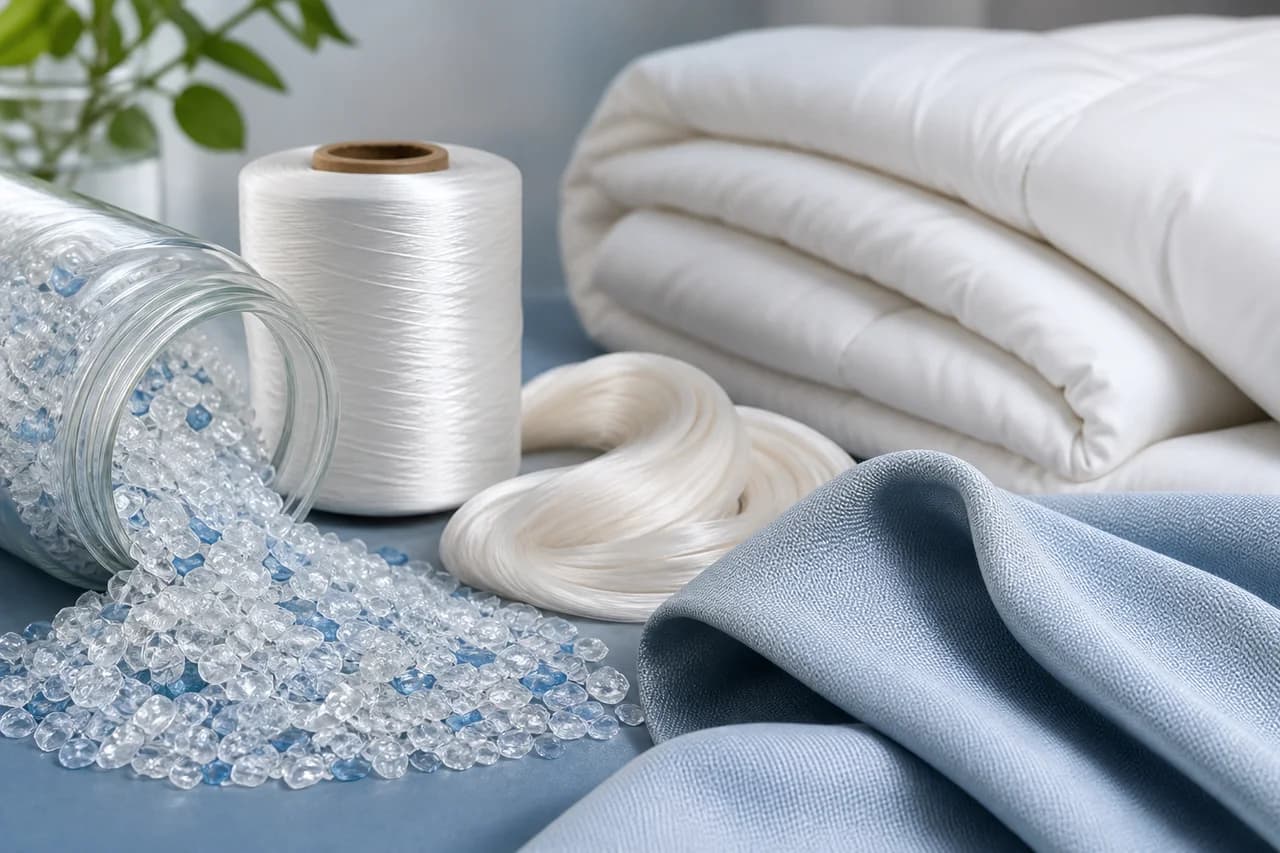
rPET can reduce reliance on virgin polyester, but ‘recycled’ is not a complete specification. This B2B guide covers feedstock, chain of custody, fibre content, performance tests, labelling and the documents a bedding buyer should request.
rPET bedding usually means polyester fibre made from recycled polyethylene terephthalate, often recovered from used bottles or other PET streams. The opportunity is real, but the material name alone does not tell a buyer the feedstock, recycled percentage, certification scope, chemical inputs, finished performance or end-of-life route. A defensible B2B purchase therefore starts with documents and a sample: define what ‘recycled’ means for the exact article, trace the claim through the supply chain, and test the finished bedding under the care conditions it will actually face.
What is rPET in bedding?
rPET is recycled PET turned back into polymer and then into filament or staple fibre. It can be spun, woven or knitted into sheets, duvet covers, filling shells and other textile components, depending on the specification. Post-consumer and pre-consumer inputs are not the same claim, and a product can contain a mixture of recycled and virgin polyester. Ask for the material composition by component rather than accepting ‘eco polyester’ as a complete answer.
| Virgin polyester | rPET polyester | |
|---|---|---|
| Feedstock | New petrochemical raw material | Reclaimed PET input defined by the supplier and standard |
| Buyer evidence | Fibre composition and normal product tests | Recycled-content claim, scope certificate and transaction evidence where applicable |
| Performance | Depends on polymer, yarn and construction | Still depends on polymer quality, spinning, yarn, weave and finishing |
| Main claim risk | Overstating durability or environmental benefit | Calling all polyester ‘recycled’ or implying blanket circularity |
| Specification priority | Construction, hand and care durability | The same performance checks plus feedstock and chain-of-custody control |
What do GRS and RCS actually verify?
Textile Exchange describes the Global Recycled Standard (GRS) as a product standard that verifies and tracks recycled raw materials through the supply chain, with processing, chemical and social or environmental criteria in its scope. The Content Claim Standard (CCS) provides the chain-of-custody foundation. RCS is a recycled-content chain-of-custody standard with a narrower scope. These standards are useful evidence when the certificate covers the relevant site, material and product category, but a logo is not a substitute for checking the certificate, transaction records and exact claim wording.
| RFQ evidence | What to request | What it answers |
|---|---|---|
| Feedstock | Post-consumer or pre-consumer definition; input description | What was recycled? |
| Content | Recycled percentage by component and total composition | How much of this article is recycled? |
| Chain of custody | Scope certificate, certified sites and transaction certificate where required | Can the claim be traced through the supply chain? |
| Finished performance | Colourfastness, shrinkage, pilling, seam and wash results | Will the bedding perform in service? |
| Chemical safety | Destination-market restricted-substance or product test documentation | Is safety evidence separate from recycled-content evidence? |
| Claim copy | Approved label and marketing wording | What can be said without implying unsupported benefits? |
How should a buyer verify an rPET bedding sample?
From recycled-fibre claim to approved bulk order
- 01
1 — Define the claim
Write whether the brief requires post-consumer PET, pre-consumer material, a minimum percentage or a certified standard.
- 02
2 — Check the scope
Match the supplier, processor, product category and material to the scope certificate and current standard documents.
- 03
3 — Confirm the transaction
Request the transaction or equivalent chain-of-custody record for the material used in the proposed article where the standard requires it.
- 04
4 — Test the article
Run colourfastness, dimensional stability, pilling, seam, strength and laundering tests on the actual fabric or finished bedding.
- 05
5 — Approve the claim
Use precise fibre and recycled-content wording; do not claim zero impact, infinite recyclability or improved health without separate evidence.
- 06
6 — Control the lot
Keep the sealed sample, documents, composition and inspection record together for production and reorder checks.

What can be said on a label?
Fibre naming and environmental claims should be kept distinct. The European Commission’s textile-labelling FAQ explains that recycled information may be given if it is not misleading, and gives the example of stating the fibre name separately from the recycled-fibre information. The practical rule is to identify the fibre composition, state the recycled portion accurately, and retain the supporting documentation. Avoid broad phrases such as ‘100% sustainable’, ‘zero-impact polyester’ or ‘fully circular bedding’ unless a competent authority and evidence support that precise claim. A GRS or RCS certificate is evidence within its standard scope, not permission to make every environmental statement.
Where does rPET fit in a bedding range?
rPET can be useful for lightweight shells, decorative woven covers, selected filling applications and contract ranges where the buyer values documented recycled input alongside consistent performance. It should be compared with cotton, Lyocell and virgin polyester on hand, moisture behaviour, care, price, expected service life and claim requirements. Our B2B team can coordinate custom bedding through locked, dedicated production lines at large-scale Nantong mills, with goods shipping direct from the mill and a 100-set minimum per color and size combination; the final fibre claim remains tied to the approved material documents and sample.
The buyer’s conclusion
Treat rPET as a traceability and performance project. Define the feedstock and percentage, match the standard scope to the exact product, request transaction evidence, test the finished bedding and approve narrow label wording. This process gives sustainability teams a claim they can defend and gives purchasing a product that still works after the first wash, rather than a recycled adjective with no commercial control.
BeddingTextilePro is a Nantong B2B supplier of bedding sets, summer quilts and hotel linen on source-factory direct supply — locked, dedicated production lines at large-scale Nantong mills, goods shipping direct from the mill — with a 100-set minimum per color and size combination, full OEM/ODM customization and OEKO-TEX support. Request a wholesale quotation and our export team will reply within one business day.
Frequently asked questions
- What does rPET mean in bedding?
- rPET is recycled polyethylene terephthalate turned into polyester fibre. In bedding it may appear in yarn, woven fabric, filling or a component. The term does not by itself state whether the input is post-consumer or pre-consumer, the recycled percentage or the certification scope, so those details belong in the RFQ.
- Does GRS prove that every part of a bedding set is recycled?
- No. GRS evidence applies to the certified scope, material and product details covered by the certificate and related chain-of-custody records. A set may contain several components with different compositions. Match the certificate and transaction evidence to the exact article and state the recycled portion by component where needed.
- Is recycled polyester as durable as virgin polyester?
- Durability depends on polymer quality, spinning, yarn, weave, finish and construction—not only on whether the feedstock is recycled. Test the finished fabric or bedding for strength, pilling, colourfastness, shrinkage, seams and laundering under the intended service conditions.
- Can I label bedding as 100% recycled polyester?
- Only when the exact labelled fibre composition and supporting evidence justify it. If other fibres, trims, thread or fillings are present, the claim must not imply that the entire product is recycled polyester. Keep fibre composition and recycled-content wording precise and non-misleading.
- Does recycled polyester make bedding sustainable?
- It can support a narrower recycled-content claim, but it does not prove overall sustainability, low impact, safe chemistry, durability or recyclability. Evaluate the full product life cycle and keep each environmental statement tied to evidence within its stated scope.
Sources & references
- 1.Textile Exchange — What is the Global Recycled Standard?
- 2.Textile Exchange — Chain of Custody
- 3.Textile Exchange — Materials and Products Classification (bedding and recycled polyester examples)
- 4.European Commission — FAQ on Textile Regulation 1007/2011
- 5.European Commission — EU Strategy for Sustainable and Circular Textiles
Featured products
Shop by category
Explore our services
Sourcing bedding for your market?
Factory-direct quotes, 100-set minimum per color and size combination, full OEM/ODM customization. We reply within one business day.