TL:DR
Functional bedding should be compared as a finished system: fibre, yarn, weave, density, GSM, fill and finishing interact with climate and care. A buyer should define the use case, request the construction and any method-specific evidence, then compare like-for-like samples after the same care cycle. Cooling or moisture claims are conditional, not guaranteed outcomes.
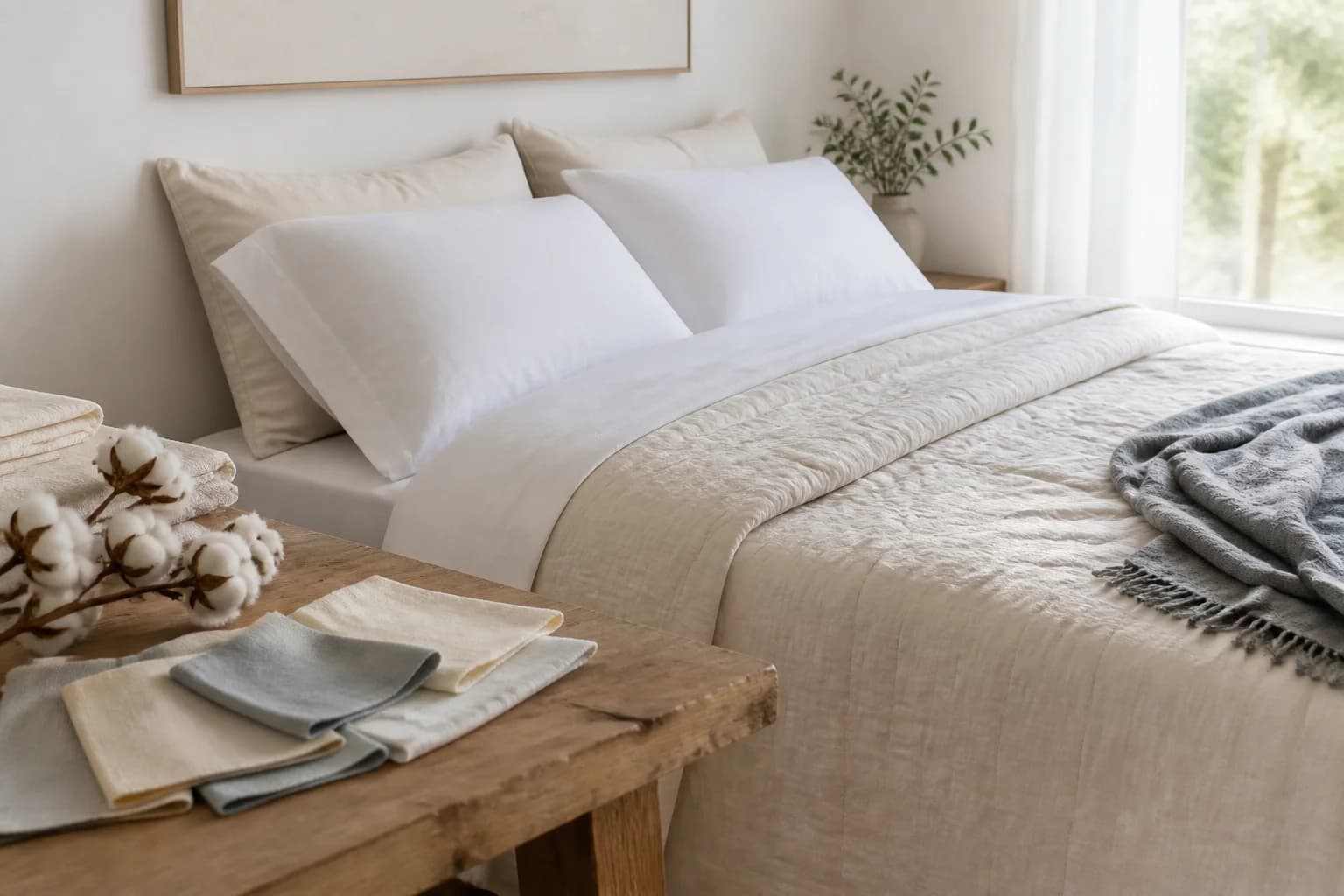
Functional bedding is a finished construction, not a single fibre claim. This buyer guide shows how to compare temperature, moisture, fill and care evidence in an RFQ.
Direct answer: functional bedding is not defined by one yarn, fibre or marketing adjective. Temperature and moisture behaviour depend on the finished combination of fibre, yarn, weave, density, GSM, filling, construction and finish, plus the room and care conditions. Buyers should compare the same finished specification, request method-specific evidence for any performance claim, and treat cooling or moisture language as conditional until samples and records support it.
What does functional bedding mean?
A functional bedding brief describes what the article is intended to help manage—such as heat, humidity or seasonal comfort—then records the construction that could influence that result. A systematic review of bedding and sleepwear research found heterogeneous materials and study conditions, so it does not support a universal ranking of fibres. Fill weight, trapped air, finishing, cover fabric and room conditions can change the buyer's experience.
| Buyer question | Fibre/fabric layer | Fill/structure layer | Evidence to request |
|---|---|---|---|
| Will it feel cooler? | Fibre, weave, density, GSM and finish may affect heat and moisture transfer | Fill, loft and quilting affect insulation and air movement | Finished construction, intended climate and comparable sample review |
| Will it manage moisture? | Surface structure and fibre interaction influence liquid movement | Fill and cover can change drying and retention | A method-specific moisture test such as AATCC TM195 when claimed |
| Is it suitable for a hotel programme? | Hand feel and appearance must match the approved room concept | Durability and care route must match use and laundering brief | Care basis, sampling plan and evidence scope—not a generic promise |
| Can one SKU work year-round? | Seasonal comfort depends on room and user conditions | Insulation and construction may suit one climate better than another | A defined use case, sample comparison and labelling decision |
Which variables belong in a functional-bedding RFQ?
| Variable | Specify | Why it matters |
|---|---|---|
| Climate and use | Room climate, season, hotel or retail application and target user | Sets the comfort question before a supplier suggests a material |
| Shell construction | Fibre composition, weave, yarn, density, GSM and finish when known | Keeps a sample comparison tied to the finished fabric |
| Fill and structure | Filling type, quilting or channel construction and finished dimensions | Changes loft, insulation, drape and handling |
| Moisture or thermal claim | Exact claim wording, method, sample and report scope | Prevents a marketing adjective becoming an unsupported result |
| Care and QA | Care instructions, retained sample, inspection and release records | Makes a comfort claim traceable through production |
How should buyers compare samples?
Functional bedding comparison flow
- 01
1 · Define the brief
Record climate, room use, season, article size, target hand feel and the exact buyer problem.
- 02
2 · Freeze construction
Ask for fibre, yarn, weave, density, GSM, filling, quilting and finish details that are actually available.
- 03
3 · Request evidence
Where a moisture or thermal claim matters, request the test method, sample identity, conditions and scope.
- 04
4 · Compare like for like
Review samples with the same finished dimensions and care route; do not compare a shell fabric with a finished quilt.
- 05
5 · Approve the RFQ
Record the accepted sample, claim wording, care basis, packaging and any per-color-and-size minimum in the quotation.
How to turn the comparison into a quotation
- Ask which fibre, yarn, weave, density, GSM, filling and finish are confirmed for the proposed SKU.
- Separate a product fact from a conditional comfort statement and record the intended climate.
- If moisture management is material to the claim, request the method and report scope rather than a generic badge.
- Confirm care instructions, retained sample, inspection point and packaging before artwork is released.
- Treat 100 sets for each color and size combination, without pooling variants—not as a universal order MOQ.
Buyer conclusion
The safest functional-bedding decision is a controlled comparison of finished samples and evidence. BeddingTextilePro is a Nantong trading company coordinating source-factory direct supply, dedicated mill lines and direct mill shipping; it is not a manufacturer or its own factory. Send the climate, article, construction and claim brief through the contact page for a traceable quotation and sample plan.
Frequently asked questions
- Does a higher yarn count make bedding cooler?
- Not by itself. Yarn is one input; fibre, twist, weave, density, GSM, finish and the finished structure also affect the result. Compare the complete construction and sample under the intended conditions.
- What should I request for a moisture-management claim?
- Request the exact finished article, test method, sample identification, conditions and report scope. AATCC TM195 is one recognized method for liquid moisture management, but a method result is not a universal sleep outcome.
- Can PCM bedding guarantee better sleep?
- No. Phase-change or thermoregulating materials may be studied under defined constructions and conditions, but a supplier should not promise a sleep outcome without evidence for the finished SKU and use case.
- Can one summer quilt serve every climate?
- Do not assume that. Room temperature, humidity, fill, cover, construction and care all influence comfort. Define the target market and compare samples for that use.
- Does OEKO-TEX prove cooling or moisture performance?
- No. OEKO-TEX wording must stay within the verified document scope; it does not replace a finished-product performance test or prove a comfort outcome.
Sources & references
Featured products
Shop by category
Explore our services
Sourcing bedding for your market?
Factory-direct quotes, 100-set minimum per color and size combination, full OEM/ODM customization. We reply within one business day.