TL:DR
Do not choose a summer quilt from the words “ice silk”, modal or TENCEL™ alone. First define the target user and climate, then state the shell fibre and construction, fill type and amount, quilting, finished dimensions, edge treatment, pack and sample question. Ask suppliers to name any alternative and compare matched finished samples. Each colour-and-size combination at BeddingTextilePro starts at 100 sets; colours and sizes cannot be pooled.
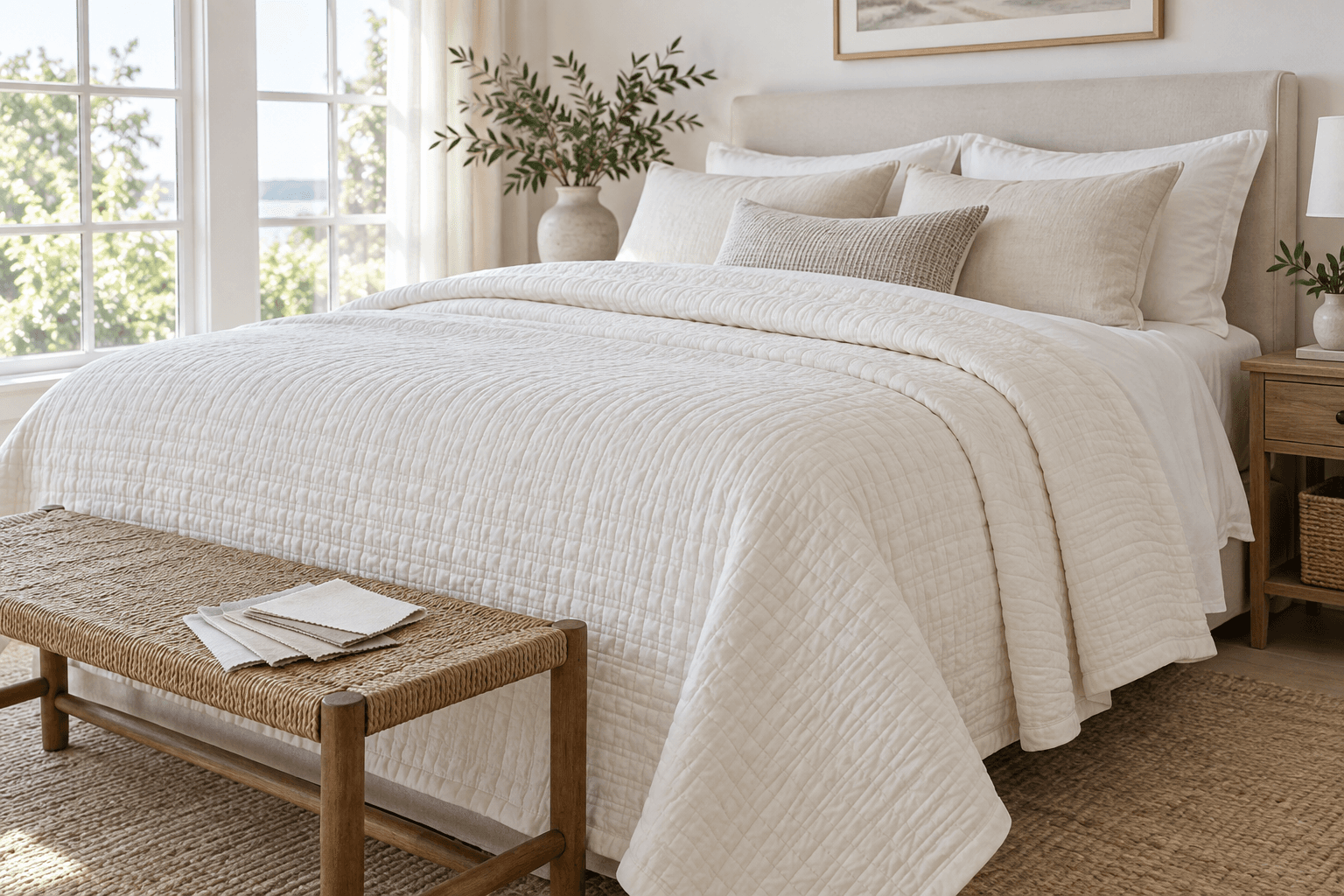
A useful summer-quilt brief names the shell, fill, construction and target market, then asks suppliers to quote and sample the same finished quilt.
A summer quilt should be bought as a finished product, not as a cooling keyword. “Ice silk”, modal and Lyocell/TENCEL™ may describe different shell fibres, constructions or marketing positions, while the fill, quilting, size and pack can change the product just as much. Start with the customer and selling climate, then make each physical field visible in one brief.
Separate the shell, fill and finished quilt
A shell name does not tell the buyer what is inside or how the quilt is constructed. Write the outer-shell fibre and construction separately from fill type, target fill quantity, quilting pattern, finished dimensions, edge treatment and packaging. If a supplier uses a name such as ice silk, ask for the exact shell description rather than assuming a shared industry definition.
| Decision field | Buyer defines | Supplier returns | What it prevents |
|---|---|---|---|
| Market and use | Target climate, customer, room use and seasonal role | Proposed product position | A generic cool claim replacing the buyer task |
| Shell | Fibre name, construction, finish and desired hand | Exact shell description and option | Ice silk/modal/Lyocell being treated as a fixed grade |
| Fill | Fill type, declared amount or an open range question | Proposed fill and exceptions | Shell name being mistaken for fill |
| Make-up | Quilting, edge, dimensions and size system | Finished construction | A swatch being mistaken for a quilt |
| Pack and quantity | Colour × size matrix, unit pack, carton and destination | Price basis and exclusions | An unlike commercial scope |
Write a range brief before asking for a cooling claim
Decide what role the quilt has in the range: a lightweight add-on, warm-climate everyday option, premium drape-led offer or another clearly named proposition. Then record shell, fill, make-up, dimensions and pack. Ask for any comfort or cooling statement to be tied to a specific finished sample and method, rather than accepting a category-wide phrase.
| Brief line | Buyer input | Sample comparison question |
|---|---|---|
| Target user | Market, climate context and intended seasonal role | Does the sample fit the stated range role? |
| Shell | Fibre, construction, finish and colour direction | Which shell field differs from the brief? |
| Fill and quilt build | Fill type, requested amount/range, quilting and edge | What is actually inside this finished sample? |
| Size and pack | Finished dimensions, size system, unit pack and carton | Does the sample represent this SKU and pack? |
| Commercial line | Units by colour × size, destination and delivery basis | Which option or exclusion changes the quote? |
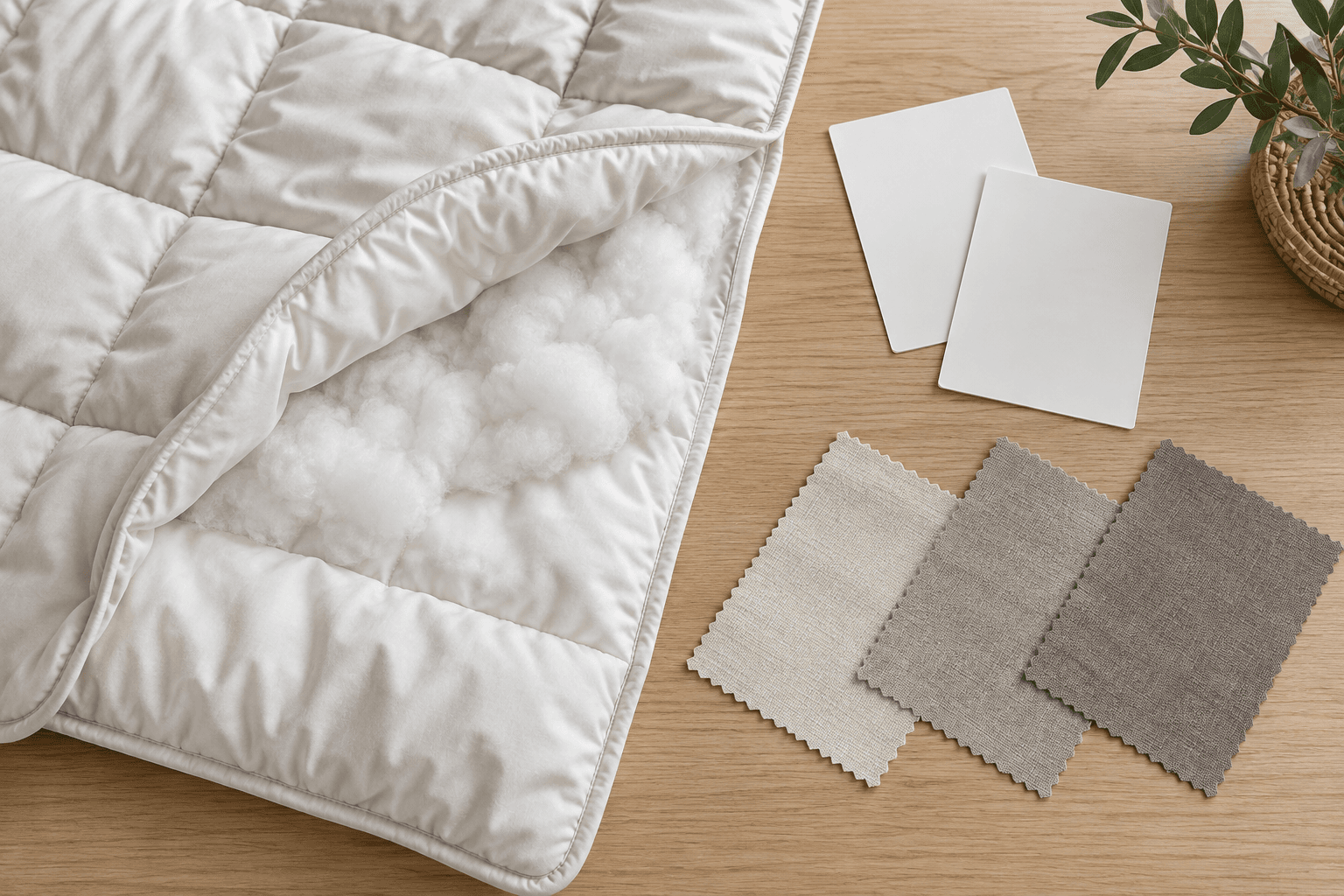
Compare matched finished samples
Send the same brief to each candidate and review samples with their identity attached: shell, fill, construction, size and pack version. Assess hand, weight and drape as observations against the buyer’s target; ask a follow-up where a field differs. A cover swatch, a finished quilt and a retail label are different evidence, so keep them in separate rows.
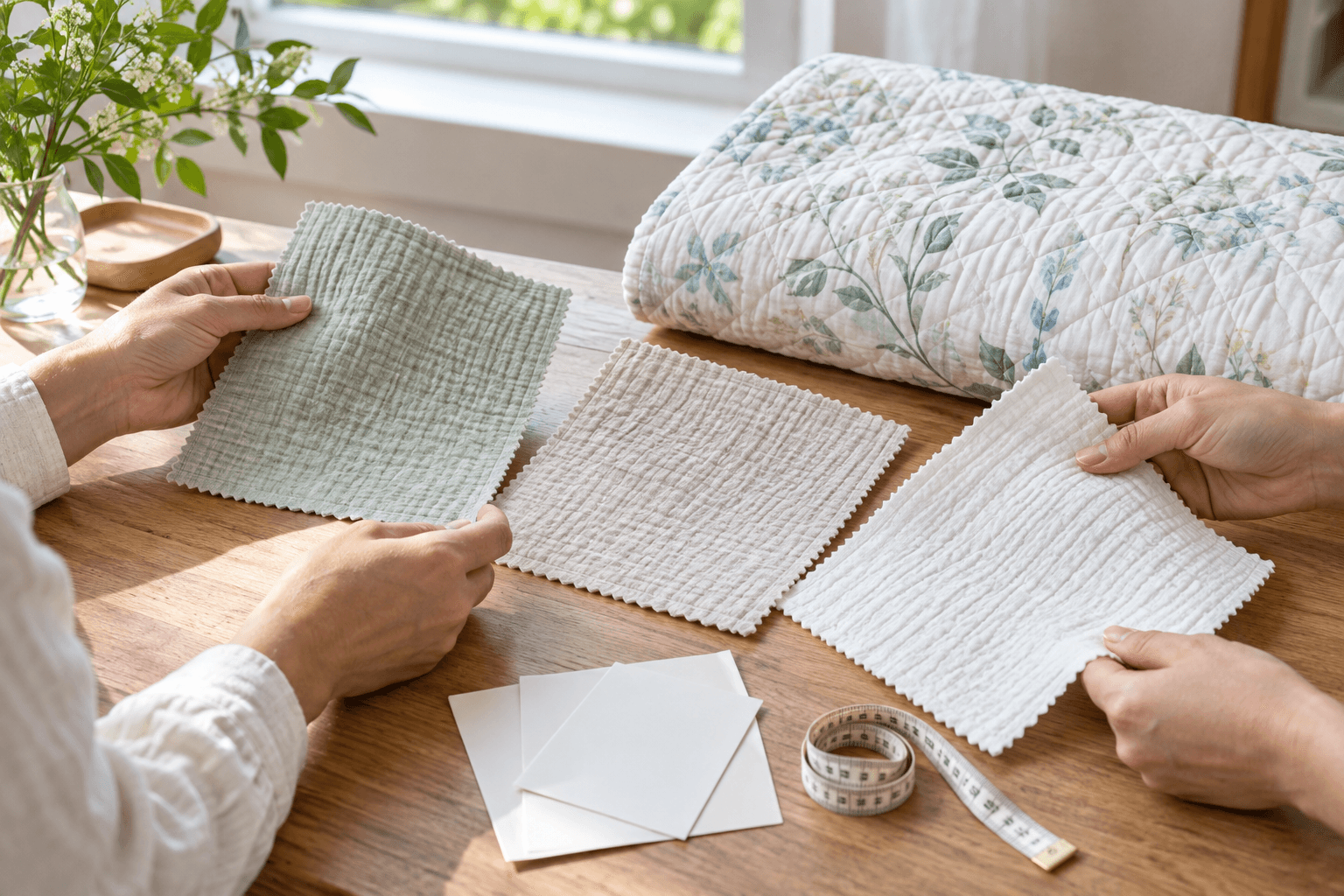
Use names accurately in the product file
Keep generic fibre names, branded-fibre claims and marketing descriptors distinct in the specification and packaging. “Ice silk” is not a universal technical composition; modal and Lyocell are not interchangeable; and a TENCEL™ claim must match the documented product route. This protects the buyer from quoting, sampling and labelling three different versions under one attractive name.
Summer quilt buying route
- 01
1 · Define the range role
Name the customer, climate context and seasonal job.
- 02
2 · Set shell and fill fields
Keep fibre/construction separate from fill and quilt build.
- 03
3 · Fix the finished SKU
Add dimensions, edge, quilting, colour × size and pack.
- 04
4 · Request matched samples
Attach a version and question to every finished sample.
- 05
5 · Compare quotes
Show options and exclusions beside the active brief.
- 06
6 · Release the selected file
Link sample decision, labels, quantities and delivery handover.
Prepare a summer-quilt enquiry
Use the cooling summer quilts category as the related route, then send your target customer, shell, fill, quilt construction, dimensions, pack, destination and quantity by colour × size. If the catalogue does not show an exact construction, say it is a related category. The next useful step is a supplier response to the same finished-quilt brief.
Frequently asked questions
- Is ice silk a fixed summer-quilt material?
- No. It is used as a market descriptor and does not by itself define fibre composition, construction, fill or finished quilt. Ask for those fields in writing.
- Can modal and Lyocell quilts be specified as the same product?
- No. Keep shell fibre, construction, fill and finished build distinct. They can be compared as separate range options, not merged under one specification.
- What should a summer-quilt RFQ include?
- Include target user and market, shell, fill, quilting, edge, finished dimensions, size system, colour × size quantity, packaging, sample question, destination and delivery basis.
- How do I compare cooling-quilt samples?
- Compare only samples that show their shell, fill, construction, finished size and pack version. Record observations against the buyer brief and name every alternative.
- What is the minimum summer-quilt order by variant?
- The minimum is 100 sets for each colour-and-size combination. Quantities from different colours or sizes cannot be pooled.
Sources & references
Featured products
Shop by category
Explore our services
Sourcing bedding for your market?
Factory-direct quotes, 100-set minimum per color and size combination, full OEM/ODM customization. We reply within one business day.