TL:DR
Microfiber duvet fill is fine polyester staple used as down-alternative stuffing, and its quality is a stack of measurable parameters, not just soft and fluffy: denier (fiber fineness), whether the fiber is hollow, conjugated (crimped) and siliconized, the fill weight in GSM by season, and the down-proof shell. Put those plus anti-clumping tests in the purchase order.

Most 'microfiber duvet' guides stop at soft and fluffy. This one gives the measurable spec — denier, fiber grade, GSM by season and shell construction — that a wholesale buyer needs to write a tech pack and avoid a clumping, bearding comforter.
Microfiber duvet fill is fine polyester staple used as a down-alternative stuffing, and its quality is not one thing — it is a stack of measurable parameters: denier (fiber fineness), whether the fiber is hollow, whether it is crimped (conjugated), whether it is siliconized, the fill weight in GSM, and the shell that holds it. Two errors sink most orders: confusing microfiber fill with a microfiber shell fabric, and assuming 'microfiber' automatically means premium. It does not — the premium tier is hollow, conjugated and siliconized fiber, and the top tier is ultra-fine micro-gel or cluster fill.
Denier: the fineness number that drives feel
Denier is the mass in grams of 9,000 meters of a single fiber, and it is inverse to fineness — the lower the denier, the finer, softer and more down-like the fiber. 'Microfiber' classification begins below about 1.5 denier, far finer than standard textile fiber; volume bedding fill runs roughly 0.9–1.5 denier, with 0.7–0.8 denier reserved for ultra-premium down-alternative. Finer fiber packs more filaments per gram and traps more tiny air pockets, so it is softer and warmer per gram — but fine solid fiber also clumps more easily, which is why the good grades are siliconized.
Fiber grades, low to high
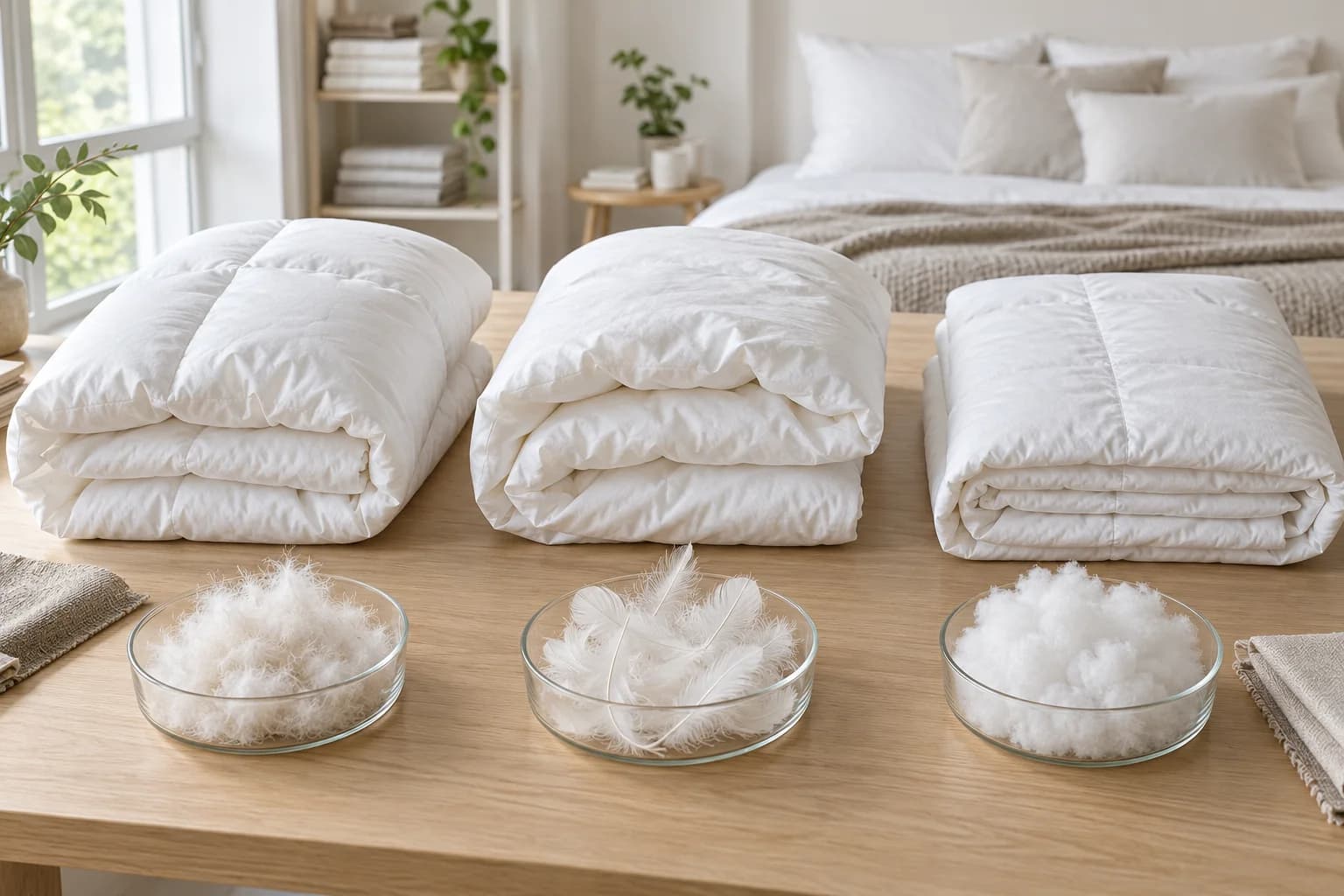
Grade is a combination of hollowness, crimp and finish, not a single word. From cheapest to best: solid polyester staple (flat, heavy, clumps fastest); hollow fiber, with an air channel down the filament that makes it roughly 20% lighter for the same loft; conjugated fiber, with a built-in spiral crimp that springs back for resilience; siliconized fiber, silicone-coated so the filaments glide instead of grabbing, resisting the matting that ruins cheap fill and recovering loft after washing; and at the top, ultra-fine micro-gel or cluster fill — micro-denier siliconized fiber processed into small down-like clusters for the best drape and warmth-per-gram.
| Grade | Fiber type | Denier / feel | Loft & durability | Typical use / cost |
|---|---|---|---|---|
| Tier 1 — Basic | Solid polyester staple | ~2–6D; flat, heavier hand | Low loft; flattens and clumps fastest | Budget / promo duvets; lowest cost |
| Tier 2 — Standard | Hollow fiber (air-channel core) | ~6–7D; springy, medium hand | ~20% lighter per volume; good loft, moderate life | Mainstream all-season duvets; low–mid cost |
| Tier 3 — Premium | Conjugated siliconized hollow fiber | ~3–7D; soft, resilient, down-like recovery | High loft; best resilience and wash recovery; resists matting | Quality all-season and winter duvets; mid–high cost |
| Tier 4 — Luxury | Micro-gel / ultra-fine microfiber or clusters | ~0.7–0.9D; silkiest, most down-like | Highest warmth-per-gram; premium loft; needs down-proof shell | Luxury down-alternative and hotel lines; highest cost |
GSM by season — and why microfiber needs more grams than down
For synthetic fill, warmth is specified in GSM: roughly 150–300 g/m² for summer, 400–500 for all-season, and 600 g/m² and up for a true winter comforter. Because microfiber traps less air per gram than down, it needs more grams to reach the same warmth — a winter microfiber duvet at around 600–750 g/m² sits near a 13.5-tog winter down duvet at 400–500 g/m². Finer denier and cluster fill reach a target warmth at fewer grams, which is a real cost and weight lever. State GSM as a target with a tolerance, plus total fill weight per size.
Shell and construction stop bearding and shifting
Fine fill escapes a loose weave — filaments poke through in a process called bearding, and the duvet loses loft. Specify a down-proof or fiber-proof shell: tightly woven cotton or cotton-rich, typically 233 thread count or higher and commonly 300, in a cambric or down-proof weave. The finer your fill, the tighter the shell must be. For construction, use baffle-box or box quilting on winter and high-fill duvets so the fill cannot migrate and leave cold spots; sewn-through is cheaper but fine only for light summer weights.

Pros, cons and the standards to require
Microfiber fill is hypoallergenic, machine-washable (often at 60°C, which kills dust mites), cheaper and vegan, and it dries fast. The trade-offs: it is heavier than down for equal warmth, less breathable, and low-grade fill clumps and loses loft over time. Protect yourself in the PO with OEKO-TEX STANDARD 100 on both fill and shell, FTC-compliant fiber-content labeling (for example '100% polyester,' stated by percentage in order of predominance), an independent fill-weight and fiber-content test, a wash-and-loft-recovery test on the sample, a destination-market flammability statement, and a sealed gold-seal sample as the acceptance benchmark.
How to spec a microfiber duvet order
From season to accepted bulk
- 01
1 · Pick the season and warmth target
Summer, all-season or winter — this sets your warmth goal (winter is roughly 13.5 tog equivalent).
- 02
2 · Set target GSM with tolerance
Summer ~150–300 g/m², all-season ~400–500, winter ~600–750 for microfiber. State it as target g/m² ± tolerance plus total fill weight per size — do not copy down GSM figures.
- 03
3 · Choose fiber grade and denier
Basic solid → hollow → conjugated siliconized hollow → ultra-fine micro-gel or cluster. For premium and winter, specify hollow, conjugated and siliconized, and a denier; finer denier hits the target at lower weight.
- 04
4 · Choose a down-proof shell and construction
Down-proof cotton shell, 233 TC or higher (commonly 300), tighter for finer fill; baffle-box for winter and high fill, sewn-through only for light weights.
- 05
5 · Require standards, tests and a sealed sample
Into the PO: OEKO-TEX STANDARD 100, '100% polyester' fiber labeling, a third-party fill-weight and fiber-content test, a wash and loft-recovery test, a market flammability statement, and an approved sealed sample as the acceptance standard.
A microfiber duvet lives or dies on three details buyers forget to write down: the fiber grade, the GSM with a tolerance, and a down-proof shell tight enough for the denier you chose.
Sourcing microfiber duvets factory-direct
BeddingTextilePro supplies down-alternative and microfiber duvets and comforters factory-direct from Nantong, China — hollow, conjugated, siliconized and micro-gel fills, specified by denier and GSM, in down-proof cotton shells with box or baffle-box construction, at a 100-set minimum per color and size combination with full OEM/ODM and OEKO-TEX STANDARD 100 support. Tell us your season, target GSM and shell, and our team will build the tech pack and quote within one business day.
Frequently asked questions
- Is a lower denier always better for duvet fill?
- Lower denier is finer, softer, more down-like and warmer per gram, so it is better for feel and premium positioning — but only if it is siliconized (fine solid fiber clumps) and paired with a tighter down-proof shell (fine fiber beards through loose weaves). For budget or high-durability SKUs, coarser hollow fiber is the more robust choice.
- What GSM do I order for a true winter comforter?
- For microfiber fill, winter is roughly 600–750 g/m², near a 13.5-tog rating. Microfiber needs more grams than down for the same warmth, so do not copy down GSM figures. State GSM as a target with tolerance plus total fill weight per size, and specify baffle-box construction so the higher fill does not shift.
- Microfiber, hollow fiber, HCS, gel fiber — what am I actually buying?
- Grade is a stack, not one word. Hollow means lighter and loftier; conjugated adds spiral crimp for resilience; siliconized resists clumping and recovers loft; micro or ultra-fine (below 1 denier) is the softest and most down-like; cluster or 'gel' fiber is micro-fine fiber rolled into down-like balls. Premium fill combines several — get denier, hollow, conjugated and silicone into the spec in writing.
- How do I stop the fill leaking out (bearding) and clumping?
- Two levers: the shell — tightly woven down-proof cotton, 233 TC or higher (commonly 300), tighter for finer fill; and the fiber — siliconized hollow or conjugated fiber resists matting and recovers loft after washing. Verify with a wash-and-loft-recovery test on the sample before approving bulk.
- Which certifications and tests belong in the PO?
- Require OEKO-TEX STANDARD 100 on fill and shell, FTC-compliant fiber-content labeling ('100% polyester,' percentage by weight), an independent fill-weight and fiber-content test, a flammability statement for the destination market, and an approved sealed sample as the acceptance standard. This protects you against under-filling and mislabeled fiber.
Sources & references
- 1.OEKO-TEX — STANDARD 100 (tests fillings and fabric for harmful substances)
- 2.IDFL — International Down and Feather Laboratory (tests synthetic fills)
- 3.IDFL — Explanation of fill and content tests
- 4.FTC — Threading Your Way Through the Textile and Wool Labeling Requirements
- 5.eCFR — 16 CFR Part 303 (Textile Fiber Products Identification Act rules)
Featured products
Shop by category
Explore our services
Sourcing bedding for your market?
Factory-direct quotes, 100-set minimum per color and size combination, full OEM/ODM customization. We reply within one business day.