TL:DR
Fill power grades the loft of down, GSM records mass per area, and tog records thermal resistance of a finished article; they are not interchangeable. Start with the target room and season, then specify the fill system, fill weight for every size, shell and chamber construction, and any finished-article thermal test. Ask every supplier to return the same matrix and approve a sample against that written version.
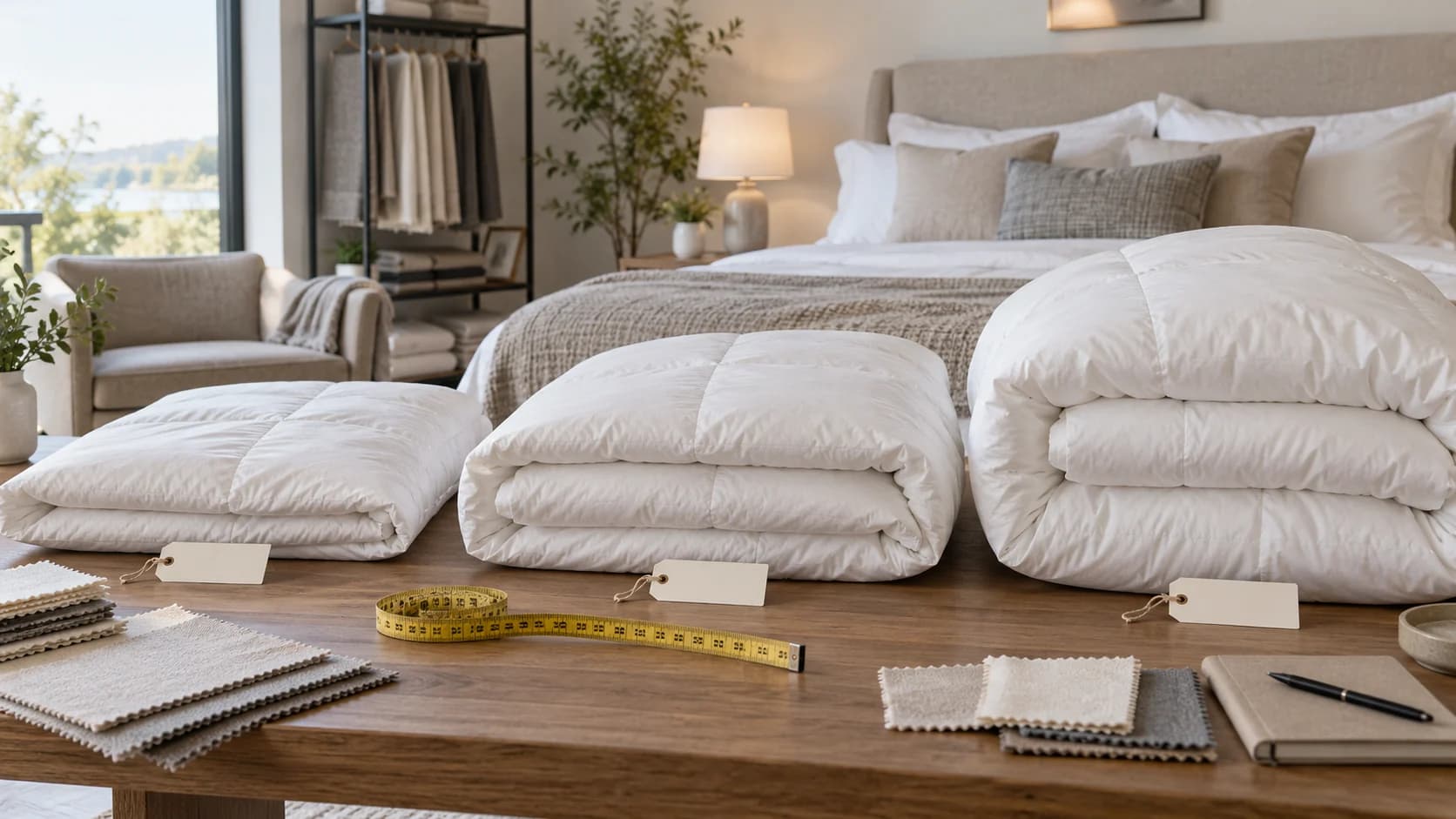
A buyer-side method for turning climate, fill, construction and finished thermal requirements into comparable duvet quotations and samples.
A duvet warmth RFQ is comparable only when it separates the metric from the product decision. Fill power tells you how much a measured quantity of down lofts under a stated method; it does not state how much down is inside the duvet. GSM tells you how many grams sit in one square metre; it does not identify the fill or prove insulation. Tog describes thermal resistance and belongs to the tested finished article. Define the room, season and buyer target first, then connect the right metric to fill weight, construction, size and a representative sample.
Use each warmth metric for the job it can do
| Metric | What it describes | Useful for | What must accompany it |
|---|---|---|---|
| Fill power | Loft of down under a named conditioning and test method | Comparing down quality and warmth-to-weight potential | Down species/claim, down-to-feather composition, test method and fill weight by size |
| Fill GSM | Mass of filling per square metre | Synthetic, silk, wool or other filled constructions when the basis is explicit | Fill identity, size area, total fill weight, distribution and tolerance |
| Finished-product GSM | Mass per square metre of the complete article | Weight and handling comparison for lightweight quilts | Clear statement that shell and filling are included; not a warmth conversion |
| Tog / thermal resistance | Measured resistance of the finished assembly to heat flow | A finished warmth claim in markets and programmes that use it | Named method, specimen, conditioning, result/tolerance and exact sample identity |
Start with the use case before asking for a number
Write the destination market, selling channel or property type, intended season, expected room conditions and whether the buyer wants a light, medium or warm hand. These are design inputs, not universal comfort promises: occupants, covers, ventilation and humidity change the experience. Ask the supplier to propose a construction against that brief and to state every assumption. If a retailer or hotel already owns a reference duvet, identify its size, fill, construction and approved sample rather than asking another supplier to copy a marketing label such as ‘all season’.
Convert GSM into fill grams, not into tog
For a rectangular filled panel, area in square metres equals finished length in metres multiplied by finished width in metres. Planned fill grams equal that area multiplied by the fill GSM. This arithmetic is useful for checking whether size quotations use the same mass basis. It is not a thermal conversion: two products at the same GSM can differ because the fill structure, loft, shell, quilting, moisture behaviour and air movement differ. Require the supplier to confirm the actual fill weight for each finished size and identify whether the quoted GSM is fill-only or the whole article.
| Buyer field | Copy and complete | Supplier must return |
|---|---|---|
| Finished size | Length: [ ] cm; width: [ ] cm | Confirmed finished dimensions and tolerance |
| Area | [length ÷ 100] × [width ÷ 100] = [ ] m² | Calculation basis used |
| Weight basis | Fill-only GSM / total-article GSM: [choose one] | Exact definition and unit |
| Planned fill | [area] × [fill GSM] = [ ] g | Actual target fill grams per size and tolerance |
| Warmth evidence | Tog or thermal resistance required? [yes/no]; method: [ ] | Exact finished specimen, method and result scope |
| Open assumptions | Room/season/cover assumptions: [ ] | Exceptions and proposed alternatives on separate lines |
Build the construction around the chosen fill
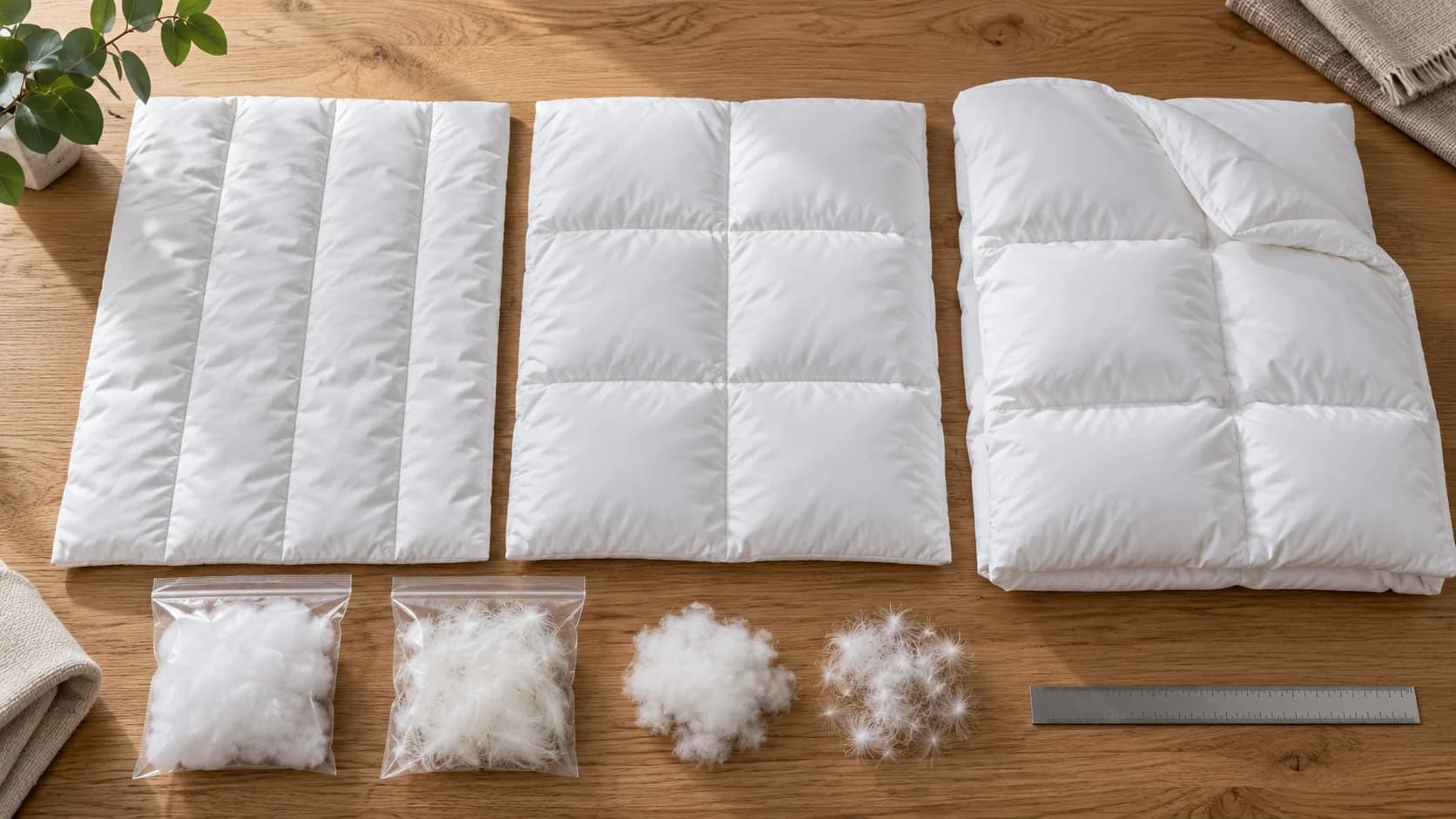
A down route needs declared composition, fill-power method, fill weight per size, shell specification, downproofness question and a chamber plan that can hold the intended loft. A synthetic route needs the fibre description and structure, fill-only GSM or total fill weight, distribution method, shell and intended care route. A lightweight summer quilt may be sold by finished weight, but the quotation still needs to separate shell, filling and finished assembly. Baffle-box, cassette, channel and sewn-through layouts change distribution and potential cold seams; specify the drawing or sampled layout instead of assuming a construction from a photograph.

Use a test method only for the claim it supports
ISO 11092:2026 covers steady-state measurement of thermal and water-vapour resistance for textiles and multilayer assemblies, including quilts; a buyer should still confirm that the selected method and apparatus suit the intended finished product. IDFL lists separate tests for fill power, content, fill weight, downproofness, air permeability, size and other properties. That separation is useful procurement discipline: a fill-power report does not establish finished tog, an OEKO-TEX label does not establish warmth, and a visual sample does not establish any laboratory value. Tie every requested report to the exact material or finished sample, method, date and decision it is meant to support.
Copy this duvet warmth RFQ block
| RFQ section | Paste and complete |
|---|---|
| Buyer and use | Company/project: [ ]; market/channel/property: [ ]; season: [ ]; room or climate context: [ ]; target feel: [ ] |
| Article | Duvet/comforter/quilt: [ ]; buyer SKU/revision: [ ]; finished sizes: [ ]; cover compatibility: [ ] |
| Fill | Material: [ ]; composition/ratio: [ ]; fill-power method/value if down: [ ]; fill-only GSM or fill grams per size: [ ]; tolerance: [ ] |
| Shell and construction | Fibre/construction: [ ]; finished weight if relevant: [ ]; down/fibre-proof question: [ ]; chamber/quilt layout: [ ]; edge/corner details: [ ] |
| Warmth claim | Finished tog/thermal resistance required: [ ]; method: [ ]; specimen: [ ]; acceptance question: [ ]; claim market/language: [ ] |
| Care and evidence | Intended care route: [ ]; sample checks: [ ]; requested reports and exact scope: [ ]; label/claim owner: [ ] |
| Variants and quantity | Colour × size lines attached: [ ]; quantity each: [ ]; BeddingTextilePro minimum 100 sets per colour × size, no pooling |
| Quotation and sample | Currency/basis/named place: [ ]; sample type/version: [ ]; supplier assumptions, alternatives and exclusions: [ ] |
From warmth need to approved quotation
- 01
1 · Define the use
Name market, season, room context and the intended weight/feel direction.
- 02
2 · Choose the metric
Use fill power for down loft, GSM for a stated mass basis, and tog only for finished thermal resistance.
- 03
3 · Calculate each size
Turn fill GSM into fill grams by size and require the supplier to confirm the basis.
- 04
4 · Lock construction
Record fill, shell, chamber layout, tolerance, care and claim fields.
- 05
5 · Review a sample
Connect the physical sample and any test evidence to the same SKU and revision.
- 06
6 · Compare exceptions
Compare like-for-like quotations before approving a variant or bulk route.
Send the completed matrix to the right commercial route
Use the private-label bedding page for a branded duvet programme or the hotel-linen page for a property specification, then attach the completed matrix. The published down duvet and cooling summer quilts are real related product entries and useful starting points, but they do not prove that a pictured item matches a new warmth brief. Ask for the exact article, fill basis, dimensions, construction, sample and evidence scope to be confirmed in the quotation.
Frequently asked questions
- Can fill power, GSM and tog be converted directly?
- No. Fill power measures down loft, GSM measures mass per area, and tog measures finished thermal resistance. They can sit in one specification, but no universal direct conversion is valid across fills and constructions.
- What should a buyer specify for a down duvet?
- Specify the down and feather composition, fill-power test method and target, fill weight for every size, shell, chamber construction, finished dimensions, tolerances, sample identity and any finished thermal test required.
- How do I calculate duvet fill weight from GSM?
- Multiply the finished filled area in square metres by the fill-only GSM. Record the result as planned fill grams per size and ask the supplier to confirm the actual target and tolerance. The calculation does not determine tog.
- Should the RFQ use fill-only GSM or total-product GSM?
- State which basis you require. Fill-only GSM supports a fill calculation; total-product GSM includes the shell and other components. If the basis is not written, two quotations may look equal while describing different products.
- What should a sample approval record for duvet warmth?
- Record SKU and revision, size, fill identity and mass, shell, chamber layout, finished weight, care route, claimed metric, test/sample link, open exceptions and the buyer's accept, revise or reject decision.
Sources & references
Featured products
Shop by category
Explore our services
Sourcing bedding for your market?
Factory-direct quotes, 100-set minimum per color and size combination, full OEM/ODM customization. We reply within one business day.