TL:DR
Choose a duvet fill system by the use case, care route, permitted claims and evidence—not by a generic ‘best fill’ ranking. Down-rich fills need composition, species/claim, fill-power method and fill weight; feather-rich blends need exact content, quill-management and shell questions; synthetics need fibre structure and fill mass. Lock the shell, chamber plan, label market, sample identity and evidence scope in one comparison brief.
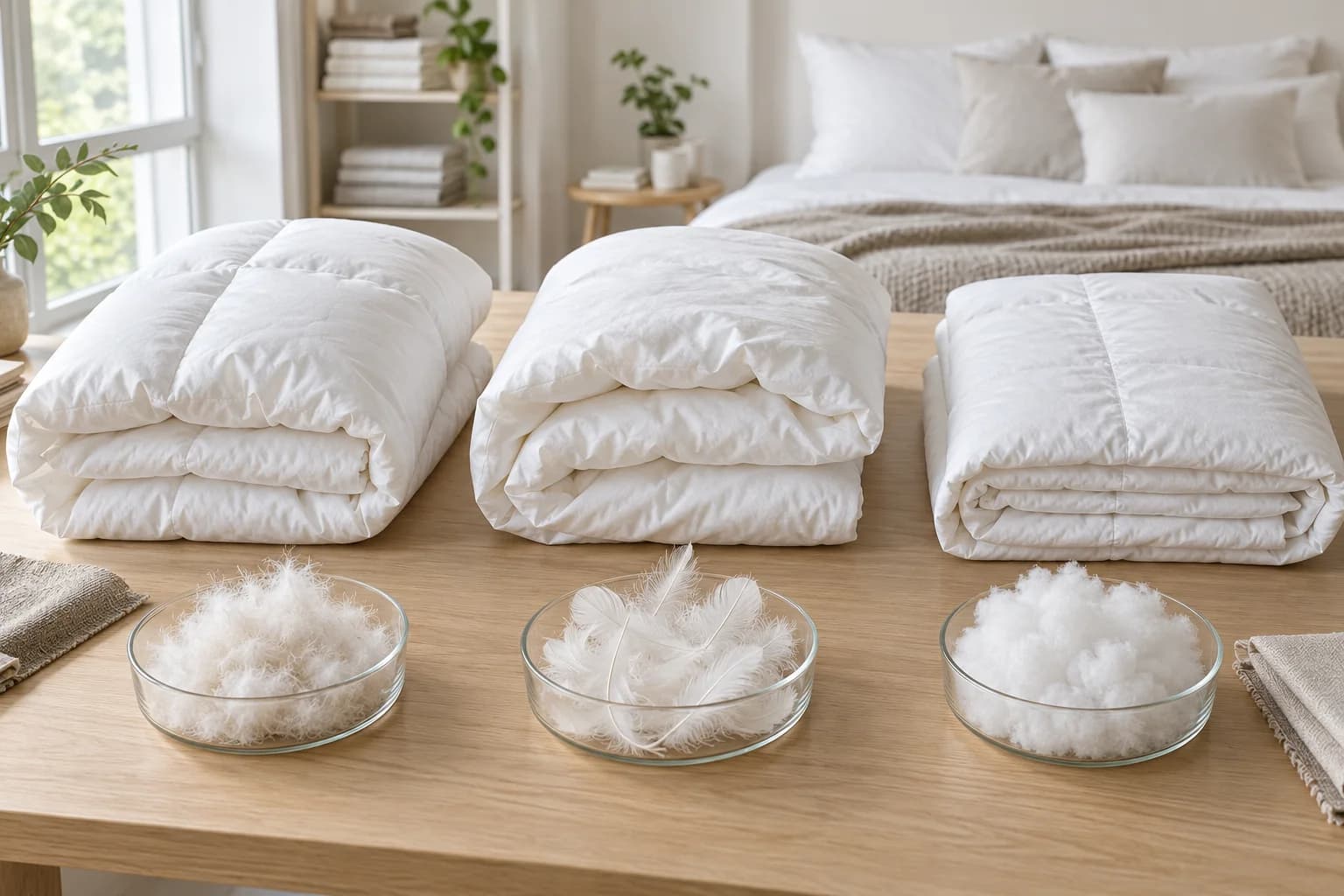
A buyer-side decision matrix for choosing a duvet fill route and sending every supplier the same evidence, construction and sample questions.
Choose down, a feather-rich blend or down-alternative only after you define the room, user, care route, label market and evidence the programme can support. Down can deliver high loft at low mass, feather changes feel and cost but introduces quill-management questions, and synthetic systems offer a different care and claim route. None is automatically the best. Put composition, mass by size, shell, chamber plan, sample identity and required evidence into one brief, then compare suppliers against the same version.
Start with the decision, not a material ranking
| Fill route | Buyer reason to consider it | Fields that control the offer | Evidence or risk question |
|---|---|---|---|
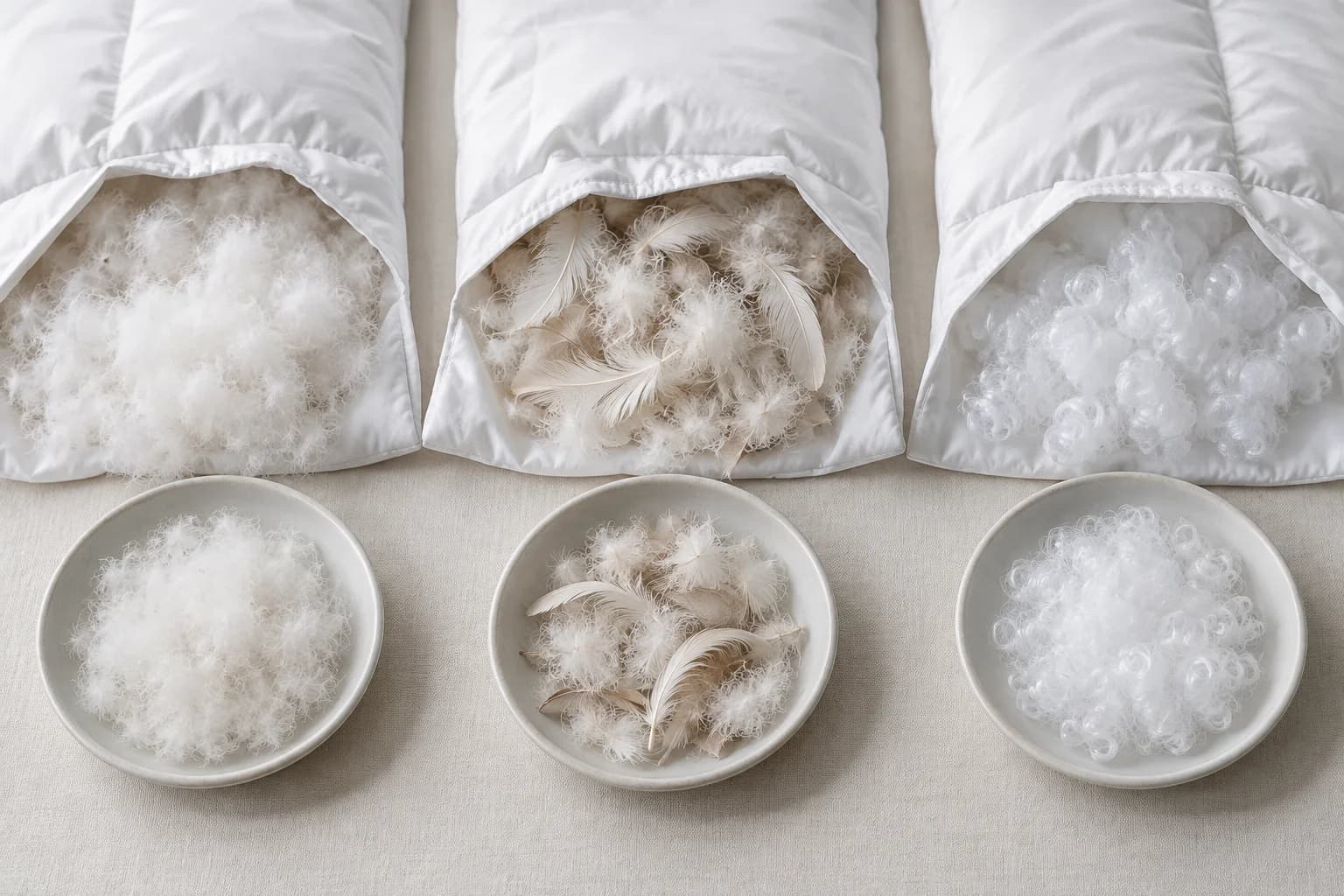
| Down-rich | Low-mass loft and a down-led product proposition | Declared composition, species/claim, fill-power method, fill grams by size, shell and chamber layout | Does each report cover the same material or sample and the destination label claim? |
| Feather-rich blend | More structured hand or a different cost/feel balance | Exact down/feather content, fill grams, feather size/content method, shell and quill containment | Will the shell and construction manage migration without implying a result before sampling? |
| Down-alternative | Animal-free positioning or a synthetic care and sourcing route | Fibre type/structure, fill-only GSM or grams by size, distribution, shell and intended care | Is the fibre description specific enough to repeat, and which claim is actually supported? |
Keep the choice separate from the warmth specification. The companion fill-power, GSM and tog guide explains how to state loft, mass and finished thermal resistance. This page owns a different task: deciding which fill family fits the programme and which material, claim and construction fields must accompany the quotation. A buyer can select a down-alternative route and still need a precise fill-mass and warmth brief; choosing down does not make fill power alone a finished-duvet specification.
Translate the market claim into evidence fields
For U.S. advertising, FTC materials require feather-and-down filling claims to be truthful, non-deceptive and substantiated; the precise wording and percentage claim must match the evidence used for that market. That is a claims issue, not a universal product recipe. IDFL lists composition, species, fill power, fill weight, cleanliness, downproofness, air permeability and size as separate tests. Ask for the report that supports the exact decision; one result should not be stretched across unrelated claims.
The Responsible Down Standard is a voluntary animal-welfare and chain-of-custody standard. It does not establish fill composition, warmth, downproofness or finished-product durability. If an RDS-related product claim is required, record the certified organisation, supply-chain route, claim wording, approval responsibility and current Textile Exchange claims requirements. If the programme does not require that claim, do not add it merely as decorative language.
| Proposed claim or decision | Buyer records | Supplier returns | Do not infer |
|---|---|---|---|
| Down content label | Destination, exact wording and percentage if used | Applicable composition method, specimen identity and report scope | Warmth, species or ethical sourcing |
| Goose or duck claim | Species wording and market | Species evidence tied to the same fill lot/sample | Higher warmth or quality from species name alone |
| RDS-related claim | Claim owner, certified route and approval step | Current certification/transaction evidence appropriate to the route | Composition, thermal or chemical performance |
| Fill power | Method and minimum value if relevant | Conditioning/method, sample identity and result | Total warmth without fill mass and construction |
| Synthetic description | Fibre family and permitted consumer wording | Repeatable fibre specification and sample reference | Hypoallergenic, vegan or wash performance without support |
Control shell and construction with the fill
A fill quotation is incomplete without the containing system. Record shell fibre and construction, finished dimensions and tolerances, seam and edge details, chamber or quilting drawing, corner tabs, fill distribution and the intended care route. Down and feather programmes should include a downproofness or migration question appropriate to the exact shell and construction; synthetic routes need a distribution and recovery question suited to the selected fibre structure. Do not borrow a performance claim from a different shell, sample or fill.
Compare samples against the same use case
Issue one base brief and allow alternatives on separate lines. Give each sample an ID and revision; record finished size and weight, fill mass, distribution, shell hand, noise, visible migration, stitching, odour observations, care review and exceptions. These are sample observations, not universal material claims. If a laboratory report is required, connect it to the exact specimen and decision. Preserve the approved reference and the signed deviation list before bulk approval.
| Sample check | Sample A | Sample B | Decision / follow-up |
|---|---|---|---|
| Fill route and declared composition | [ ] | [ ] | [accept / evidence gap / revise] |
| Finished size, weight and fill mass | [ ] | [ ] | [ ] |
| Shell and chamber revision | [ ] | [ ] | [ ] |
| Distribution, hand, noise and visible migration | [ ] | [ ] | [ ] |
| Care route and label/claim review | [ ] | [ ] | [ ] |
| Reports tied to this specimen | [ ] | [ ] | [ ] |
| Open deviations and owner | [ ] | [ ] | [ ] |
Copy this duvet fill decision brief
| RFQ section | Paste and complete |
|---|---|
| Programme | Buyer/project: [ ]; destination/channel/property: [ ]; use/room: [ ]; target user: [ ]; care route: [ ] |
| Fill route | Down-rich / feather-rich / down-alternative: [ ]; reason: [ ]; permitted alternative: [ ] |
| Material | Composition/fibre structure: [ ]; species/claim if used: [ ]; fill-power method/value if used: [ ]; fill grams or fill-only GSM by size: [ ]; tolerance: [ ] |
| Article | Finished sizes: [ ]; shell: [ ]; chamber/quilt drawing revision: [ ]; seams/edges/tabs: [ ]; finished-weight field: [ ] |
| Claims and evidence | Market/language: [ ]; exact claim: [ ]; report/certification needed: [ ]; specimen/lot link: [ ]; approver: [ ]; expiry/current-status check: [ ] |
| Sample comparison | Sample ID/revision: [ ]; checks: [ ]; reports: [ ]; deviations: [ ]; retained reference: [ ] |
| Variants and quantity | Colour × size rows attached: [ ]; quantity each: [ ]; BeddingTextilePro minimum 100 sets per colour × size, no pooling across combinations |
| Quotation response | Currency/Incoterm/named place: [ ]; base offer: [ ]; alternatives separate: [ ]; assumptions/exclusions: [ ]; sample and bulk timing to be quoted: [ ] |
From use case to controlled fill approval
- 01
1 · Define the programme
Name destination, channel or property, room/use, care route and permitted claims.
- 02
2 · Select the fill route
Choose down-rich, feather-rich or synthetic for the actual programme—not a generic ranking.
- 03
3 · Lock material fields
Write composition or fibre structure, mass by size, shell and chamber revision.
- 04
4 · Map evidence
Tie every label or certification request to its market, specimen and decision.
- 05
5 · Compare samples
Use identical checks, identify deviations and retain the approved reference.
- 06
6 · Quote the matrix
Return every colour × size combination separately and keep alternatives visible.
Send the brief to the right commercial route
Use the hotel-linen route for a property or project programme, or private-label bedding for a branded range, and attach the completed fill brief. The published down-duvet and cooling-quilt pages are real related product routes, but their images and descriptions do not prove a new composition, care result or programme claim. Ask the quotation to confirm the exact article, evidence scope, sample version and every colour × size line.
Frequently asked questions
- Is down always better than feather or down-alternative?
- No. The suitable route depends on use, care, feel, label market, evidence and construction. Compare all candidates against one written programme rather than a universal ranking.
- Which fields belong in a down or feather duvet RFQ?
- Record exact composition, species or claim if used, fill-power method/value when relevant, fill grams by size, shell, chamber plan, finished dimensions, care route, evidence scope and sample revision.
- Does RDS prove duvet warmth or down content?
- No. RDS addresses animal welfare and chain of custody. Composition, species, fill power, fill weight, downproofness and thermal performance are separate decisions and may require separate evidence.
- How should a buyer compare down-alternative fills?
- Specify the fibre family and structure, fill-only GSM or grams by size, distribution method, shell, quilting, intended care and sample checks. Do not rely on a generic microfiber label.
- Can one supplier sample support every future duvet order?
- No. Limit approval to the named SKU, specification revision, fill, shell, construction and sample identity. Record deviations and reapprove when a controlled field changes.
Sources & references
- 1.U.S. FTC — Down…But Not Out: Advertising and Labeling of Feather and Down Products
- 2.IDFL — Tests and Standards List
- 3.IDFL — Down and Feather Tests Explanation
- 4.Textile Exchange — Responsible Down Standard
- 5.Textile Exchange — Labeling Standards and Claims
- 6.Textile Exchange — Standards Policy Updates
Shop by category
Explore our services
Sourcing bedding for your market?
Factory-direct quotes, 100-set minimum per color and size combination, full OEM/ODM customization. We reply within one business day.