100 Sets / Style · Minimum OrderNo Retail · B2B Wholesale OnlyNantong Factory-Direct · No MiddlemanOEM / ODM · Full CustomizationEXW / FCA / CIP / DDP · FCL & LCL Shipping100 Sets / Style · Minimum OrderNo Retail · B2B Wholesale OnlyNantong Factory-Direct · No MiddlemanOEM / ODM · Full CustomizationEXW / FCA / CIP / DDP · FCL & LCL Shipping
BeddingTextilePro

Fabric Guide

21S Coarse Yarn Explained: Thick Cotton, Sparse Weave, Heavy Cloth

Mr. Jason Wang·

In short

A 21S yarn is coarse cotton yarn: 21 hanks of 840 yards weigh one pound, making it far thicker than 40S or 60S. Woven with sparse warp and weft, 21S produces a heavy, textured, hard-wearing cloth suited to budget bedding, workwear-grade textiles and rustic washed looks.

A 21S yarn is very thick cotton yarn, and when it is woven with sparse warp and weft the result is a heavy, textured, hard-wearing cloth. That combination — coarse yarn plus low density — is exactly why 21S sits at the value end of the bedding range and why it behaves nothing like a 40S percale.

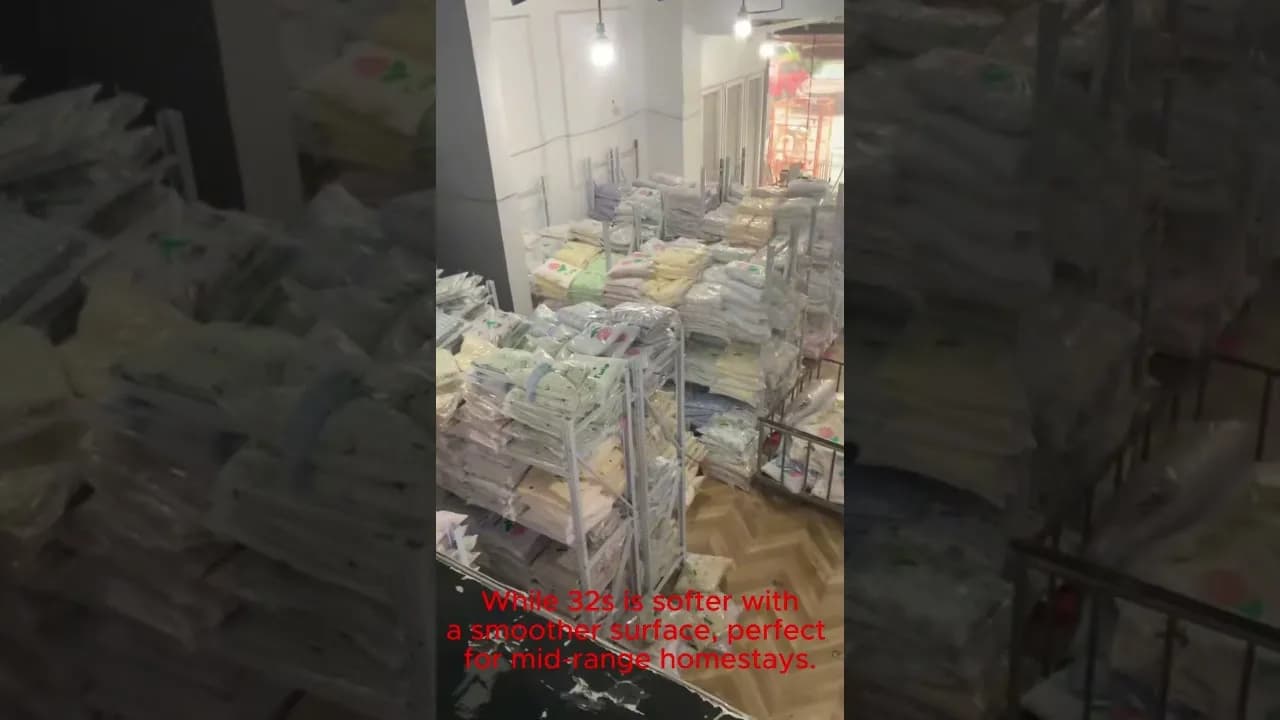
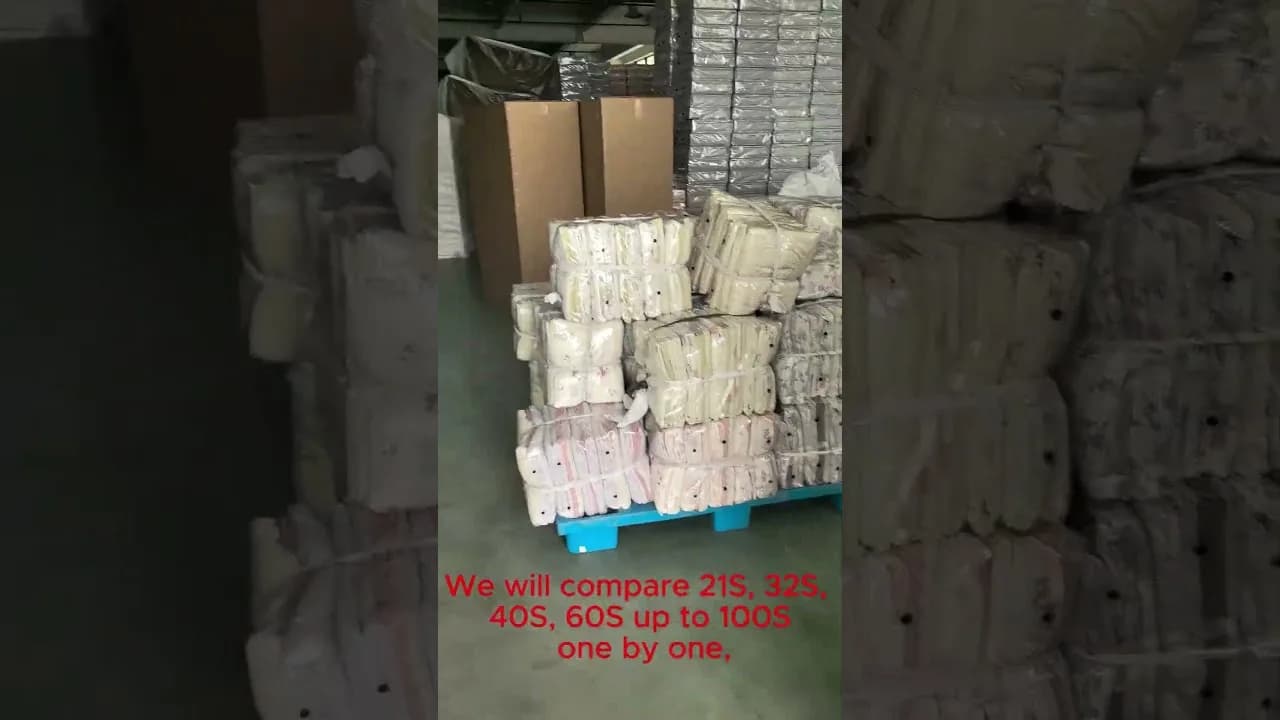
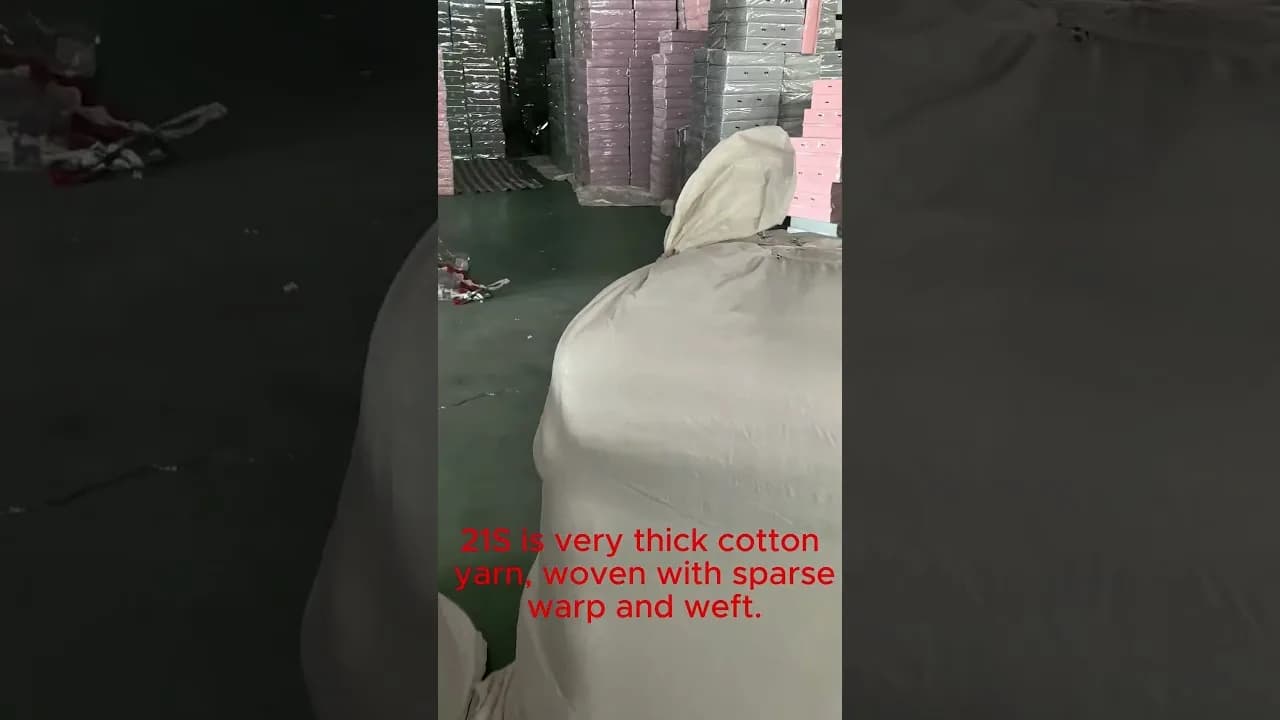
A 21S yarn is very thick cotton yarn: it takes only 21 hanks of 840 yards to weigh one pound, so each strand carries a lot of mass per unit length. Woven with sparse warp and weft — comparatively few threads per inch in both directions — it produces a heavy, open, visibly textured cloth with high abrasion resistance and a low price per metre. The bales of undyed greige fabric shown in this video are the raw output of exactly that process, before dyeing, printing or finishing.

What makes 21S a coarse yarn?

Coarse yarn is yarn with a low English cotton count, meaning high mass per unit length. Because Ne is an indirect system — the number of 840-yard hanks per pound — a low count number means fewer, heavier hanks and therefore a thicker strand. At 21S, one pound of yarn stretches to roughly 17,640 yards. The same pound spun at 40S reaches about 33,600 yards, and at 60S about 50,400. That is the whole story of coarseness expressed arithmetically: a 21S strand is close to twice the thickness of a 40S strand.

Coarseness is a spinning outcome, not a defect. Short and irregular cotton fibres that could never hold together in a fine yarn are perfectly serviceable at 21S, and the combing step that Wikipedia's textile manufacturing article describes as removing shorter fibres to create a stronger yarn can usually be skipped. Fewer processing steps, less fibre waste, faster spinning — the cost advantage is structural, not a discount.

Why sparse warp and weft matters as much as the yarn

Warp is the lengthwise thread system on the loom and weft is the crosswise one, counted as ends and picks per inch. A thick yarn physically occupies more of the reed, so fewer ends and picks fit into each inch — a coarse yarn forces a sparse construction whether or not the mill intends one. This is why you will never see a genuine 21S fabric carrying a 300TC label: the geometry forbids it.

The visible consequence is a distinct open grain — you can see the interlacing at arm's length. Buyers who want that rustic, stonewashed, artisanal look are buying the sparseness deliberately. Buyers expecting a smooth sheeted surface will read the same cloth as cheap. Nothing about the fabric changed; the brief did. Our guide thread count truth bedding quality guide explains why the raw TC number tells you so little without the yarn count beside it.

21S vs 40S vs 60S: a direct comparison

Attribute21S coarse40S standard60S fine
Yarn thicknessVery thick — ≈17,640 yd per lbMedium — ≈33,600 yd per lbFine — ≈50,400 yd per lb
Typical warp/weft densitySparse — low ends and picks per inchMedium — e.g. 133 x 72 constructionsDense — supports 300TC–400TC
Fabric weight (indicative)≈150–200 g/m² — heaviest≈110–140 g/m²≈100–130 g/m² but denser hand
Hand-feelDry, textured, rustic; softens with washingSmooth with body; crisp percaleSoft, fluid, cool; sateen drape
Wear lifeHighest — thick yarn resists abrasionHigh — the durability benchmarkMedium-high; finer singles abrade sooner
Fibre requirementShort-staple, carded, combing optionalCarded or combedLong-staple, combed effectively mandatory
Where it belongsValue bedding, rustic washed ranges, heavy coversHotel linen, mainstream retail programmesPremium sateen and private-label retail
21S is roughly twice as thick as 40S and nearly three times as thick as 60S, which is why it must be woven sparsely and why it produces the heaviest, most durable and least expensive cloth of the three.

Weight figures above are indicative and shift with construction, finishing and shrinkage allowance. Yardage per pound is derived directly from the 840-yard hank definition and is arithmetic, not an estimate.

Reading a 21S greige fabric spec

Greige fabric is cloth straight off the loom, before bleaching, dyeing, printing or finishing — the undyed bales in the footage. Wikipedia's textile manufacturing entry notes that fresh off the loom cotton fabric still contains impurities including warp size and needs further treatment to develop its full potential. Greige weight is therefore not finished weight, and any GSM figure quoted at this stage needs its state declared. Our post what is GSM in bedding covers how finishing moves that number.

Spec fieldWhat to requireWhy it matters
Yarn count, warp and weftState both, e.g. 21S x 21SMills sometimes run a finer weft to cut cost while the label still says 21S
PlySingle or plied, stated explicitly21S/2 is a completely different, far heavier cloth
Density (ends x picks)e.g. 60 x 60 per inch, tolerance statedSparseness is the defining variable at coarse counts
Width and stateGreige or finished, cuttable widthGreige weight and width are not finished weight and width
Finished GSMTarget plus agreed toleranceThe single most reliable field check on a coarse cloth
ShrinkageWashed shrinkage percentage, both directionsCoarse open constructions move more in the first wash
On a 21S order the density and finished GSM fields carry more risk than the yarn count itself, because a sparser weave is the easiest undeclared cost saving to make.

Where 21S genuinely belongs — and where it does not

  • Belongs: rustic and stonewashed bedding ranges where visible grain is the design language.
  • Belongs: heavy-duty mattress covers, protectors and back-of-house textiles where abrasion resistance beats hand-feel.
  • Belongs: high-volume value bedding programmes with a hard landed-cost ceiling.
  • Does not belong: four-star and above hotel bed linen, where guests read texture as wear — see our hotel linen page for the constructions that survive commercial laundry and still feel right.
  • Does not belong: premium private-label retail sold on softness; our private label bedding page starts at 40S and moves up.
  • Does not belong: any programme quoting 300TC or higher — the count and the claim are incompatible.

How to verify the 21S goods you were actually shipped

Bulk verification for a coarse-yarn order

  1. 01

    1 · Cut a measured square from the roll

    Take a 10 x 10 cm cut from an inner layer, not the outer wrap. Outer layers are the most likely to be representative of nothing.

  2. 02

    2 · Weigh it and scale to GSM

    Multiply the gram weight by 100 for a 10 x 10 cm cut. Compare against the approved finished GSM and its agreed tolerance — this catches most substitutions on its own.

  3. 03

    3 · Count ends and picks under a pick glass

    Count warp ends and weft picks per inch in three separate places. A density below the contracted figure is the classic undeclared saving on a coarse construction.

  4. 04

    4 · Compare against the sealed reference swatch

    Hold the cut against the signed approval swatch for hand-feel, grain openness and shade. Both parties should hold an identical sealed sample.

  5. 05

    5 · Wash-test for shrinkage and grain shift

    Run one set through the specified wash cycle and re-measure. Sparse constructions move most in the first cycle, and this is where a downgraded yarn shows up.

  6. 06

    6 · Escalate to lab testing only if the file disagrees

    If GSM, density and hand-feel all deviate together, request an accredited count determination before accepting the lot. Keep the whole file attached to the SKU record.

At 21S nobody can feel a two-count difference by hand. Weigh the cloth and count the threads — the scale and the pick glass settle arguments that opinions never will.

Moving up from 21S: what the next step buys you

The step from 21S to 32S or 40S is the largest single upgrade in perceived quality per unit of cost in cotton bedding. You gain a smoother surface, a denser weave and a much wider printing window, while retaining most of the durability. The classic reference point is the 133 x 72 construction in 40S — dense enough to print cleanly, robust enough for commercial laundry, and priced for volume. Our posts 13372 high density cotton explained and bedding yarn count explained 40S 60S 80S map that ladder in full.

Sourcing coarse and standard-count cotton bedding

BeddingTextilePro is a trading company running a source-factory-direct supply model out of Nantong, China. We hold locked, dedicated production lines at large-scale Nantong mills and place our own in-line QC on those lines, and finished goods ship direct from the mill — mill pricing, no middleman markup, and a construction we can document at every stage from greige to packed set. MOQ is 100 sets, OEM and ODM cover coarse 21S value ranges through to fine combed programmes, OEKO-TEX documentation is supported where a market requires it, and quotations come back within one business day. Send the count, ply, density and target GSM and we will confirm what the line can hold before anything is committed.

The short version

21S is thick cotton yarn at 21 hanks of 840 yards per pound, and it can only be woven sparsely. That gives a heavy, textured, hard-wearing, inexpensive cloth that is right for rustic and value programmes and wrong for premium sateen. Specify the density and finished GSM as tightly as the count itself, verify with a scale and a pick glass at bulk, and 21S is a dependable, well-behaved fabric rather than a compromise.

Frequently asked questions

What does 21S mean in cotton fabric?
21S is an English cotton count: 21 hanks of 840 yards of that yarn weigh one pound, so one pound stretches to about 17,640 yards. Because the count system is indirect, the low number signals a thick, coarse yarn. In bedding, 21S produces a heavy, textured, open-grain cloth with strong abrasion resistance, and it sits at the value end of the cotton range.
Is 21S cotton good quality?
It is good quality for the jobs it suits and poor for others. 21S delivers the highest durability and lowest cost of the common bedding counts, and it is the right choice for rustic washed ranges, heavy covers and value programmes. It is the wrong choice where softness or a high thread count is the selling point, because a coarse yarn physically cannot be woven densely enough.
Why does 21S fabric feel rough?
Two reasons compound. The yarn itself is thick, so the surface texture is coarser to the touch, and it is usually spun from shorter carded fibres without the combing step used for fine counts. The weave is also sparse, so the interlacing is more pronounced. Most of the roughness eases after several washes as the fibres relax, which is why washed and enzyme finishes are common on 21S ranges.
What thread count can you achieve with 21S yarn?
Realistically a low one. A thick yarn occupies more of the reed, so fewer warp ends and weft picks fit into each inch — the geometry sets the ceiling, not the mill. Coarse 21S constructions land far below the densities that 60S or 80S yarn supports. Any 21S fabric marketed with a high thread count is either counting plies as separate threads or misstating the yarn count.
What is greige fabric and why does it matter on a 21S order?
Greige fabric is cloth as it comes off the loom, before bleaching, dyeing, printing or finishing, and it still contains impurities including warp size. Its weight and width are not the finished weight and width. On a coarse 21S order this matters because finishing and washing move both figures noticeably, so every GSM and width figure on the specification must state whether it is greige or finished.
#21S coarse yarn#coarse cotton yarn bedding#greige fabric#warp and weft density#heavy cotton bedding fabric#wholesale bedding fabric spec

Sourcing bedding for your market?

Factory-direct quotes, 100-set MOQ, full OEM/ODM customization. We reply within one business day.
More videos

All videos