TL:DR
These four terms are not standardised, and suppliers use them inconsistently. In bedding, white label means buying a stock set and adding your label; private label means an exclusive spec built for you; OEM means the factory sews to your design; ODM means you adapt the mill's existing design. Define them in your contract.
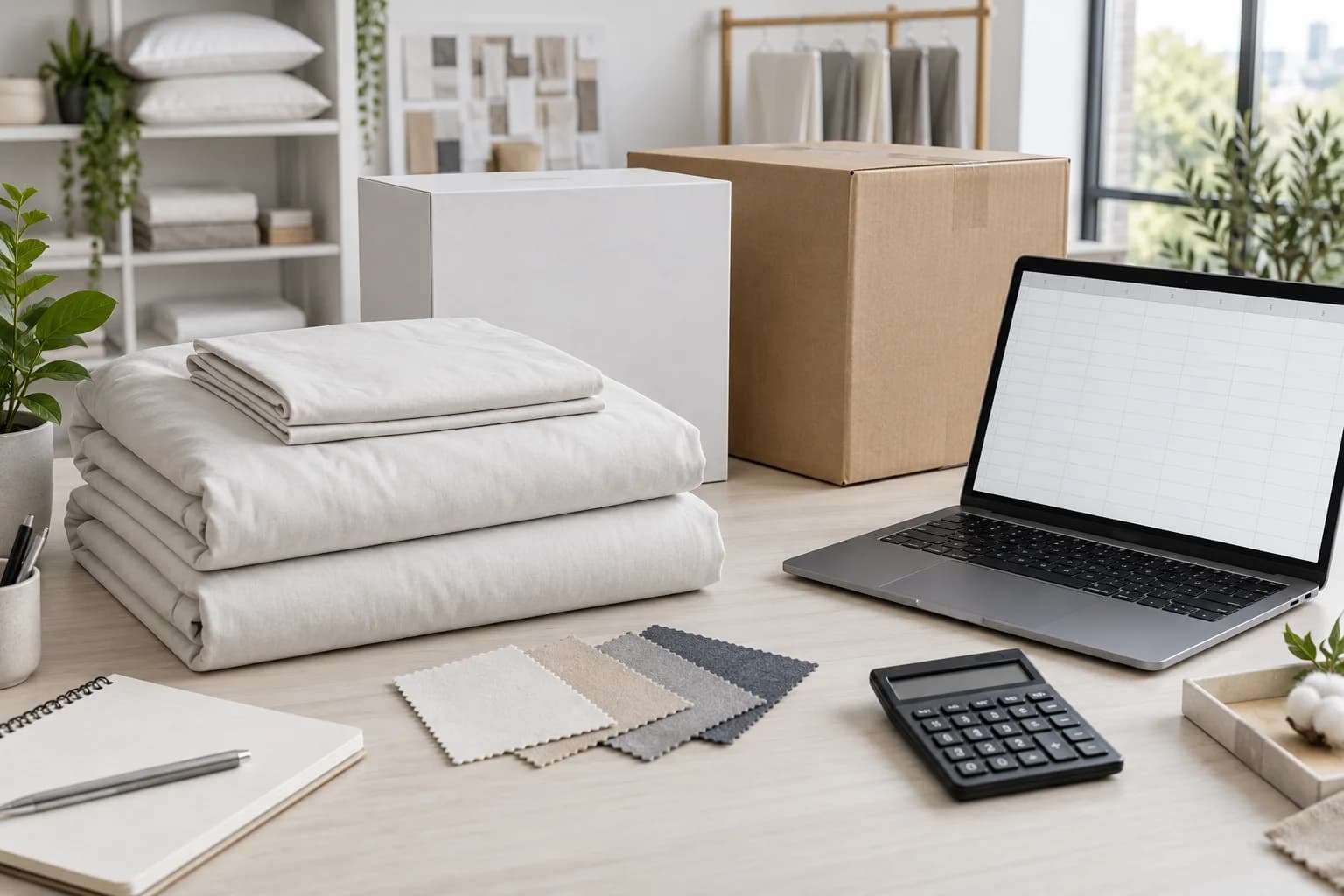
Ask three bedding suppliers what OEM means and you will get three answers — Wikipedia's own entry calls the term ambiguous. Here is what changes in a real bedding order under each model, and the contract language that stops the disagreement before it starts.
Start with the uncomfortable part: these four terms have no agreed definition. Wikipedia's own entry on OEM opens by calling the term ambiguous and lists four incompatible common meanings, and in practice a supplier in Nantong, a buyer in Rotterdam and a marketplace listing in Texas may each use "private label" for something different. So the useful question is not which definition is correct. It is which of four concrete things you are actually buying — and whether that is written down. This guide sets out how the terms are most commonly used in bedding, what genuinely changes in the order under each, and the contract wording that prevents the argument.
Why the four terms contradict each other
The terms come from different places. OEM and ODM originate in electronics and describe who did the engineering. White label and private label come from retail and describe whose brand appears on the shelf. They were never designed to form a single scale, which is why they overlap awkwardly when borrowed into textiles. Wikipedia treats white label and private label as near-interchangeable in general usage, while in sourcing conversations they usually carry a sharp practical distinction around exclusivity.
One reliable dividing line survives the confusion, and it is worth holding onto: OEM and ODM describe who designed the product, while white label and private label describe whose brand is on it. A private-label range can be produced under an OEM or an ODM arrangement. They are two different axes, not four points on one line.
Do not negotiate the label on the model. Negotiate the four things the model is shorthand for: who designs it, who owns that design, whether anyone else can buy it, and whose name is on the sewn-in label.
The four models, side by side
| White label | Private label | OEM | ODM | |
|---|---|---|---|---|
| Who designs the product | Supplier | Buyer specifies, supplier engineers | Buyer | Supplier, adapted for buyer |
| Who owns the design | Supplier | Usually the buyer, if contracted | Buyer | Supplier |
| Can a competitor buy the same product | Yes | No | No | Often yes |
| Typical bedding example | Stock 200TC white sateen set, your label sewn in | Your GSM, weave and size chart, made only for you | Your jacquard artwork woven to your tech pack | Mill's existing jacquard in your colourway |
| Development lead time | Days | Weeks | Longest | Short |
| Where margin comes from | Buying well | Exclusivity and spec | Differentiation | Speed to range |
What actually changes in a bedding order
Abstract definitions matter less than what lands in your inbox. The table below is the same four models expressed as the documents that change hands, which is the level at which misunderstandings actually surface.
| Model | What you send the supplier | What you get back | What you cannot control |
|---|---|---|---|
| White label | Your logo artwork and label file | An existing set with your label | Fabric, construction, sizes, who else stocks it |
| Private label | A specification: composition, GSM, size chart, packaging | A set built to your spec, exclusive to you | The mill's base capability and machinery limits |
| OEM | A full tech pack and design artwork | Your design, engineered and sewn to it | Lead time — development is genuinely slower |
| ODM | Colour direction and branding | The mill's design adapted for you | Design ownership and exclusivity |
The legal test: whose name goes on the label
There is one place where the distinction stops being a marketing word and becomes a legal obligation, and buyers routinely miss it. Under the US Textile Fiber Products Identification Act rules, a bedding label must identify the company marketing the product — by name or Registered Identification Number — alongside fibre content and country of origin. In the European Union, Regulation (EU) No 1007/2011 places responsibility for correct fibre-composition labelling on whoever places the product on the market.
Read those together and the consequence is clear. The moment your brand is on the label, the accuracy of that label is your exposure, not the mill's — regardless of which of these four models produced the goods. Under white label especially, where you did not choose the fabric, you are still the party answering for the composition claim. That is a strong argument for verifying fibre content against the actual bulk lot rather than accepting the supplier's product sheet, whichever model you buy under.
How to choose
Picking the model for your situation
- 01
1. Do you have proven demand?
No — start white label or ODM and buy real sell-through data cheaply. Yes — the exclusivity of private label or OEM is what protects the margin you have found.
- 02
2. Can a competitor list your exact product?
If that would damage you, you need exclusivity in writing. Exclusivity is a contract term, not a consequence of the word you used for the model.
- 03
3. Do you have a design worth protecting?
An original jacquard or print justifies OEM and the tech-pack work it requires. A colour preference does not — that is ODM territory.
- 04
4. What is your real lead time?
OEM development runs weeks longer than adapting an existing design. If your season is already tight, ODM this round and OEM the next is usually the better sequence.
- 05
5. Write the definitions down
State in the purchase agreement who owns the design, whether the spec is exclusive, and for how long. The word you use matters far less than the clause.
Contract language that prevents the argument
- Name the deliverable, not the model: "the specification set out in Annex A" beats "private label".
- State design ownership explicitly, including who owns artwork the supplier developed at your request and paid for.
- Define exclusivity with a scope and a term — exclusive to which markets, for how long, and does it survive a reorder gap.
- Require the fibre composition to be confirmed against the bulk lot, not the sample, before labels are sewn in.
- Agree who supplies and approves label artwork, and who bears the cost if a label is legally non-compliant.
- Record the sealed counter sample as the quality reference, and keep your half of it.
None of this requires agreeing on vocabulary with your supplier. It requires making the vocabulary irrelevant. If the four clauses above are in the agreement, it does not matter whether the pro forma invoice says OEM, ODM, private label or white label — the obligations are unambiguous either way, and that is the only outcome worth negotiating for.
BeddingTextilePro is a Nantong B2B supplier of bedding sets, summer quilts and hotel linen on source-factory direct supply — locked, dedicated production lines at large-scale Nantong mills, goods shipping direct from the mill — with a 100-set minimum per color and size combination, full OEM/ODM customization and OEKO-TEX support. Request a wholesale quotation and our export team will reply within one business day.
Frequently asked questions
- Is private label the same as white label?
- In general usage they are often treated as interchangeable, and Wikipedia's articles reflect that overlap. In sourcing practice the distinction that matters is exclusivity: white label usually means an existing product that several buyers can put their own labels on, while private label usually means a specification built for one buyer and not sold to others. Because usage varies, put the exclusivity term in the contract rather than relying on the label.
- What is the difference between OEM and ODM in bedding?
- Under OEM you supply the design and tech pack and the mill produces to it, so the design is yours. Under ODM the mill already has the design and you adapt it — colourway, branding, packaging — which is faster and cheaper but normally leaves design ownership and exclusivity with the supplier unless you negotiate otherwise.
- Which model is cheapest to start with?
- White label, because there is no development cost and no tooling of any kind — you are buying an existing product and adding a label. ODM is the next step up. OEM carries the highest development cost because someone has to engineer your design into a manufacturable specification, and that work is real whether it is billed separately or built into the unit price.
- Do I own the design if I pay for the sampling?
- Not automatically. Paying a sampling charge is not the same as buying the intellectual property, and in ODM arrangements the supplier typically retains rights to its own base design unless they are expressly assigned. If design ownership matters to you, write it into the agreement before development starts rather than after.
- Who is legally responsible for the label under white label?
- You are, in both major markets. US textile labelling rules require the company marketing the product to be identified on the label, and EU Regulation 1007/2011 places responsibility for correct fibre-composition labelling on whoever places the product on the market. Buying an off-the-shelf product does not transfer that responsibility back to the supplier.
Sources & references
- 1.Wikipedia - Original equipment manufacturer (notes the term is ambiguous)
- 2.Wikipedia - Original design manufacturer
- 3.Wikipedia - Private label
- 4.Wikipedia - White-label product
- 5.Cornell LII - 16 CFR 303.1, definitions (including "beddings")
- 6.EUR-Lex - Summary: textile fibre names and labelling
- 7.USPTO - Trademark basics
Featured products
Shop by category
Explore our services
Sourcing bedding for your market?
Factory-direct quotes, 100-set minimum per color and size combination, full OEM/ODM customization. We reply within one business day.