TL:DR
Before placing a private-label bedding reorder, compare the new PO line by line with the last approved specification and retained sample. Confirm the finished SKU, fibre and construction, colour standard, dimensions, make-up, labels, packaging, quantity split and delivery basis. Record every proposed change, assess its product, compliance, barcode and supply-chain impact, and reopen sampling or artwork approval where needed. A previous approval does not automatically cover a changed product.

A repeat order is safe to release only after the current specification, retained sample, labels, packaging and commercial scope have been reconciled with the last approved version.
Direct answer: do not release a private-label bedding reorder by copying the previous PO number and quantity. Reconcile the proposed order with the last approved finished-SKU specification, retained sample, colour reference, label and packaging versions, then list every difference. Decide whether each difference is an administrative update, a controlled specification revision, or a product change that requires a new sample, artwork review, evidence check or GTIN decision before production.
What should a private-label bedding reorder checklist cover?
Use one change register for the finished article, not separate conversations for fabric, sewing and packaging. Compare the duvet cover, sheet, pillowcase, quilt or protector by component; verify exact dimensions, construction and make-up; then reconcile branding, unit pack, case pack, destination and commercial terms. A previous order is evidence of what was once approved, not proof that the same material, shade, process, lead time or result is available now.
| Reorder status | Typical example | Buyer action | Release condition |
|---|---|---|---|
| No intended change | Same approved SKU and document versions | Confirm availability and compare current sample/spec records | All governing fields and exceptions reconciled |
| Administrative update | New PO reference or requested delivery window | Update commercial record without altering product identity | Supplier confirms feasibility in the new quotation/PO |
| Controlled specification revision | Size split, closure, label position or case pack changes | Revise affected files and assess sample/artwork needs | New version approved by the named owner |
| Material or claim change | Fibre, construction, finish, colour route or product claim changes | Reopen technical and evidence review | Product-specific approval and evidence scope confirmed |
| Retail identity change | Brand, declared content, net content, pack assortment or major pack dimension changes | Review label, artwork and GTIN rules for the target market | Brand owner/importer confirms identity and compliance route |
Start with the last approved control pack
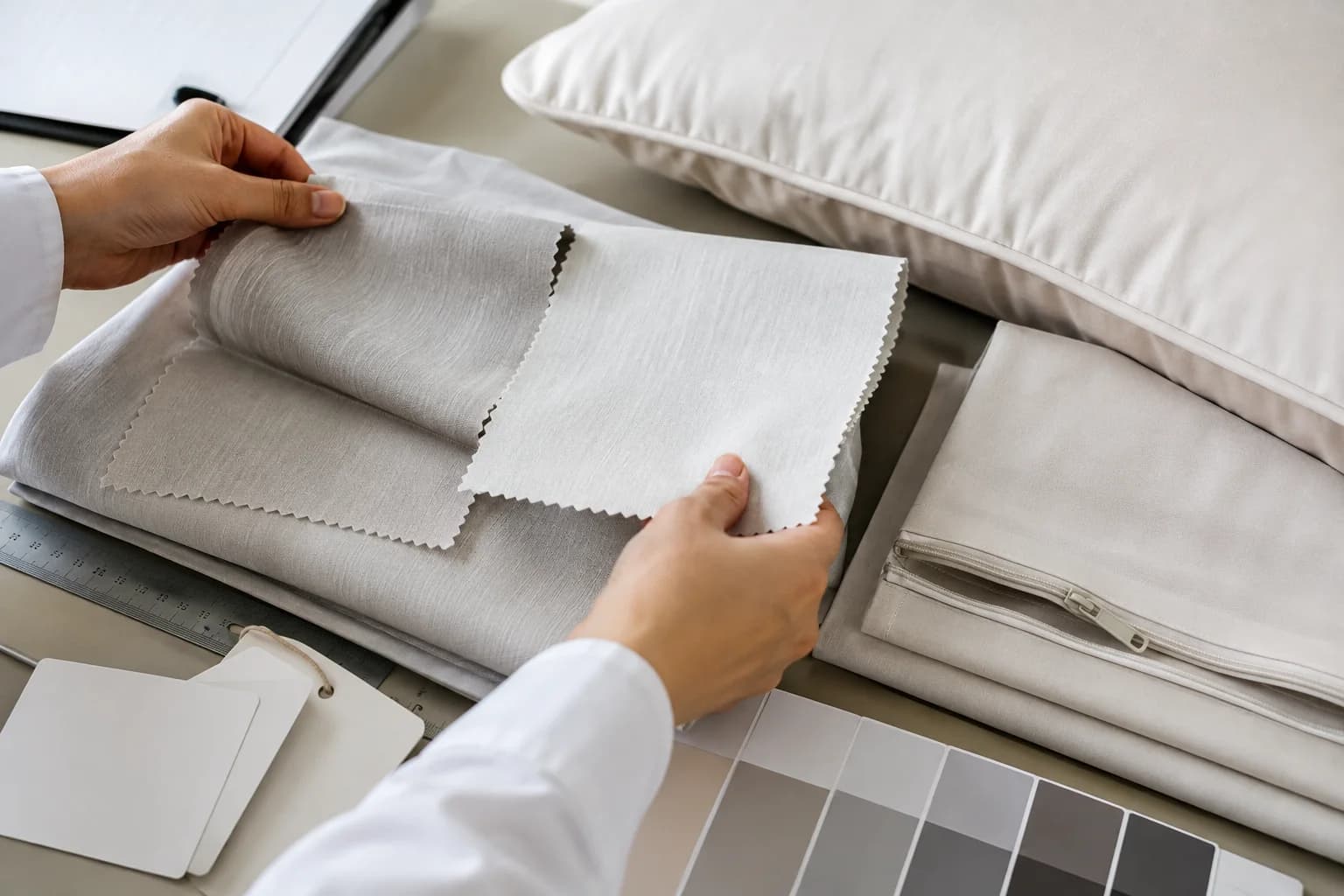
Assemble the signed specification or tech pack, retained sample ID, approved lab dip or print reference, packaging artwork version, label copy, GTIN/SKU master, last accepted PO and any agreed inspection or evidence scope. Mark which source governs each field. If records conflict, resolve the conflict before copying data into the new PO; do not let the newest email silently replace a controlled approval.
Compare the finished product, not one headline parameter
A matching yarn count, thread count or GSM does not establish that two finished fabrics will perform alike. Fibre, yarn, weave, density, GSM, finish and finished structure work together. Ask the supplier to identify any change in fibre source, yarn/construction, weaving or knitting route, dye or print route, finishing, cut-and-sew details and component suppliers. Where performance or a market claim matters, decide whether the revised finished SKU needs a new sample or appropriately scoped evidence; never invent a shrinkage, colourfastness or wash-life result.
| Control layer | Compare with approved version | Question if different |
|---|---|---|
| Finished SKU | Article, component set, sizes and design/style | Is this still the same sellable product? |
| Material | Fibre, construction, density/GSM where relevant and finish | Does the difference change hand feel, use, claims or evidence needs? |
| Make-up | Dimensions, tolerances, seams, hems, closures and trims | Is a new finished sample required? |
| Colour/artwork | Standard, print file, placement and version | Does a lab dip, strike-off or artwork approval reopen? |
| Labels and pack | Fibre/care copy, origin, brand, GTIN, unit pack and case pack | Does the market, product identity or logistics record change? |
| Commercial scope | Quantity by design/style and size, delivery basis and payment milestones | Has feasibility and price been reconfirmed for this order? |
When do labels, packaging or GTINs need another decision?
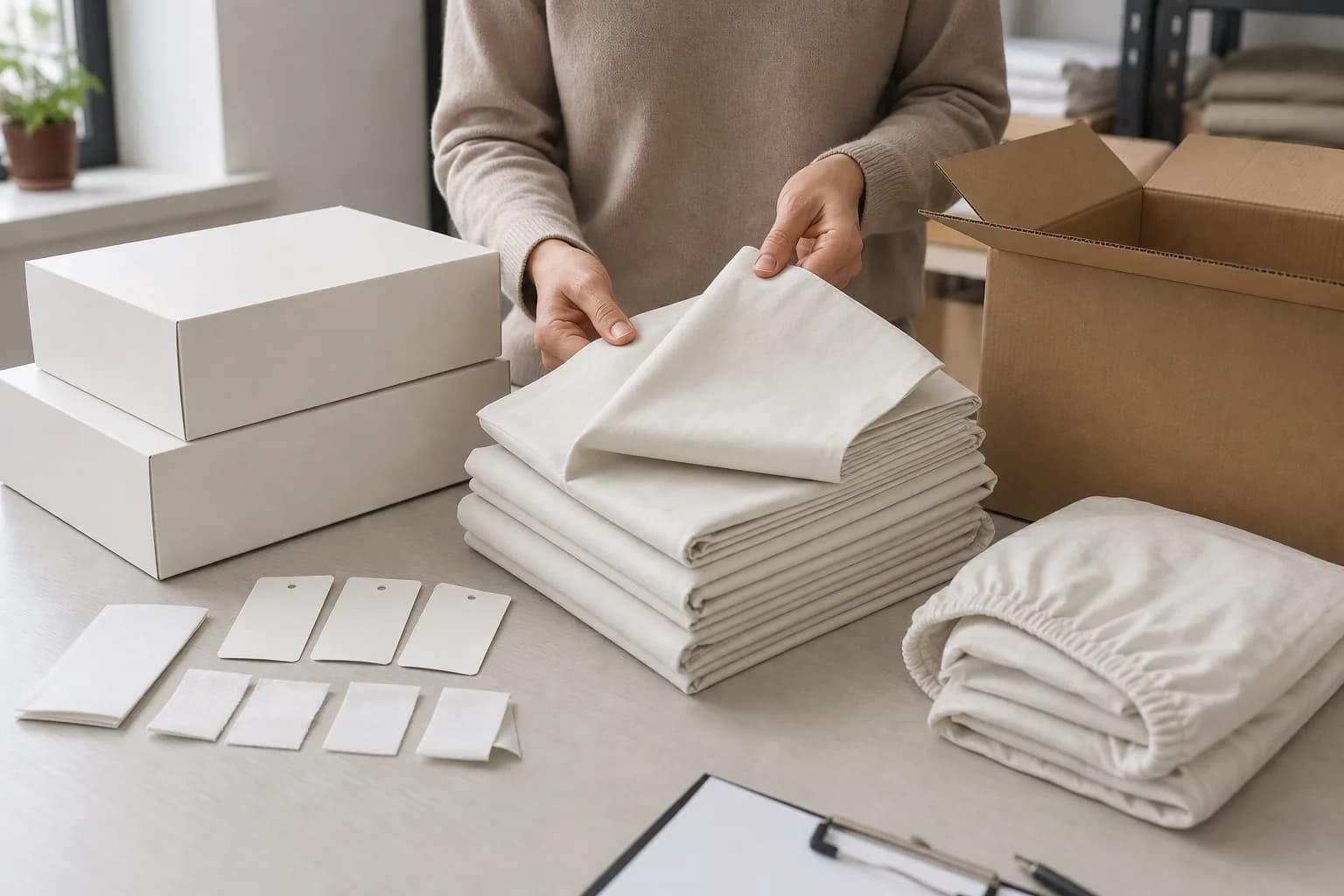
The brand owner and importer must assess the destination-market rules. In the United States, the FTC states that most textile products need fibre content, country of origin and manufacturer or responsible marketer identity; EU textile rules require fibre-composition labelling and destination-language handling. GS1's GTIN Management Standard separates a new product from a change and includes rules for declared formulation or functionality, dimensions or gross weight, primary brand, pack/case quantity and predefined assortments. Do not reuse a barcode or label merely because the bedding looks similar; document the change and apply the current rule for the exact product and market.
Private-label bedding reorder workflow
From reorder request to controlled release
- 01
1 · Retrieve the baseline
Identify the approved SKU, specification, retained sample, colour, artwork, label and pack versions.
- 02
2 · Build the new order matrix
List quantity by confirmed design/style, colour and size plus destination and delivery basis.
- 03
3 · Record every difference
Compare product, material, make-up, claims, labels, packaging and commercial scope field by field.
- 04
4 · Assess the impact
Assign sample, artwork, evidence, GTIN, price and schedule questions to the responsible reviewer.
- 05
5 · Reapprove what changed
Issue controlled versions and record the named buyer approval; do not inherit unrelated approvals.
- 06
6 · Release and retain
Align the PO and supplier confirmation, then retain the final pack for later production and shipment checks.
Common repeat-order mistakes
- Calling an order unchanged while substituting a fabric, finish, trim, packaging material or production route.
- Using the old sample as the only instruction when the written specification and label files have changed.
- Treating one matching number—thread count, yarn count or GSM—as proof of finished-fabric equivalence.
- Reusing label artwork or a GTIN without checking changed composition, brand, pack content or destination rules.
- Assuming the earlier price, MOQ or lead time still applies without a current, scope-matched quotation.
- Treating a certificate, report or approval for one article or version as coverage for a changed finished SKU.
Prepare a controlled repeat-order brief
BeddingTextilePro is a Nantong trading company coordinating source-factory direct supply, dedicated partner-mill lines, in-line QC and direct mill shipping. Send the previous and proposed finished-SKU files, retained sample reference, quantity split, changed fields, branding, packaging, destination and requested delivery basis through the private-label path. A 100-set discussion remains only a possible trial starting point for each confirmed design/style; repeat-order MOQ, price and timing require current feasibility confirmation.
Frequently asked questions
- What should I send for a private-label bedding reorder?
- Send the last approved specification and sample reference, the proposed PO/SKU matrix, colour and artwork versions, label and packaging files, quantity by design/style and size, destination, delivery basis and a list of requested changes.
- Does a repeat bedding order need a new sample?
- Not automatically. It does when a changed material, construction, size, make-up, colour, artwork, label, packaging or production route cannot be safely approved from controlled records alone.
- Can the supplier substitute a similar fabric on a reorder?
- Only after the buyer reviews the exact proposed construction and its impact, then records any required sample, evidence, price and approval decision. A similar name or headline parameter is not equivalence.
- Can I reuse the same GTIN and packaging artwork?
- Only after the brand owner or importer checks the current GS1 and destination-market rules against the exact change. Composition, brand, declared content, assortment or packaging changes may trigger a new decision.
- Does a previous price carry over to a reorder?
- Not automatically. The minimum remains 100 sets for each color and size combination, without pooling variants; request a fresh quote for current material, packaging and delivery terms.
Sources & references
Featured products
Shop by category
Explore our services
Sourcing bedding for your market?
Factory-direct quotes, 100-set minimum per color and size combination, full OEM/ODM customization. We reply within one business day.