TL:DR
La literie rPET doit être achetée comme une spécification documentée de fibre et de chaîne d'approvisionnement, pas comme un adjectif vert. Vérifiez la matière post- ou pré-consommation, le pourcentage recyclé, le périmètre du certificat et les transactions, puis testez l'article fini. GRS ou RCS soutiennent la traçabilité dans leur périmètre, pas toutes les allégations ni la performance finale.
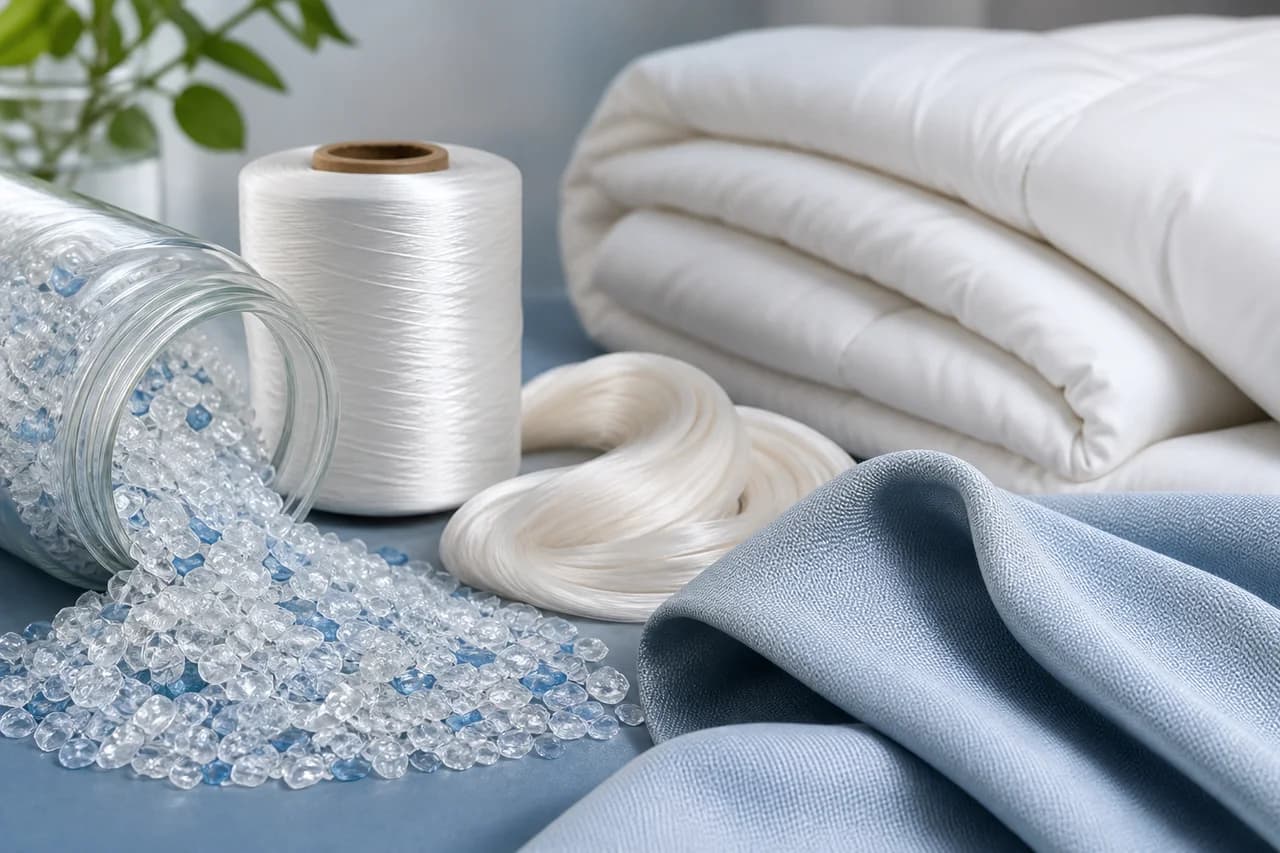
Le rPET peut réduire le polyester vierge, mais « recyclé » n'est pas une spécification complète. Ce guide couvre matière, traçabilité, performances et documents.
Le rPET désigne généralement une fibre polyester issue de PET recyclé, souvent récupéré de bouteilles ou d'autres flux PET. L'opportunité est réelle, mais le nom ne précise ni la matière, ni le pourcentage, ni le certificat, ni la chimie, ni la performance ou la fin de vie. Un achat B2B défendable commence par les documents et un échantillon : définir « recyclé », tracer l'allégation et tester le produit selon son entretien réel.
Qu'est-ce que le rPET dans la literie ?
Le rPET est du PET recyclé reconverti en polymère puis en filament ou fibre courte. Il peut entrer dans le fil, le tissu, le garnissage ou un composant. Post-consommation et pré-consommation ne sont pas la même allégation, et un article peut mêler polyester recyclé et vierge. Demandez la composition par composant plutôt qu'un vague « polyester écologique ».
| Virgin polyester | rPET polyester | |
|---|---|---|
| Feedstock | New petrochemical raw material | Reclaimed PET input defined by the supplier and standard |
| Buyer evidence | Fibre composition and normal product tests | Recycled-content claim, scope certificate and transaction evidence where applicable |
| Performance | Depends on polymer, yarn and construction | Still depends on polymer quality, spinning, yarn, weave and finishing |
| Main claim risk | Overstating durability or environmental benefit | Calling all polyester ‘recycled’ or implying blanket circularity |
| Specification priority | Construction, hand and care durability | The same performance checks plus feedstock and chain-of-custody control |
Que vérifient réellement GRS et RCS ?
Textile Exchange décrit le GRS comme un standard qui vérifie et suit les matières recyclées dans la chaîne, avec critères de transformation, chimie et aspects sociaux ou environnementaux. Le CCS fournit la base de chaîne de contrôle et le RCS a un périmètre plus étroit. Faites correspondre certificat, sites, matière, catégorie, transactions et texte d'allégation.
| RFQ evidence | What to request | What it answers |
|---|---|---|
| Feedstock | Post-consumer or pre-consumer definition; input description | What was recycled? |
| Content | Recycled percentage by component and total composition | How much of this article is recycled? |
| Chain of custody | Scope certificate, certified sites and transaction certificate where required | Can the claim be traced through the supply chain? |
| Finished performance | Colourfastness, shrinkage, pilling, seam and wash results | Will the bedding perform in service? |
| Chemical safety | Destination-market restricted-substance or product test documentation | Is safety evidence separate from recycled-content evidence? |
| Claim copy | Approved label and marketing wording | What can be said without implying unsupported benefits? |
Comment vérifier un échantillon rPET ?
From recycled-fibre claim to approved bulk order
- 01
1 — Define the claim
Write whether the brief requires post-consumer PET, pre-consumer material, a minimum percentage or a certified standard.
- 02
2 — Check the scope
Match the supplier, processor, product category and material to the scope certificate and current standard documents.
- 03
3 — Confirm the transaction
Request the transaction or equivalent chain-of-custody record for the material used in the proposed article where the standard requires it.
- 04
4 — Test the article
Run colourfastness, dimensional stability, pilling, seam, strength and laundering tests on the actual fabric or finished bedding.
- 05
5 — Approve the claim
Use precise fibre and recycled-content wording; do not claim zero impact, infinite recyclability or improved health without separate evidence.
- 06
6 — Control the lot
Keep the sealed sample, documents, composition and inspection record together for production and reorder checks.

Que peut-on écrire sur une étiquette ?
Le RFQ doit demander définition de la matière, pourcentage par composant, certificat et transaction, essais de solidité, retrait, boulochage, coutures et lavage, documents chimiques du marché et wording d'étiquette validé.
Où placer le rPET dans une gamme literie ?
Le rPET peut convenir aux enveloppes légères, housses tissées décoratives, certains garnissages et programmes contract lorsque l'acheteur demande un contenu recyclé documenté et une performance régulière.
Conclusion pour l'acheteur
Traitez le rPET comme un projet de traçabilité et de performance : définir matière et pourcentage, aligner le standard, obtenir les transactions, tester l'article et approuver une formulation précise.
BeddingTextilePro est un fournisseur B2B de Nantong de parures de lit, couettes d'été et linge hôtelier en approvisionnement direct usine d'origine — lignes de production dédiées et réservées dans de grandes usines à Nantong, marchandise expédiée directement depuis l'usine — avec un MOQ de 100 parures par combinaison de couleur et de taille, une personnalisation OEM/ODM complète et un accompagnement OEKO-TEX. Demandez une cotation de gros et notre équipe export vous répondra sous un jour ouvré.
Questions fréquentes
- What does rPET mean in bedding?
- rPET is recycled polyethylene terephthalate turned into polyester fibre. In bedding it may appear in yarn, woven fabric, filling or a component. The term does not by itself state whether the input is post-consumer or pre-consumer, the recycled percentage or the certification scope, so those details belong in the RFQ.
- Does GRS prove that every part of a bedding set is recycled?
- No. GRS evidence applies to the certified scope, material and product details covered by the certificate and related chain-of-custody records. A set may contain several components with different compositions. Match the certificate and transaction evidence to the exact article and state the recycled portion by component where needed.
- Is recycled polyester as durable as virgin polyester?
- Durability depends on polymer quality, spinning, yarn, weave, finish and construction—not only on whether the feedstock is recycled. Test the finished fabric or bedding for strength, pilling, colourfastness, shrinkage, seams and laundering under the intended service conditions.
- Can I label bedding as 100% recycled polyester?
- Only when the exact labelled fibre composition and supporting evidence justify it. If other fibres, trims, thread or fillings are present, the claim must not imply that the entire product is recycled polyester. Keep fibre composition and recycled-content wording precise and non-misleading.
- Does recycled polyester make bedding sustainable?
- It can support a narrower recycled-content claim, but it does not prove overall sustainability, low impact, safe chemistry, durability or recyclability. Evaluate the full product life cycle and keep each environmental statement tied to evidence within its stated scope.
Sources et références
- 1.Textile Exchange — What is the Global Recycled Standard?
- 2.Textile Exchange — Chain of Custody
- 3.Textile Exchange — Materials and Products Classification (bedding and recycled polyester examples)
- 4.European Commission — FAQ on Textile Regulation 1007/2011
- 5.European Commission — EU Strategy for Sustainable and Circular Textiles
Produits en vedette
Acheter par catégorie
Découvrir nos services
Vous vous approvisionnez en linge de lit pour votre marché ?
Devis en direct de l'usine, MOQ de 100 parures par combinaison de couleur et de taille, personnalisation OEM/ODM complète. Nous répondons sous un jour ouvré.