TL:DR
La ropa de cama rPET debe comprarse como una especificación documentada de fibra y cadena de suministro, no como un adjetivo verde. Verifique si el insumo es posconsumo o preconsumo, el porcentaje reciclado, el alcance de la certificación y los registros de transacción; después ensaye el producto acabado. GRS o RCS respaldan la trazabilidad dentro de su alcance, no toda alegación ambiental ni el rendimiento del producto.
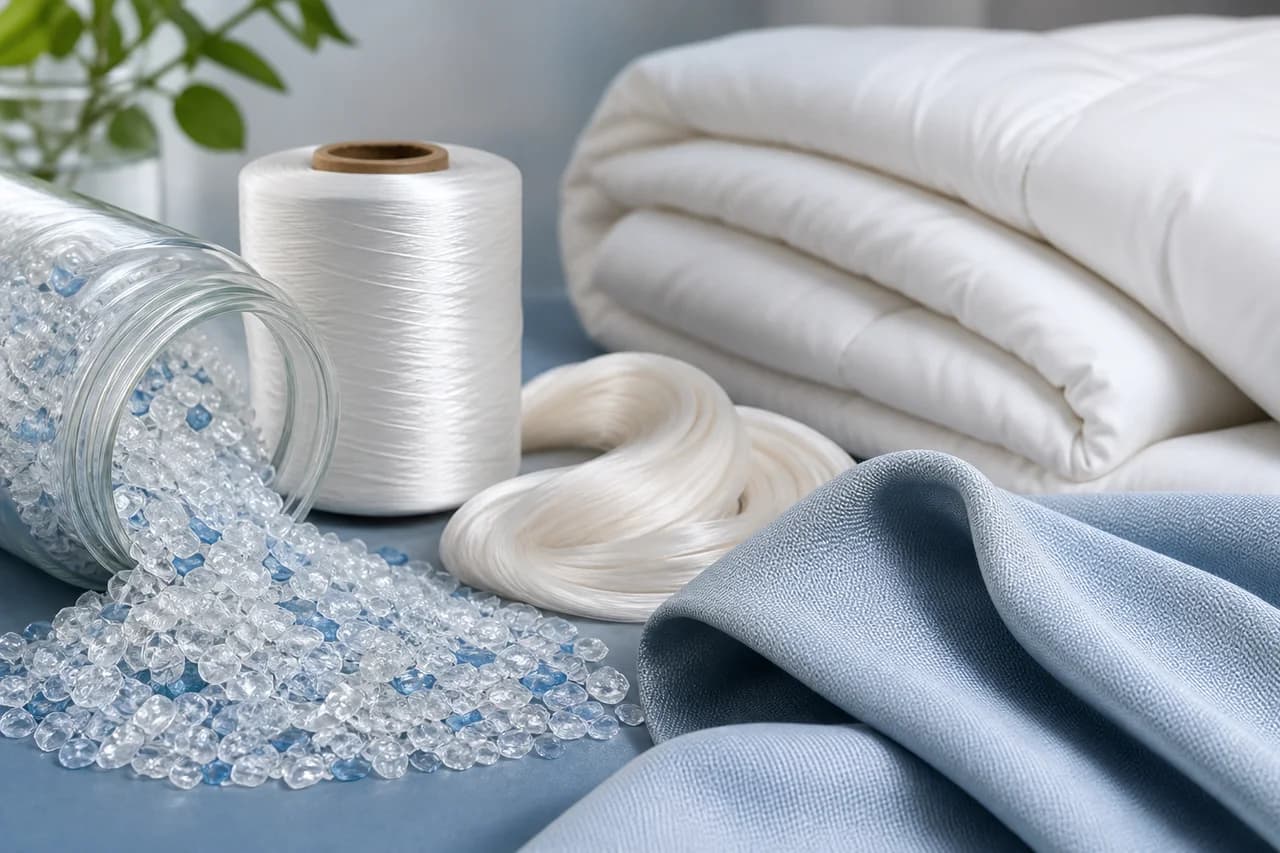
rPET puede reducir el uso de poliéster virgen, pero ‘reciclado’ no es una especificación completa. Esta guía cubre materia prima, trazabilidad, contenido, rendimiento y documentación.
rPET suele significar fibra de poliéster fabricada con PET reciclado, a menudo recuperado de botellas u otras corrientes de PET. La oportunidad es real, pero el nombre no indica materia prima, porcentaje reciclado, alcance de certificación, química, rendimiento ni fin de vida. Una compra B2B defendible empieza con documentos y muestra: defina qué significa ‘reciclado’, trace la alegación y ensaye la ropa de cama bajo sus condiciones reales de cuidado.
¿Qué es el rPET en ropa de cama?
rPET es PET reciclado convertido de nuevo en polímero y después en filamento o fibra corta. Puede formar hilo, tejido, relleno o componentes según la especificación. Posconsumo y preconsumo no son la misma alegación, y un artículo puede mezclar poliéster reciclado y virgen. Pida composición por componente, no solo ‘poliéster ecológico’.
| Virgin polyester | rPET polyester | |
|---|---|---|
| Feedstock | New petrochemical raw material | Reclaimed PET input defined by the supplier and standard |
| Buyer evidence | Fibre composition and normal product tests | Recycled-content claim, scope certificate and transaction evidence where applicable |
| Performance | Depends on polymer, yarn and construction | Still depends on polymer quality, spinning, yarn, weave and finishing |
| Main claim risk | Overstating durability or environmental benefit | Calling all polyester ‘recycled’ or implying blanket circularity |
| Specification priority | Construction, hand and care durability | The same performance checks plus feedstock and chain-of-custody control |
¿Qué verifican realmente GRS y RCS?
Textile Exchange describe GRS como un estándar que verifica y sigue materias primas recicladas en la cadena, con criterios de proceso, químicos y aspectos sociales o ambientales. CCS aporta la base de cadena de custodia y RCS tiene un alcance más estrecho. Compruebe certificado, centros, material, categoría, registros de transacción y texto de la alegación.
| RFQ evidence | What to request | What it answers |
|---|---|---|
| Feedstock | Post-consumer or pre-consumer definition; input description | What was recycled? |
| Content | Recycled percentage by component and total composition | How much of this article is recycled? |
| Chain of custody | Scope certificate, certified sites and transaction certificate where required | Can the claim be traced through the supply chain? |
| Finished performance | Colourfastness, shrinkage, pilling, seam and wash results | Will the bedding perform in service? |
| Chemical safety | Destination-market restricted-substance or product test documentation | Is safety evidence separate from recycled-content evidence? |
| Claim copy | Approved label and marketing wording | What can be said without implying unsupported benefits? |
¿Cómo debe verificar un comprador una muestra rPET?
From recycled-fibre claim to approved bulk order
- 01
1 — Define the claim
Write whether the brief requires post-consumer PET, pre-consumer material, a minimum percentage or a certified standard.
- 02
2 — Check the scope
Match the supplier, processor, product category and material to the scope certificate and current standard documents.
- 03
3 — Confirm the transaction
Request the transaction or equivalent chain-of-custody record for the material used in the proposed article where the standard requires it.
- 04
4 — Test the article
Run colourfastness, dimensional stability, pilling, seam, strength and laundering tests on the actual fabric or finished bedding.
- 05
5 — Approve the claim
Use precise fibre and recycled-content wording; do not claim zero impact, infinite recyclability or improved health without separate evidence.
- 06
6 — Control the lot
Keep the sealed sample, documents, composition and inspection record together for production and reorder checks.

¿Qué se puede decir en una etiqueta?
Incluya en el RFQ la definición de materia prima, porcentaje por componente, certificado y transacción, ensayos de solidez, encogimiento, pilling, costuras y lavado, documentación química del mercado de destino y redacción aprobada de la etiqueta.
¿Dónde encaja el rPET en una gama de ropa de cama?
El rPET puede servir para carcasas ligeras, fundas tejidas decorativas, ciertos rellenos y programas contract donde el comprador exige contenido reciclado documentado y rendimiento constante.
Conclusión para el comprador
Trate rPET como un proyecto de trazabilidad y rendimiento: defina la materia prima y el porcentaje, haga coincidir el alcance del estándar, solicite la evidencia de transacción, ensaye el artículo y apruebe una redacción limitada.
BeddingTextilePro es un proveedor B2B de Nantong de juegos de cama, edredones de verano y lencería hotelera con suministro directo de fábrica de origen —líneas de producción dedicadas y reservadas en grandes fábricas de Nantong, con la mercancía enviada directamente desde la fábrica—, con un MOQ de 100 juegos por combinación de color y talla, personalización OEM/ODM completa y soporte OEKO-TEX. Solicita una cotización mayorista y nuestro equipo de exportación responderá en un día hábil.
Preguntas frecuentes
- What does rPET mean in bedding?
- rPET is recycled polyethylene terephthalate turned into polyester fibre. In bedding it may appear in yarn, woven fabric, filling or a component. The term does not by itself state whether the input is post-consumer or pre-consumer, the recycled percentage or the certification scope, so those details belong in the RFQ.
- Does GRS prove that every part of a bedding set is recycled?
- No. GRS evidence applies to the certified scope, material and product details covered by the certificate and related chain-of-custody records. A set may contain several components with different compositions. Match the certificate and transaction evidence to the exact article and state the recycled portion by component where needed.
- Is recycled polyester as durable as virgin polyester?
- Durability depends on polymer quality, spinning, yarn, weave, finish and construction—not only on whether the feedstock is recycled. Test the finished fabric or bedding for strength, pilling, colourfastness, shrinkage, seams and laundering under the intended service conditions.
- Can I label bedding as 100% recycled polyester?
- Only when the exact labelled fibre composition and supporting evidence justify it. If other fibres, trims, thread or fillings are present, the claim must not imply that the entire product is recycled polyester. Keep fibre composition and recycled-content wording precise and non-misleading.
- Does recycled polyester make bedding sustainable?
- It can support a narrower recycled-content claim, but it does not prove overall sustainability, low impact, safe chemistry, durability or recyclability. Evaluate the full product life cycle and keep each environmental statement tied to evidence within its stated scope.
Fuentes y referencias
- 1.Textile Exchange — What is the Global Recycled Standard?
- 2.Textile Exchange — Chain of Custody
- 3.Textile Exchange — Materials and Products Classification (bedding and recycled polyester examples)
- 4.European Commission — FAQ on Textile Regulation 1007/2011
- 5.European Commission — EU Strategy for Sustainable and Circular Textiles
Productos destacados
Comprar por categoría
Explora nuestros servicios
¿Abasteciendo ropa de cama para su mercado?
Cotizaciones directas de fábrica, MOQ de 100 juegos por combinación de color y talla, personalización OEM/ODM completa. Respondemos en un día hábil.